The River Made No Such Claim
A Narrative History of the Maumee Valley — and Everyone Certain It Was Theirs
First the animals, then the people, then the French, then the British, then the Americans — each in its turn certain the valley belonged to it. The river made no such claim. It only kept running, and outlasted them all.
Prologue
You have very likely never stood here, and almost no one has who was not born to it or sent for. There is no famous skyline on the Maumee, no wonder anyone crosses an ocean to see; the interstate crosses it in an afternoon of soybeans and billboards, and not one driver in a thousand suspects that the flat, unremarkable country under the wheels is the most contested ground in the whole interior of the continent. Nothing here is special; everything here is common, and that is the point of it. Every ground on earth carries some version of this story, of the people who were certain it was theirs and were each in turn proved wrong by the time that came after; this one only happens, by the accident of a low notch and a rich swamp, to have kept unusually good books.
And the people in those books are a great many: a boy carried across a river at twelve and loved into a nation not his own blood; a war chief who broke two American armies in the timber and then, when the tide turned, counseled the peace he could not win and was called a coward for it; a Shawnee who tried to gather every scattered nation into a single closing hand and came within a battle of doing it; a girl who was the one true seam between two armies, and the daughters after her whom the record kept on almost nothing at all. Each will be certain, in turn, that the ground is theirs; each will be proved wrong by whoever comes next; and the river will keep none of their claims and all of their names.
But they come later, because they came later. The country was old past their imagining before the first of them ever saw it, and the whole of what they would die contending for was made long before there was anyone to contend. So the story has to start where they could not — under water, with no one watching — and work its slow way up to the light and the fighting. The books are not closed yet. Read on a while, and see whether the country stays a stranger’s.
The Water and the LandWhat the Ice Left
The hills / Rock-ribbed and ancient as the sun, — the vales / Stretching in pensive quietness between; / The venerable woods — rivers that move / In majesty, and the complaining brooks / That make the meadows green.
— William Cullen Bryant, Thanatopsis
The land was made by water, and it has been trying to become water again ever since.
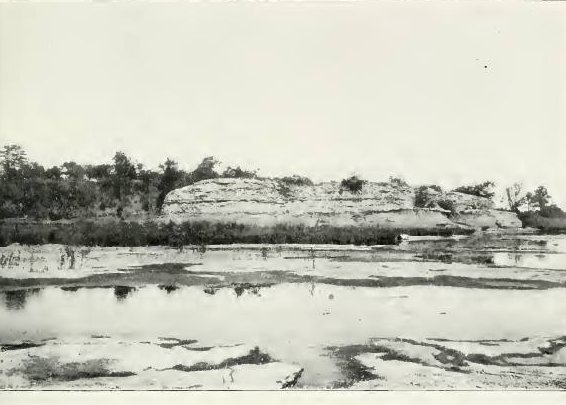
To begin at the beginning is to begin under a sea. Long before there was a valley, before there was ice or a river or a name for either, before the first blade of anything green, the ground that this whole story stands on lay drowned at the bottom of a warm and shallow ocean, somewhere south of the equator, in a world that would not have known itself. Nothing that walks the valley now was there to see it, and no eye of any kind looked up through that clear tropical water at the sun crossing overhead; but the sea was busy all the same, in the patient, mindless way of seas, laying down on its own floor the bodies of the small lime-shelled things that lived and died in it by the uncountable billion, season upon season, an inch in an age, until their gathered remains were pressed into a floor of pale limestone and dolomite hundreds of feet deep. That floor is still there. It is the bedrock of the whole country, the hard pale bone under the black skin of the fields, and where the river has since worn down to it — at the rapids, where the water breaks white over shelving ledges, and at the great flat-topped rock that stands in the stream above them — a man may lay his hand on the bottom of that vanished ocean and not know he is touching the oldest thing in the valley. The land came up out of the water once already, ages before the ice, and hardened, and waited. It has never entirely forgotten the sea it was, and everything that follows is in some sense the account of its long unfinished effort to lie down under water again.
The sea left more than a floor. Deep in that old stone, deeper than any plow would ever bite or any grave be dug, it had sealed away the last of itself — the oil and the gas pressed out of the same numberless small dyings that had made the rock, and held there in the dark pores of it for four hundred million years, like a breath the drowned world had drawn and never let go. No one would suspect it was there through the entire human story to come. The nations would walk over it, and the French paddle over it, and the armies march and bleed over it, and not one of them dream that the richest thing in all the valley was neither the beaver on the water nor the black loam on the fields but a pocket of ancient captured sunlight locked in the bones of a vanished ocean a half-mile down. It would keep. The land is patient with its buried things, as it is patient with its buried dead. And when the last of the people who ever lived on it at last had need of it, near the very end, it would come roaring up out of the ground in a column of flame a hundred feet high and remake the whole country a second time — but that is the final chapter, and this is the first, and between them lie four hundred million years and every soul the valley ever carried down to the water. The sea laid the stone, and salted the stone with fire, and lay still.
There was a river here before the river, and the only reason anyone knows it is the fire.
When the drillers came, near the end of this story, boring down through the black fields after the sea’s buried oil, their bits dropped in places through the floor of the country into something that was not floor: a channel of drowned gravel and ground stone, walled like any riverbank, a full mile wide from lip to lip and better than five hundred feet down, cut clean through limestones that the living streams of this country hardly scratch. The well-logs traced it hole by hole, the way a blind man traces a face — north under the canal men’s great reservoir, up past the St. Marys, west into Indiana, crossing beneath the bed of the Wabash at a right angle, as indifferent to the river running above it as if the two belonged to different worlds. And they do.
The learned men who plotted the soundings judged that the drowned channel might be the ancient course of the Kanawha, a stream that now keeps itself hundreds of miles away in another country entirely — which is to say that before the ice there was a master river drawn across this ground on another slant altogether, gathering waters that are now strangers to each other, running errands for a continent whose whole map is lost. The ice ended it. The glacier did not merely rearrange the surface of this country; it unwrote a geography entire and wrote its own over the top, packing the old channel to the brim with the milled rubble of its own burial, grading the ground smooth above it, and leaving not one sign on the surface — not a dimple, not a bend in a creek — to show where a river the size of a province had gone. What grew on its banks, what drank at it, what the country of that river was like in its living day, no one will ever know; it is the one cast of characters in this whole long story of whom the valley kept no record at all.
The first thing ever removed from this ground was a river. It would not be the last removal, and the pattern was set from the start: the new order laid down so completely over the old that the people of the new walk their whole lives across the old one’s bed and never suspect it is under them. There is a bookkeeping in the finding of it fit for this valley’s books: the drills that went down hunting the drowned sea’s fire were the ones that struck the ice’s buried secret instead — the two oldest things in the country filed in the same deep drawer, each the other’s accidental key.
What raised it and shaped it into the country the peoples would know was not the sea but the ice, and the ice came late and came more than once. Down out of the north, in the last and greatest of its comings, ground a wall of ice a mile high and a continent wide — not a drift or a winter’s freeze but a moving mountain of it, slow as grief and heavier than mountains, that scraped the high places flat and filled the low ones and dragged the very hills along under its belly, carrying boulders a hundred miles from the ledges they were broken off of and setting them down, when at last it melted, in fields where no such stone belonged, so that the later farmers who cursed and levered them out of the plow’s way were handling freight the glacier had carried and forgotten. For tens of thousands of years the ice held all of this country in a grip that left nothing as it found it. And then the world tilted back toward warmth, and the ice began, along its southern edge, to fail.
The ice signed its work before it went. Where its sole ran over bared limestone it dragged the boulders frozen into its belly like styluses, and cut grooves — on an island out in the lake, channels scored so deep and planed so smooth that a man may lie down in one, the finest of their kind anywhere near this basin, the plain handwriting of a mile of moving ice recorded in the one material patient enough to keep it. The fate of that handwriting is the whole story in a page. The quarrymen of the made city, cutting the same island limestone for breakwaters and courthouses, blasted the glacier’s autograph away for building stone, year over year, as fast as the trade would bear — until a historical society bought the last small patch of the scratches and fenced it, and so the surviving signature of the power that manufactured the entire country is a curiosity the size of a garden, spared at the eleventh hour from men getting on with exactly what men came here to do. The boulders themselves the ice left scattered broadcast — granites and dark hard stones foreign to every ledge native to Ohio, northern rock hauled hundreds of miles and dropped — and they lie in the fence rows yet, each one a bill of lading from a carrier that went out of business ten thousand years ago. Nor was that carrier’s one visit the whole account. The scorings and the buried soils say the ice came down not once but again and again — six invasions by one careful count, near a dozen by another, glacial and warm ages alternating like strokes of a slow piston — so that the coming of the cold is less a chapter this country closed than a chapter it is between. The land, which is patient with everything, is patient with that too: the fields lie on the floor of the last ice as on the floor of the vanished lake, holding their black harvests in the pause between two winters, and what the next coming will make of the works of the made city, the grooves on the island are perhaps the politest way of saying.
It did not fail all at once, and it did not fail cleanly. It failed the way a great thing dies, in fits and long reprieves, giving back a mile of ground and taking half of it again, weeping out its meltwater faster than any river could carry it away, and there, in the drowned ground at the foot of the dying glacier, is where the valley was truly born. For the melt had nowhere to go. To the south and the west lay the land the ice had already quit, tilted gently up and away; to the north and the east stood the ice itself, a wall as good as any range of mountains, damming the water back against its own cold face. So the meltwater ponded in the great shallow basin between the high ground and the ice, and stood, and rose, and became a lake — a cold gray inland sea with no name, because there was as yet no mouth to speak one and no throat that could have spoken it.
It was a greater lake than the one that would inherit its bed. It stood, at its height, two hundred feet and more above the level of the lake we know, drowning under its flat gray water everything the fields now cover, and it stood not for a year or a lifetime but for thousands of years, long enough to do the deliberate work of a sea. And at first — this is the strange thing, the thing the whole later history turns on without knowing it — the great lake drained the wrong way. With the north and the east sealed by ice, the rising water could find no outlet toward the ocean it belonged to. It backed up and up until it brimmed over at the one low place along its far southwestern rim, a shallow notch in the tilted land, and poured out there, away from the future and toward the past — southwest, into the valley of the Wabash, and down the Wabash to the Ohio, and down the Ohio to the great river, and down the great river at last to the warm gulf at the bottom of the continent. For an age the water that would one day run north to the cold Atlantic ran south instead to the tropics, over a lip of the land no wider than a village, and wore that lip down as it ran.
Then, slowly, over centuries no one counted, the ice let go of the north. And as it drew back off the low country it unstopped, one after another, the lower and lower doors that had been dammed shut behind it — and each time a door opened, the great lake dropped to find it, and paused at the new lower level long enough to cut itself a new shoreline, and dropped again. The men who came thousands of years too late to see any of it would find those old shorelines still ringing the flat country, one inside another like the marks a falling tide leaves in sand, and would give the vanished lakes at each level their several names — Maumee first and highest, then Whittlesey, then Warren, and on down through lesser stands to the modest lake that stands there yet — and would name the whole first and greatest of them for the river that would inherit what it left. Glacial Lake Maumee: a sea named after a stream, the parent christened for the child, because the child was the only one of them left alive to ask.
And at the last the ice uncovered the northeast, and the water turned. The drainage that had run southwest to the gulf for an age reversed itself in a geological instant, swung round toward the newly opened low country in the northeast, and ran off that way instead, down toward the basin of the modern lake and out at length to the Atlantic — abandoning the old southwest outlet, draining the great cold sea down to a river and a marsh, and leaving behind, where all that water had lain, the flattest and blackest and richest ground on the face of the continent: a bed of heavy blue clay laid down under still water, floored over with a skin of fine dark loam, and so unspeakably level — the settled bottom of a lake, graded smooth by ten thousand years of standing water — that the streams it still had to shed could hardly decide which way to go, and mostly did not decide at all, but spread and stood and soaked and waited, as the lake had waited, for the sea to come back.
It is hard to say, to anyone who has not stood on it, how flat the bottom of that lake was left. It is not the flatness of a plain, which rolls; it is the flatness of water, which does not. A man may look across it to a treeline ten miles off and find nothing at all risen in between — no hill, no swell, no shoulder of ground — only the long level line of the fields running out to meet the long level line of the sky, as though the lake had drained the evening before and the mud had not yet dreamed of a slope. The whole fall of the country is measured not in feet to the mile but in inches; a ditch cut straight for ten miles may drop the height of a man over the entire length of it, and the water in such a ditch can hardly be said to run so much as to lean. The floor that the water left behind it was black — the black of drowned leaves and still cold water and ten thousand years of settling, a loam so deep and so dark and so fat that when at last it was broken open to the light it would raise corn as high as a man on horseback, and would be counted, acre for acre, among the most fertile ground on the face of the earth. But under the black lay the blue: a heavy, dead, water-packed clay that the standing lake had pressed down hard and airless, and that held the wet up on the surface and would not let it drain away. Rich soil laid over sour clay; a garden set down in the bottom of a saucer. That was the double gift the lake left, the fertility and the flood together, in the one act, of the one substance, so that for two hundred years no man could have the one without fighting the other.
The country the falling water gave up was born naked. It came out from under the lake as bare cold mud, a plain without one tree on it from horizon to horizon — the men who later bored the old beach ridges for buried driftwood found, in the highest and oldest of them, none at all; the shore of the first lake “has produced no logs,” one of them set down, a beach without a stick of wood on a shore without a tree — and for a long age the wind off the dying ice combed a tundra here, sedge and moss and dwarf willow, a country in the style of Labrador. Then the first forest came up out of the south, and the first forest was spruce: a low dark boreal wood, closer kin to Hudson Bay than to Ohio, and through it moved the animals that belong to such a wood — the caribou drifting the frozen flats, the great moose-like deer in the openings, beasts of the far north walking ground that would one day grow corn twelve feet tall. And then, on the heels of the retreating cold, the spruce forest did the thing that everything on this ground would do after it: it moved on. It let go of the warming country mile by mile and walked away north after the ice it belonged to, and the hardwoods came up behind it out of the south and took the vacated ground — the oak and the beech and the maple on the rises, and last of all, in the lowest wet, the elm and the ash wading out into the standing water to become the swamp. The first claimant of the new-made valley took possession, held a few thousand years, and quit the place, and its whole nation of animals went with it. Even the forests, on this ground, were a procession.
There were people in that spruce wood, and one place kept the proof of it. Off the eastern rim of the basin, in Wyandot County, a ridge of the old sea’s dolomite runs west toward Findlay; and somewhere along it the stone had dissolved from underneath until the ground let down into it and made a pit, which the country closed over and kept until a bulldozer broke it open. Sheriden Cave, they call it, and in its dated layers lay cut and burned animal bone — which is to say people, on the ridge, while the spruce still had the country. The oldest human ground in this book is a hollow in the oldest stone in it.
The old shorelines the falling lake had left did not wash away. They stayed — long, low, all but invisible ridges of sand and gravel, the heaped beaches of the vanished seas, running for tens of miles in gentle curves across the dead-flat country, a few feet higher than the drowned land on either side of them and, for that reason, dry. In a country that was otherwise a swamp those few dry feet were everything. The animals found the ridges and walked them; the first people found the animals’ paths and walked them too; the nations after them wore those same paths into trails, and the trader after the nations and the soldier after the trader followed the trails, and in the fullness of time the settlers graded the trails into roads and the roads into highways, and paved them, and drove them at speed, and never knew — most of them never know it yet — that the dry line their whole journey follows across the flatland is the beach of a sea that dried up before there was a wheel in the world to leave a track. The oldest roads in the valley are the shores of a lake that is not there. And when the road-builders came at last to grade and pave, they found that the drowned lakebed would give them nothing to build with — the dead clay bears no weight and offers no stone — and so they dug their sand and gravel out of the very ridges they were driving on, the one granular ground the country owns, and laid the old beaches down again as roadbed: the vanished lake supplying, ten thousand years after it went, both the route and the making of the road. The archaeologists who came long after to map the buried camps and villages of the first people would find them strung, sure enough, along these old beaches and rises — the prehistoric hunters keeping, like the animals before them and the highways long after, to the few dry feet the vanished lakes had left them. Here already, at the very bottom of the story, is the shape the whole of it will take: the water lays down the land, and the land it lays down decides, ages later, where the people may go.
For that one low southwestern notch — the lip the dying lake had first spilled over — would matter more, in the end, than anything else the ice left behind. When the great lake was gone and the country had drained and dried, that notch remained the one shallow saddle in the whole tilted land where the waters of the north and the waters of the south very nearly met: the one place on the continent where a man in a canoe could come up out of the cold lakes on one river, lift his boat and his load across a mile or two of level ground, set them down on a stream flowing the other way, and float on, without ever truly leaving the water, all the way to the gulf. It was the seam between two halves of a continent, the single stitch that held the north to the south, and every power that would come to this ground — the nation, the empire, the young republic — would come to want it, and to bleed for it. A people would raise their great town on the crossing. After the town a fort would stand there, and after the fort a war would be fought for it, and after the war another. The road that made this whole valley worth the killing was nothing grander, at bottom, than the channel a drowning glacier had gouged to let its own meltwater out. A government geologist walked the abandoned bed of it in 1870 and took its measure: better than a mile and a half broad below the forks, twenty feet deep, and holding that size for twenty-five miles together without a fall worth the name. What threads down the middle of it now is the Little river, whose only claim to the title of river, he wrote, seems to lie in the magnitude of the deserted channel of which it is sole occupant. The oldest map of this country is the one the ice drew, blind, going away.
And the water never entirely left. What the vanished lake could not drain off its own too-level floor it left as swamp — the Great Black Swamp, the drowned unfinished forest that ran, at its full wet reach, from the marshes of Sandusky Bay in the east clear across to the Indiana line, and from the Maumee down south to the country about Findlay: a million acres and more of it, three million by one modern reckoning, standing in its own shallow flood the year around. It was a forest grown up out of a lake and never quite persuaded it was not one still — an elm-and-ash swamp forest, in the main, with islands of beech and oak and maple riding the few low rises above the water. Its trees rose a hundred feet and better out of the black water, their crowns laced so close overhead that the noon sun came down to the wet floor already going green and dim, as though filtered through fathoms; and a traveler coming at it across the drier prairie to the west saw the whole vast wood stand up on the horizon like a single unbroken thing, a wall the color of a storm, and wrote that it looked from off like a blue wall drawn across the world. Into that blue wall the sun went and did not much come out. Mosquitoes rose off the standing water in clouds that could sicken a man in a night and did. Wolves ran the deer through it. Fever lived in it. For the greater part of the year no man could cross it at all, and for the rest of the year he crossed it a mile a day if he was lucky, sinking and swearing, and remembered the crossing all his life as the worst passage he had ever made — while the swamp, which had drowned a whole forest without effort and would drown the roads and the armies of everyone who came, took no notice of him whatever, being occupied, as it had been since the ice, with the one slow work of holding the water on the land.
The swamp kept its own calendar, and it was never the settler’s. In the deep of the winter it froze, and for a few hard weeks a man might cross it on the ice, and did, hurrying, before the thaw could catch him out on it. In the spring it drowned — brimmed full, a shallow sea returned for a season — and could not be crossed at all. In the wet of the early summer the fever rose off it along with the mosquitoes, the ague that took a strong man and shook him in his bed until his teeth knocked in his head, and the whole low country lay for weeks under the sick haze of it, and the people learned to call the shaking, without much humor, the country’s way of agreeing to be settled. Only in the driest weeks of the late summer and the fall did the ground firm enough underfoot to be fought for, and then only slowly, a mile in a day of pure misery, the wagons sunk to the axle and the oxen to the belly and the men to the knee, hauling and swearing and making camp at dark on whatever low rise stood a hand’s breadth up out of the water. For the better part of two centuries after the first white man laid eyes on it, the Great Black Swamp turned back very nearly everyone who tried it, and asked nothing of them in return, and was not changed by any of them in the least. It had drowned a forest a hundred feet tall without trying. It would go on to drown roads, and drown armies, and drown the patience of three separate empires, and it would take a war waged against the land itself — fifty years of that war, and a hundred thousand miles of clay pipe buried in the dark — before any people bent it to their will, and even that, in the end, only for a little while. But the bending comes at the far end of the story. At the near end there was only the water lying on the land, and the land lying under the water, and the two of them settling their long slow argument at the patient pace of stone.
And down the middle of all this, through the swamp and the flat and the old drowned lakebed, gathering the water that no one else could shed and carrying it, at last, back to the lake, ran the river.
That river is the constant in everything that follows.
And here is the paradox to carry the whole way through it: the river claimed nothing — not the land it had made, nor the nations it fed, nor the empires it would set at each other’s throats — and it ruled the whole of them regardless. On a ground where every comer in his turn would say mine, and be carried off for the saying, the one thing that never once said the word was the water, and the water was the thing that governed. It decided where a man could walk and where he must stop, where a town could stand and where an army would drown, which peoples rose at the crossing and which were swept past it. It laid down the country and then, without lifting a hand or pressing a claim, it laid down the terms of every life the country would carry. The river dominated this valley precisely as it possessed it — which is to say, completely, and not at all.
It rose then where it rises still, at the very notch itself, at the head of the country, where two lesser streams come together out of the tilted farmland to the south and the west and join to make one — and from that joining it fell away to the northeast, a hundred miles and a little more, to a wide and shallow bay at the corner of the lake. It was not a large river as the continent measures rivers, but it was a working one, and it did in miniature what the glacier had done in the grand: it moved the water off the land — and it moved the land itself besides, carrying the ground down grain by grain to lay at the mouth, building there in silt what it stripped from the fields above, the one slow work it had done since the ice and would be doing still when the last of the people in these pages had come and gone. For most of its length it ran broad and unhurried through the flat, so gentle a fall that a loaded canoe could work up it against the current; but near its middle, where it crossed the old buried floor of limestone the tropical sea had laid, it quickened and shoaled and broke into rapids — eighteen feet to the mile through seven miles of white and shelving water, tumbling over the bared bone of that first ocean, the one loud stretch in a hundred quiet ones. Those rapids were the river’s whole character and the valley’s whole geography in little: the fast water where the boats must stop and the loads come out and go round by land, the one place the traffic of a continent had to gather and touch the shore. Wherever a river forces men to stop, men build; and everything that mattered here would be built, in the end, within sight and sound of that broken water.
And the river ends slow. Its last fifteen miles are hardly a river at all: at the upper edge of the village that would one day wear its name, the falling water meets the standing level of the lake and stops falling, and from there to the bay it is slackwater — the lake reaching its arm up into the land, tide-still, the current a rumor. The old outer banks stand back from that quiet water a mile and two miles apart, the ghost banks of some mightier stage of the stream; and the sounding-line, dropped in the channel, finds the same story at the mouth that the well-drills found under the fields: rock lying far too deep for any water now running to have cut it. The river’s throat is drowned — an estuary poured into the bed of an older, deeper river — so that the buried world announces itself at both ends of the valley at once, in the well-logs at the springs and in the soundings at the mouth, the way a thing thoroughly erased shows at the edges of its erasure. Down that slack water the river strews its islands, and their names alone are an atlas of everything to come: Hollister and Ewing, Garden and War Club and Hop, Sandbar and Willow and Corn and Muskrat, Grassy and Delaware and Clark and Horseshoe — a war club, a cornfield, and a removed nation, all gone to grass and riverbank, every island a small history with the history worn off it. Even their titles are ledger-work: the government’s geographer, choosing between two owners’ names for the biggest of them, fixed it forever after the earlier owner, and so much for how islands are christened. A mile and a half below the village of Maumee, under the surface where no eye would ever remark it, a ledge of limestone crosses the channel and holds the summer water above it to six feet and a half of depth. Mark that ledge, invisible and trivial as it is. Nothing in this valley is trivial that decides what a boat can do: when the lake ships of a later century grew past that draft, everything above the ledge became, commercially speaking, upstream country, and a courthouse, a county seat, and the whole fortune of the rival towns at the rapids would ride, without one soul quite saying so aloud, on a shelf of drowned limestone laid by the tropical sea four hundred million years before there was anyone to outsmart.
The river did not do its work alone. It sat at the gathering-point of a whole family of waters — nine of them, by the count of the man who wrote this basin’s first full history, who named them like a roll of kin. The St. Joseph and the St. Marys come together at the head of the country and make the Maumee between them; the Auglaize comes up out of the south to meet it at the Glaize. And two of the nine wear one name — a river Ottawa paying into the Auglaize, and a second river Ottawa entering down at the bay: two streams in one small basin called after the same displaced people, which is its own quiet history lesson. The shape of that family on the map is the ice’s dictation still. The streams of this basin do not run out from the center of the country like the spokes of a wheel, as streams in a simple country do; they bend and double and go long miles sidelong, tracing crescents, because they are threading the curved moraines and the old beach ridges the glacier left — water obeying, to this hour, the edges of a thing that has been gone ten thousand years. Even the newest map of the valley is the ice’s map. And the family had its family traits. None of the nine runs clear: they are fed off the fattest fields on the continent and they carry the fields with them, turbid and brown in every wet season, the land forever riding away in the water — though the old historian noted, with a straight face, that the river’s water, for all its color, made safer drinking than the wells beside it. And one of the nine can die in a dry summer. The Auglaize, in the survey notes of the dry season of 1868, ceased to flow at all for miles together above its mouth — stood in warm disconnected pools like a river taken apart for storage, a “dead river,” waiting for the autumn rains to resurrect it — because in a country this flat the difference between a river and a chain of ponds is a few inches of rain; the land lies so level that its very streams hold their office at the weather’s pleasure.
And because the land was what it was — drowned flat, walled with swamp — the water was not merely the country’s drain. It was the country’s road, and for two centuries and more it was very nearly the only one. A careful estimate of the early continent reckons nineteen parts in twenty of all human movement went by the watercourses, and on this ground the share was greater still, for here the alternative to the river was the swamp. Whoever would come into this valley, or cross it, or trade through it, or make war in it, came by water or mostly did not come; and everything else in this book arrived aboard the little fleet this river carried.
The bark canoe led — though with a local irony, for the white birch whose skin makes the perfect boat hardly grows in this basin, and the one great water-country of the interior had to build its canoes of second-best elm bark and hickory, or buy the true article down from the north. A British surveyor-general, marveling in 1724 at the craft the traders had learned from the nations, set down the whole physics of the continent’s commerce in a line: a boat that carries a dozen men “can itself be easily carried upon two men’s shoulders,” and loaded “don’t sink six inches into the water.”§ That was the key that fit the portage — the boat light enough to walk.
Behind the canoe came the pirogue, the great dugout the French named: tree-trunks hollowed and matched and pinned together two abreast — the rivermen called the double ones slap-togethers — sixty and seventy feet of them, five tons of peltries or corn aboard, worked upstream by three or four men with poles and paddles and a walking-plank along the gunwale, fifteen or twenty miles a day against the current and multiples of it going down. That was the freight-wagon of this valley for a century and a half; empires changed above it and it did not much alter.
And its end is worth a line in the ledger too. The last working pirogues at Defiance rotted past use in the 1870s; and in the spring of 1902 the historian of the basin, walking the Auglaize bank in Putnam County, came on three of them lying dead in the grass above the water — the last of their kind in the whole valley — and wrote them down, name and place and date, as carefully as he wrote the treaties. By then the men who could make one were gone too. The river’s own first fleet went the way of everything else the river carried, and got, like most of it, a burial notice in somebody’s book and no other monument.
The peoples who came to it would give the river a dozen names, in a dozen tongues, and would quarrel over the naming as they quarreled over everything else, and would spell each other’s guesses wrong, and hand the wrong spellings down — the French writing rivière aux Miamis, the river of the Miami; the English answering Miami of the Lake; the Americans, twisting an Ottawa pronunciation on their own tongues, arriving at Maumee — so that the name the river wears today is a young nation’s mishearing of an older nation’s name for a people older still. The river did not need any of them. It had been running before there was a mouth on the whole earth to name it and a mind behind the mouth to care; it had run south to the gulf when the ice said south and turned and run north to the lake when the ice said north; and it would go on running, indifferent and unhurried and exact, over the same rapids and the same limestone and the same buried sea, long after the last of the namers had been carried off to the west or laid down to rest in its banks.
This is the story of that ground, and of the long procession of those who believed, each of them in turn and each of them only for a little while, that they had come at last to own it.
First came the animals.
The AnimalsThe Light Hand
The air was literally filled with Pigeons; the light of noon-day was obscured as by an eclipse.
— John James Audubon, Ornithological Biography
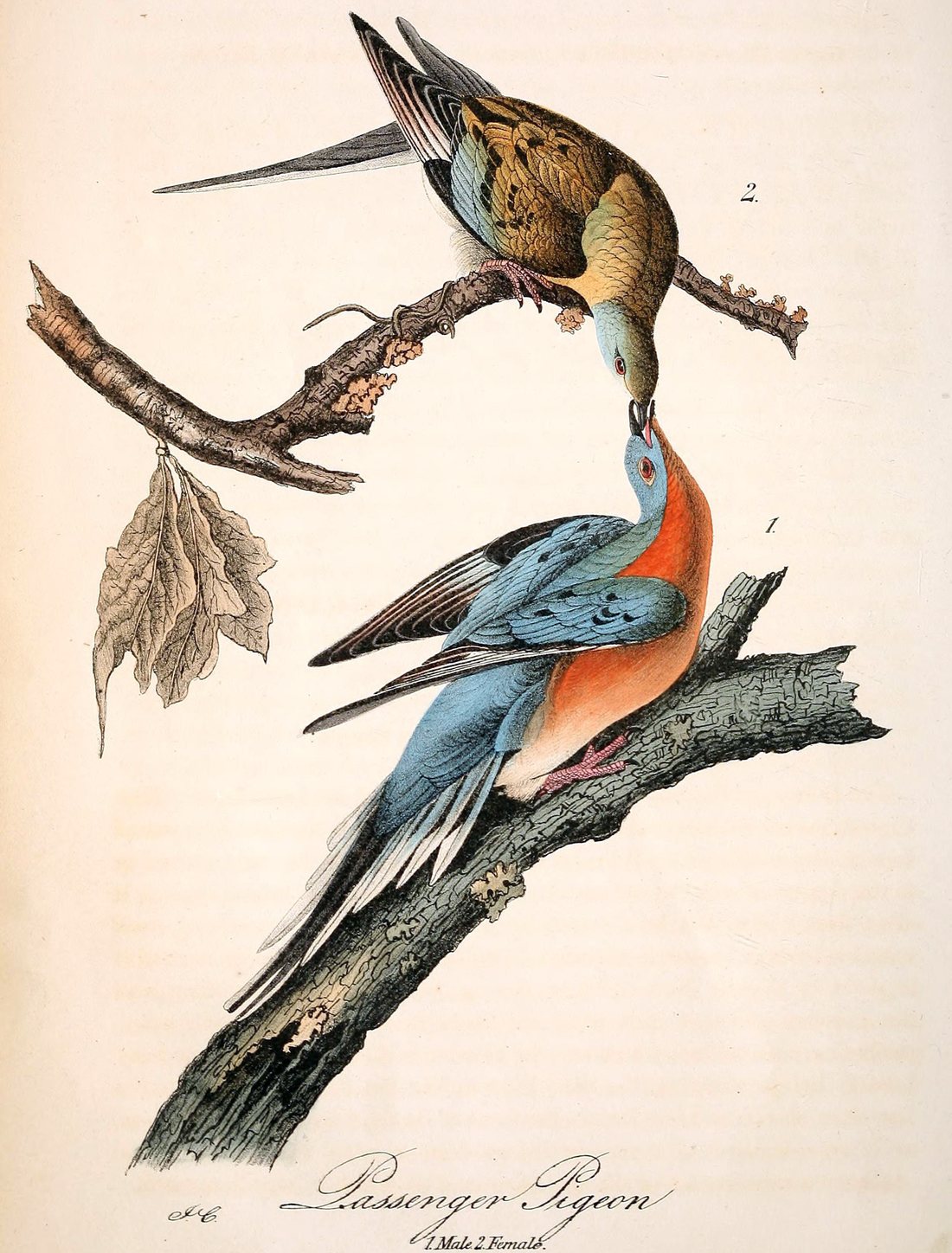
Before the first canoe, the valley belonged to the things that walked and swam and flew, and they held it on the only terms the land has ever really honored: they took what they needed and left the ground to close behind them.
The oldest of them were monsters, and the first people knew them. When the ice was still near, this was a cold spruce country ranging animals the valley would never see again — caribou and lemming down from the north, and giants: the mastodon and the mammoth, the stag moose, the short-faced bear, the flat-headed peccary in its herds, and a beaver the size of a black bear. Their bones still come up out of the bogs, tusks the length of a canoe surfacing in the black muck where the great animals mired and died; the later peoples who found them made them into grandfathers. One of them came up in the summer of 1870, and what brought it up is worth marking, because it was the same instrument that would shortly finish the country it had lain under. A crew of farmers in Auglaize county, running a broad ditch through the swamp two miles and a half east of the village of St. Johns, cut down through eight feet of peat and marl and struck bone. The state’s geologist came out and found the animal lying as it had gone down: the lower halves of the legs still nearly upright and each in its own place, the small bones of the feet perfect, the ribs and the vertebrae and the tusks settled along one level where the body had rotted on the surface of the bog. There was a live argument in the science just then over whether the mastodon had outlived the ice at all, and the geologist, having looked, declined to soften what he had seen: the creature had “mired and died in the place where he was§ found,” and he stated the conclusion “without reservation.” The ditch that was in the act of digging the swamp out from under the valley had opened, in passing, the swamp’s own archive.
And the first men were already here to hunt them. Thirty feet down, under what is now a flat sea of corn and soybeans, in a sinkhole a little east of the river, lie their spear points of bone and chipped stone, and a snapping turtle’s neck bone with the chopping marks still on it, and the skeleton of one of those vanished peccaries with a hunter’s bone point among its ribs — some of the oldest trace of human beings anywhere in the eastern half of the continent, laid down twelve or thirteen thousand years ago, when the mammoth was not yet a memory but a meal. So the neat order of the telling is a convenience and a small lie. The animals came first, but the people came in among them while the giants still walked — hunters moving with the herds, owning nothing, taking what they needed and letting the ground close behind them, exactly as the animals did. There was no line, at the beginning, between the animals and the people. There was only the hunting, and the cold, and the ice drawing slowly back off the land.
When the giants died — and they died, all of them, as the ice went and the world warmed — the valley settled into the country the later peoples would know: elk moving in herds through the oak openings, black bear in the beech mast, deer past counting, wild turkey so thick a hunter could feed a town. It was, by every account that survives, one of the richest hunting grounds on the face of the continent, and it was rich because the drowned land no one could farm was a paradise no one had spoiled.
It did not stay unspoiled, and the record of the spoiling is unusually exact, because a careful man sat down at the turn of the next century and made a list. When the physician-historian who wrote the natural history of the basin came to set down its wild animals, he put at the front of the book a plain roll of the creatures that had lived in the valley and did no longer, with the year beside each one that the last of its kind was known to have fallen, and the thing reads like a burial register for a whole animal kingdom, kept in the flat hand of a clerk. The buffalo went first, in 1812, the year the war came; the herds that had grazed the wet prairies were gone before the first treaty was fairly dry. The elk followed in 1824, the wolverine about the same year, the beaver — the hinge of the whole story, the animal three empires would cross an ocean for — trapped out of the valley by 1837. Then the lynx in 1840, the panther in 1850, the wolf in 1865, the wildcat in 1866, the black bear in 1872, the badger in 1879; and last of the great ones, in 1885, the wild turkey a hunter had once fed a town on. Inside a single human life, inside the span between a man’s birth and his grandchildren’s, the whole heavy freight of the valley’s wild life was subtracted, species by species, each with its own small dated headstone in a scientist’s footnote.
The manner of it was seldom dramatic and never merciful. The wolves were bountied: the county paid a man in hard coin for every scalp he carried in, and one western county of the swamp paid its whole state tax, one year, in wolf-scalp certificates — the killing of the wild animals reckoned, exactly and on the books, as the currency of settling the land. The last bear anyone killed in Wood County, in the very middle of the valley, was shot on a tracking snow late in the fall of 1858 by a farmer who had been trailing a wounded deer and simply turned his attention to the better animal when it shambled across his path. There was no ceremony to it. A man out for venison got a bear instead, and a species ended in the county, and he went home to his supper, and it was a quarter-century before anyone troubled to write the date down.
The arithmetic could run the other way as well. For three years, from 1807 to 1809, after the grey squirrels got into the corn, an Ohio taxpayer was required to carry squirrel scalps to the township clerk when he came in to pay, and was fined three cents for every scalp he was short. That was not a bounty paid out for a dead animal. It was the dead animal received as the tax itself, with a penalty for not having killed enough.
Of all that abundance the passenger pigeon was the sign and the wonder, and no one who saw it in its multitudes ever afterward found words for it that did not sound, in the retelling, a little like a lie. They came over in the spring and the fall in flocks that were not flocks but rivers of birds, a moving roof drawn clear across the width of the sky; and they came not for an hour but for a day, and another day behind that one, so that a man in his field looked up at noon into a false and beating dusk and heard, under the rush of a million wings, a sound like a rising storm, or like some great machine not yet invented for him to name it after. Where they came down to roost they broke the forest under them. They settled onto the old beeches and oaks in such dead weight that limbs as thick through as a man’s waist cracked and came down in the dark, and green trees split to the root and fell, and the dung lay a hand deep on the ground and killed the brush for years, and beneath a roosting-ground the earth was carpeted with the young shaken living out of the nests, until the hogs and the wolves and at last the men came in among them by torchlight with clubs and sacks and carried them off by the wagonload. It seemed past the power of any people on earth to make an end of such a creature, and it must be set down here, plainly and at the beginning, that the people made an end of it. They netted the pigeons and shot them and shipped them to the cities by the railroad car through the middle of the next century, until the flocks that had taken three days to pass thinned to a scatter, and then to a rumor, and then to nothing; and the very last passenger pigeon alive anywhere in the world, a hen they had named Martha, died in a cage in the Cincinnati zoo on the first of September, 1914, within the lifetime of men whose own grandfathers had knocked her kind out of the branches for the pot. The bird that had darkened the whole Ohio sky at noon went out of the world, at the end, in an Ohio cage, alone, under a keeper’s eye. But that is the far end of the story. In the beginning the sky went dark at noon with the weight of them, and there was no man under it who could have dreamed that it might ever go light, and stay light.
The one man who tried hardest to fix the thing in numbers only proved it could not be done. Riding the Ohio shore in the autumn of 1813, Audubon set out to count the flocks going over and marked a dot on his paper for each; he gave it up with a hundred and sixty-three dots made in twenty-one minutes, the noon light obscured as by an eclipse§, the droppings falling not unlike melting flakes of snow, and the river towns for a week after feeding, he wrote, on no other flesh than that of pigeons. And then, having seen more of it than any man alive, he got the one thing wrong. He stood a while afterward in a Kentucky roosting-ground forty miles long, among the torches and the sulphur pots and the three hundred hogs two farmers had driven a hundred miles to fatten on what would be left, and watched the trade work all night by firelight; and he set down that none of it signified. Nothing but the gradual diminution of our forests,§ he wrote, can accomplish their decrease. It is the steadiest sentence in the chapter and it is false, and the man who wrote it had better eyes for a bird than anyone then living. That is the trouble with an abundance nobody can imagine ending: the evidence of the ending is lying in plain sight in front of a trained observer, and he reads it as evidence of plenty. The nations had kept a longer and a truer measure of the bird, which was never a number but a sound. The Potawatomi called it O-me-me-wog; and Simon Pokagon — a chief of that people, whose own father had put his mark to the paper that sold the site of Chicago to the United States for something near three cents the acre — remembered coming as a young man upon a great nesting, the birds pouring through the timber over his head with a noise like an army of horses hung with sleigh bells advancing under a far thunder, settling on his very shoulders. He stood watching the last of one abundance from inside the loss of another: the same cold reckoning that was pricing his people off their country by the acre would shortly price the bird out of the world by the barrel.
By the barrel is the exact measure, because there are books. A professional netter’s ledger puts him in the Hocking Hills in 1861, shipping two hundred and twenty-five barrels out of Circleville to New York and Boston; near that same town eleven years earlier Dr. Kirtland had watched a single net take twelve hundred and eighty-five live birds in one day. This was not hunting, and it was not hunger. It was an industry, with a season and a wage and a supply line — the telegraph to find the flocks and the railroad to move them — and the men who worked it were called pigeoners, and there were six hundred of them in 1874 and twelve hundred by 1881.
What the trade could do at full stretch is on the record from one nesting. Out of the last great Michigan nesting at Petoskey in 1878 the count was one million one hundred and seven thousand eight hundred and sixty-six birds. Two hundred and fifty-two thousand four hundred and sixty-six of them, very nearly a quarter, were taken alive, which is the number that tells you what kind of business this had become. A live pigeon was worth more than a dead one, because it could be carried to a shooting tournament, released in front of a gun, and killed a second time for money.
One of the pigeoners described his trade to a magazine in 1881, plainly, the way a man explains any work he is good at. The nets ran forty feet by thirty and were thrown like an arrow; a good cast took sixty-seven dozen — better than eight hundred birds at one throw. And to bring a wild flock down inside the net they used a bird of its own kind: a live pigeon with its feet made fast to a hinged iron band, which a man could bounce from a distance so the bird beat its wings and called, and went on calling, until the flock overhead saw one of themselves feeding in safety and came down onto the nets. They called that bird a stool-pigeon. The word is still in the language, long after the thing it named went out of it. One rail car left the Indian Territory carrying eight thousand five hundred live pigeons for a tournament at Coney Island, and that car was a single installment against a contract for twenty thousand.
And the lake, which kept no books at all, killed them too. Great bodies of birds went down into Lake Michigan off Sleeping Bear Point, trying to cross in fog and wind; a flock of young birds caught in fog over Crooked Lake struck the water and perished by thousands,§ and the shore afterward lay covered a foot deep with them. The water did that without wanting anything by it. That is the difference this book keeps returning to and can never quite get over: the lake drowned them by the thousand and asked for nothing and entered nothing, and the men drowned them by the million and wrote down the freight.
How a creature past all counting could be gone inside a single lifetime is a question with a hard answer, and the answer is in the nest. For all its numbers the passenger pigeon laid, most years, one egg; it had never needed more, because the flock itself was the whole of its defense — a thousand nests to a grove drowned every fox and hawk and hungry man in sheer surplus, and the survivors were always enough. Break the flock below that mass, as the netters and the railroad cars did, and the arithmetic ran backward: too few to glut the predators, too scattered to breed, the engine wound down and could not be started again by any remnant. The abundance and the fragility were the one fact. It was the most numerous bird on the face of the earth, and it went out like a blown lamp, and nothing since, not law nor mourning nor the gene-splicers of our own day who talk of raising it again out of a cousin’s cells, has relit it. When the last individual of a race of living beings breathes no more, a naturalist wrote eight years before Martha died, another heaven and another earth must pass before such a one can be again.§
Nor was it the pigeons only. The drowned country that no plow could touch was, to everything with a wing or a fin, about the nearest thing to a paradise the middle of the continent had to offer. The marshes at the mouth of the river and the wet prairies out in the swamp lay square across the road of the great flyway, and twice in the year the waterfowl came down onto them in their seasons by the hundred thousand — swan and goose and every make of duck, the tall cranes standing gray and stilted in the shallows, the whole marsh gone clamorous at dusk and clamorous again at first light — feeding up on the wild rice and the wild celery, and rising off the water when a canoe pushed in among them in a thunder a man felt in the chest more than heard.
And in the spring the fish came up the other way, up out of the lake and hard against the current to spawn, and packed the rapids so thick in their running that the old accounts cannot help but boast of it: that a man could not have missed with a spear if he tried, could have taken them out with his bare hands, could very near have crossed the river dry on the backs of them.
Once, at least, the boast was kept in a form that admits of checking. When the army came up to the rapids in the war, the garrison at Fort Meigs — the same raw earthwork that would shortly stand the great siege, on the same broken water — set down what it took out of the river below the post, and the daily catch ran anywhere from sixty fish to fifteen hundred. Men dug in behind their own dirt in a hostile country, waiting to be shelled, were feeding themselves by the thousand out of the current at the foot of the walls. It is the nearest thing to a census that abundance ever got, and it was taken by the one sort of men who had every reason to count. The run was past any use a settled people could have put it to, and was pressed for one regardless: before the country was fairly opened a company got itself up at the head of the river for no purpose but to take the spawning fish by the ton and boil them down for their oil — the surplus so far beyond eating that men troubled to render it into grease. The sturgeon and the pickerel and the great walleyed runs returned to that broken water every spring as faithfully as the pigeons returned to the beeches — for the rapids that would one day halt the boats of three empires were, first, and for ten thousand years longer, a ladder the whole lake climbed to breed.
Of those two faithful returns, only one outlived the age that was coming. The pigeons that darkened the noon sky are down to a single stuffed hen in a glass case in Washington; the walleye still come. Every spring yet they climb the same broken water up out of Lake Erie to spawn on the same gravel, and they climb it the way they always did — the fish homing to the river it was hatched in, the older and the earlier leading, the run taught downstream from the veterans to the young that school behind them. The ladder the whole lake once climbed is being climbed still, this very April, past the crowds who wade the rapids now with rods where the nations once took the fish with their hands.
And it is no small remnant. The Maumee is the largest river that runs to the western end of Lake Erie, which is the most fish-fruitful water in all the Great Lakes; and the run of walleye that still climbs it every spring is, by the reckoning of the biologists who wade it now with nets where the nations waded with spears, perhaps the largest migration of river-spawning fish left anywhere in North America — better than half a million fish, a hundred thousand and more of them egg-heavy females, driving up against the current as their kind has done since the ice. Set beside the pigeon it looks like a mercy, and in part it is one: of all the rivers of abundance this account has run through — the pigeon-river across the sky, the fur-river up the water, the fowl on the marsh — this is the one great animal-river a man can still wade into the middle of and feel the old surplus of the country beat alive against his legs.
But look harder at the water and the mercy narrows, for what remains is a remnant of a remnant, and the losses under it are only quieter than the pigeon’s, not fewer. Other fish once climbed this broken water every spring beside the walleye and climb it no more: the muskellunge, the northern pike, and, greatest of them, the lake sturgeon — an armored fish out of the age of the giants, that had run these rapids to breed since before the mammoth died and does not run them now, extirpated from the river within the settling of it, gone the way of the elk and the wolf and for the very same reasons. The walleye a man wades out to meet is the survivor of a fuller company, standing where a whole congregation used to stand; the fisheries keep it, in their flat and telling word, as a surrogate — a stand-in for the vanished others, held to because it is what is left. The survivor itself runs now on a shortened leash, climbing only the lowest reach of the river it once had the whole of: the bottom ten miles dredged straight and deep for the lake ships, a dam thrown across at thirty-five miles up, and, at a set of rapids called Jerome, barely half the way to where it used to go, the run stops — turned back short of all the upstream gravel its ancestors bred on by the very works that drained the swamp and squared the fields and deepened the harbor and made the valley pay. The fish were cut off from their spawning beds by the same lifting of the water off the land — the ledger that emptied the swamp and dug the channel took, in the same motion and without ever once intending it, the upper two-thirds of a fish-run ten thousand years old.
And folded into the survival is a fragility of exactly the pigeon’s shape. The entire walleye fishery of Lake Erie, one of the great freshwater fisheries on the earth, now rests on four breeding stocks and no more: three river-runs, of which the Maumee’s is the largest, and one bank of open-lake reefs. Four, where the next lake north counts thirty-seven. A run drawn down to a few concentrated stocks is a run that a few bad springs, or a few more works thrown across a few more rivers, could break the way the netters broke the pigeon, and the men who count the eggs say as much, warning in the careful language of their trade that the thing looks larger and safer than it is. The lesson the pigeon paid its whole existence to teach — that abundance and fragility can be the one same fact, that the most numerous creature going can be the soonest undone — stands written again, in smaller letters, in the water at the foot of the rapids, for anyone willing to read a thing twice.
The pigeon did not go alone, and the other one was a parrot. The Carolina parakeet was the only parrot native to the continental United States, green and yellow with a red face, and Ohio lay inside its range; it wanted old bottomland timber along the rivers and in the swamps, and nested in hollow sycamores. It was shot for the feathers that went onto women’s hats and shot off the orchards as a pest, taken alive for the cage trade, and cut out of its nesting timber. What finished it was a habit of its own: the flocks came back and settled among the birds that had just been shot, so a gunner never had to find them twice. The last wild one was killed in Florida in 1904, and the last of all of them, a male called Incas, died on the twenty-first of February, 1918, in the Cincinnati zoo where Martha had died — and, the story goes, in the same cage. He and his mate had been together thirty-two years, and laid eggs the whole of that time, and rolled every one of them out of the nest. His skin was to have gone to the Smithsonian as hers had gone. It never got there, and nobody knows where he is.
One sound, at least, the country never lost. Long after the pigeon-thunder had gone out of the sky for good, the summer air over the valley still filled, as it fills yet, with the one great voice the ground kept — the dry, rising, metal wall of the cicadas, coming up out of the trees in the heat of every July and August and laid over the whole country like a heat made audible. These are the annual cicadas, the dog-day cicadas, that the older people called locusts though they are no such thing; a few of them climb out of the ground and split their brown shells on the bark every single summer, and the males sing by buckling a little drum of ribbed membrane in the side of the body hundreds of times in a second, and the sound of them is the sound of the season itself in this place, as native to a valley July as the green of the corn. That much the land kept, and keeps.
And the valley was denied the stranger cousin. East and south of here, in the older upland woods on the slate and the sandstone, lives the cicada that hoards itself in the dark for seventeen years and then boils out of the ground by the million in one appointed spring, to roar a few weeks and breed and die and leave the country silent for another seventeen. It has never held this flat limestone lake-plain at all; the surveyors who mapped its edge in the last century fixed the western boundary a good forty miles short of the mouth of the Maumee. The reason is the ground: that insect must have the same standing trees over it for the whole seventeen years, and the drowned country never offered them. So the swamp wrote the insects’ calendar too, and wrote it as it wrote everything else here — it gave this valley the voice that comes back every summer, and withheld the one that comes back once in a boyhood.
But the animal that mattered — the animal that would, in the end, decide who came to the valley and why, more surely than any treaty or any army — was the smallest worth naming. The beaver.
Its own giant ancestor had gone into the ground with the mammoth and the short-faced bear, but the beaver that remained — forty pounds, patient, no monster at all — was already at work on the river when the first people found it, doing the ice’s own work over again on a small water: damming, ponding, drowning the low ground, making wet country wetter. Its fur was dense and fine and, in the cold, worth more per pound than almost anything else the interior of North America could produce. A hat could be made of it that would not lose its shape in the rain, and across an ocean the men who wore such hats did not know and did not care where the valley was. They knew only that they wanted the fur, and that want reached across the water like a current and pulled the world that follows into this one small river.
Why a swamp animal in the Ohio country was worth an ocean crossing is the question the whole story hangs on, and the answer is a hat. Beaver fur is not like other fur. Beneath the long guard hairs lies a layer of dense soft underfur, and each tiny filament of that underfur is barbed, microscopically, like a burr; and those barbs are the secret of the whole trade, because they mean that beaver underfur, once it is shaved from the skin and worked with heat and moisture and pressure, mats and locks upon itself into the finest felt a hatter can make — dense, smooth, all but waterproof, and able to be blocked into a shape and to hold that shape through weather and years. For the better part of two centuries, from the age of the plumed cavalier down to the age of the tall black stovepipe, a hat of beaver felt was simply the thing a European man of any standing wore upon his head to tell the world who he was. Every officer’s cocked hat, every merchant’s high crown, was beaver if its owner could afford it and cheap imitation if he could not. And Europe, by the time this hunger was at its peak, had trapped its own beaver very nearly off the face of the continent. So the want that could no longer be fed at home reached out across the ocean — a plain want for a fashionable hat, felt in the drawing rooms and on the parade grounds of France and England by men who had never in their lives seen a wild river — and it was that narrow, specific, faintly ridiculous want, utterly indifferent to the country it was about to bleed, that came feeling its way up the St. Lawrence and along the lakes and into this valley, and set every other thing that follows in motion. The nations trapped the beaver; the French came and bought it; the empires fought over the ground the beaver lived on; the people were carried off it in the end. And at the far end of that whole long chain of wanting, a continent and an ocean away, was nothing more than a gentleman in Paris, adjusting his hat in a glass, who would have been astonished and unmoved in equal measure to learn what his reflection was costing a marsh he could not have found on a map.
The people it was happening to had an account of it too, given in this country in 1763, before a council of the lake nations. The teaching was that the Master of Life, seeing his people given over to evil, had led the wild animals away into the depths of the forest, so that they were left to depend on the newcomers to feed and clothe them, and that if they became good again he would send the animals back. The two accounts differ only as to the cause. On what came of it they do not differ at all: the game went, and the dependence came in behind it.
There is more to the beaver’s part than the price of its skin, for the beaver shaped the valley with its teeth nearly as surely as the ice had shaped it with its weight. A single pair, given a stream, will build until they have made a pond, and the pond drowns the low wood and kills the standing trees and silts up slowly behind the dam, year upon year, until the beaver at last abandons it and moves on up the water — and what they leave behind them, when the dam breaks and the pond lets down, is a flat of deep black silt lying open to the sun: a wet meadow in the heart of a closed forest, thick with grass and browse, the richest small ground in the whole country. The deer came into the beaver-meadows to feed, and the elk came, and behind them came the hunter; and behind the hunter, in the long run of time, came the settler, who mowed the beaver’s abandoned meadows for the first hay his cattle ever ate in the valley, and cursed the wet, and never thanked the animal that had cleared and drained and manured that field for him ten thousand years before he was born to stand in it. The beaver made the openings that the whole living world of the valley gathered into. There was more design in the work than a settler cursing the mud ever guessed: a naturalist who gave years to mapping the beaver’s dams on the Lake Superior streams counted sixty-three in a single district, some of them three hundred feet along the crest and ponding sixty acres of water, and came away certain he had been studying not blind instinct but a kind of reason — for below one great dam the beavers had thrown up a second and lower one whose only office was to raise the water behind it and ease the pressure on the first, and through the dry ground between the pond and the timber they had cut canals, a yard wide and hundreds of yards long, to float their winter wood down to the lodge. It was, in its small and patient way, the under-engineer of the entire country — and it was, just then, about to be hunted for the felt of a hat worn in cities it would never see, very nearly off the face of the earth.
Everything that came — the French for the pelt, the wars between the nations for the hunting grounds, the forts, the treaties, the armies — turned on the back of an animal that weighed forty pounds and asked nothing of anyone but a stream to dam. The beaver did not know it was the hinge of an empire. It went on cutting willow and raising water, and the water it raised drowned the same ground the glacier’s lake had drowned, and the ground did not mind. The ground had been under water before.
They held the country lightly, all of them — the pigeon and the beaver, the elk and the wolf — in the one way the valley has ever let anything hold it for long: they took what the season put in front of them and let the rest close over behind, and made no deed, and drew no line, and carried nothing off that the ground could not put back the following year. They were not gentle. The wolf was no kinder to the deer than it had to be, nor the pike in the rapids to anything smaller than itself, nor the pigeon to the mast it stripped. But they were, in the long slow arithmetic of the ground, sustainable — which is only our own colder word for the very thing that all the rest of the story is the losing of: they belonged to the land, and not the land to them, and the balance kept itself for ten thousand years with scarcely a creature in it ever meaning that it should — save the one that had learned to lay fire to the grass and hold the open country open, and that meant only to keep it: to keep it wild and full, and call none of it its own. And then there came into the country a new kind of animal, one that could hunt beside the others and yet think past the turning of the season — that could stand on the bank and look at a river of pigeons and a river of fur and a river of water going by, and begin, very slowly, to reckon what the three of them together might be made to be worth.
Then came the people.
The First NationsThe Oldest Title
Who is there to mourn for Logan? Not one.
— Logan, a Mingo chief, 1774, as set down in Jefferson’s Notes on the State of Virginia
They were not one tribe, they had not come from here, and they were here “first” all the same — and that last fact is the ground everything after them stands on, no matter how hard everything after tries to forget it. The valley was theirs before it was anyone’s, by the oldest title there is: the title of having lived on a country and buried your dead in it and known its every rapids and marsh and oak opening for more generations than anyone kept count of. They held it a thousand years and better. In the end they will be given a single summer to leave it forever. It is right to set them down here, at the beginning, in their own light and their own names, before the long procession of those who would take the valley from them gets fully under way. Everything after them is, in the longest view, trespass — and the trespass ought at least to know whose ground it crossed.
And they were not the first even of the first. Long before any of these nations paddled down to the western lake, the ground had been peopled and worked and buried in by others so much older that no memory of them survived among the living at all — the people who had raised, the length and breadth of the Ohio country, the great earthworks: the burial mounds and the walled enclosures and the miles of embankment thrown up in circles and squares and octagons too exact to have been laid out by any careless eye, older, some of them, than the Caesars. But they had cared little for this drowned end of the country. The great works stand thick to the south — along the Scioto and the two Miamis and the Muskingum, on the high dry river terraces — and thin here in the northwest almost to nothing, and Gerard Fowke, who at last mapped every earthwork in the state, set it down that “the entire northwest part of the state” had been “unsuited in prehistoric times for occupancy by a prehistoric people, as the greater portion was low and swampy and at certain seasons of the year covered with water.” One county square on the Maumee — Henry — would stand in the record as the only county in all of Ohio with not a single mound or earthwork of any kind to its name. The same drowned country that would one day mire Wayne’s army and Hull’s, and swallow whole the surveyors’ painstaking lines, had kept the mound-builders out a thousand years before there was a soldier or a surveyor for it to defeat — the water already setting the terms, already the author of who should live upon the land and who should not. What few works the valley did carry clung, every one, to the little dry it had: to the sand of the old lake beaches and the higher ground, and to the very lip of the lake, where a line of earthwork forts ran the southern shore, Fowke would record, from Conneaut down toward Toledo — one of them left unfinished near the mouth of the Maumee, raised and then abandoned by hands that were dust a thousand years before the Miami were a people. They had kept to the dry rises exactly as the deer and the first hunters and the traders’ trails and the paved roads all would after them: the oldest builders on the ground already bending to the shape the vanished water had left.
And what little the valley did carry, it did not keep. A state geologist coming through Toledo in 1870 found two small earthworks still legible inside the growing town, and set himself to draw them for the plain reason he gave: that whether they belonged to archaeology or to modern history was an open question, but it was well to describe them “before they are entirely destroyed.” One was by then nearly gone, graded away where Clayton and Oliver streets had been cut through it, and he restored its outline from the fragments left and from the memory of an old resident who could still say where it had run. Away up at the head of the St. Joseph, at the mouth of Silver creek, he found a group of low mounds that men from Pioneer had already opened: two held a single skeleton apiece, the rest held nothing, and the whole yield of the digging was a stone hatchet grooved for a withe and a few worked flints. So the record of this end of the state is thin for two reasons and not one. The country would not carry the works in the first place, and the little it carried was graded off for streets or turned over by neighbors with spades a generation before there was anybody on the ground whose business it was to count.
Go back to those octagons a moment, because the exactness is not a figure of speech and it has been measured. In 1982 two physicists at Earlham College, Ray Hively and Robert Horn, showed that the walls and the gateways of the great octagon at Newark, far down the state to the southeast, are laid to the moon — not to its month, which any watcher picks up in a season, but to what the astronomers call the lunar standstill: the slow swing of the points on the horizon where the moon rises and sets, drifting out to its widest and back again over eighteen and a half years and more, which is a human generation, near enough. Tested against octagons generated at random by computer, the odds that these walls fell where they did by accident come out at about one in a thousand. It is the hardest cycle in the sky to catch, for the plain reason that a season’s watching will not show it, nor a year’s, nor one attentive person’s. To have it at all, people had to watch on purpose, hand the watching on to those who were not born when it began, and set the answer down in something that would outlast every one of them; and the only such medium the country afforded was the country. They wrote it in the ground — the oldest measuring anyone can still read here, and it was not done to divide anything.
The nineteenth century came upon these works, and found them finer than it cared to credit to any Indian, and did with them the thing this whole story is made of: it invented a race to have built them. A Lost Race — a vanished and gifted civilization of Mound Builders, white or near-white in the more fevered tellings, “a great nation dominating all the country from the Atlantic Ocean to the Rocky Mountains, from Canada to the Gulf”§ — who had reared these marvels in some golden antiquity and then been set upon and destroyed, the story ran, by the brute ancestors of the very savages now camped among their ruins. It was a lovely lie, and a useful one.
For if some higher people had built the mounds and the Indian had only pulled them down, then the Indian himself was a latecomer here and a vandal, holding no title old enough to trouble anyone’s conscience, and the men who were, in those very years, marching the nations west could do it the more easily, as merely clearing off the last squatters from a country whose true and worthier owners had conveniently died out ages before anyone had to watch. The lost race was got up to do a job of work, and the job was to vacate the oldest title of all by pretending its holders had only just arrived.
It did not survive the spade. When careful men at last dug into the mounds instead of dreaming over them, they turned up no lost master-race but the plain human dead of an older native people — folk who, as Fowke set it down flatly after a lifetime among the works, were “in no particular ... superior to, or in advance of, many of the known Indian tribes. They hunted with the same kind of weapons. They worked with similar tools.”§ Fowke, honest to the last, would go no step past the evidence: asked who they were, he refused the guess in either direction and wrote only, “We simply do not know who they were” — which was already more than the age that had been so certain could truthfully say. The naming came after, and came from the Smithsonian’s own hand, when Cyrus Thomas was sent in 1894 to have the question out for good, dug the phantom race clean out of existence, and reported what would stand in the end: that the builders had been native people, kin and forebears to the Indians and no strangers to them, and that no vanished nation had ever been wanted to account for the mounds at all. They had not been crude, either — into the greatest of the works had come copper off Lake Superior and black volcanic glass out of the Rocky Mountains and seashell from the Gulf, a whole continent’s trade drawn to a valley in Ohio a thousand years before the beaver ever brought the French. The old works kept one last word for anyone still tempted to call this ground empty, or new, or anciently his own: down in the mounds the diggers found the intrusive graves of yet another people, who had come along after the builders were gone, buried their own dead in the ready earth of the abandoned works, and then themselves passed off the land and out of all memory before the first white face was ever seen on it — the claimed and the vanished lying layer under layer, on a country that had been settled, and loved, and emptied, and taken again more times over than any deed the newcomers carried would ever find room to record.
And in our own time the old lie has been turned clean inside out. The very word still hung on the builders — Hopewell — is nothing but the name of the farmer whose field one of the diggings happened to cross; their own name for themselves is gone past recovering; and the nations descended from them ask no other, calling those builders simply the ones who came before. In 2023 the greatest of their works — the Great Circle and the Octagon at Newark, the mounds at Chillicothe, Fort Ancient on its bluff — were written onto the roll of the world’s heritage beside the pyramids and the Parthenon, the first and only such place in all of Ohio; and at the naming of them stood the descendants of the very people a whole century of Americans had sworn could never have raised them, come to claim their ancestors’ hands in the earth at last, and in the sight of the whole world.
They were there to be listed because they had survived, and most of their kind had not. Squier and Davis, surveying the works for the government in the 1840s, were already recording them as things going under the plough; and the greatest effigy of them all survived by being bought. When Frederick Putnam of Harvard’s Peabody Museum came to the Great Serpent in Adams County in 1883 he found it in a deplorable state — a windstorm had torn the trees off the ridge, the land had been cleared behind it, and the serpent was, in the phrase of the Ohio society that later owned it, more or less mutilated by the cultivators of the soil.§ Putnam got a promise that it would not be further disturbed for one year, and an option on some sixty-five acres, and went back to Boston for the money.
He got it from a woman named Alice Fletcher. She raised it the way such money was raised: brought the matter up before some leading ladies of Boston at a lunch party at Newport, had a circular printed, drew in Francis Parkman the historian and Martin Brimmer of the Harvard Corporation, and gathered near six thousand dollars — about eight thousand in the end, with the repairs. The ground was bought and the title placed with the Trustees of the Peabody Museum, and in 1900 handed on to the Ohio Archaeological and Historical Society, which is how the Great Serpent comes to be standing today.
And in those same years Alice Cunningham Fletcher was the government’s allotting agent. In 1882 the United States hired her to make out the land allotments among the Omaha; afterward it sent her to do the same to the Winnebago and, over their intense opposition, to the Nez Perce. Allotment in severalty was the instrument that finished what the treaties had been doing piecemeal: it took a country held in common by a nation, drew lines across it, issued the pieces to individuals, and declared whatever was left over surplus. It is the precise thing Little Turtle had offered to prevent at Greenville and Tecumseh gave his life arguing against — common title, cut into lots — and the hand that drew those lines on three nations is the hand that saved the Serpent Mound whole. The Ohio society, writing her up in 1905 in the pamphlet about the gift she had made them, called her a wealthy lady interested in archaeology, and said nothing else about her, and may well not have known.
There is no hypocrisy to expose here, which is exactly why it belongs in this account. Severalty was sold to its own generation as the rescue of the Indian, the making of him into a landowner and therefore a citizen, and Fletcher believed it as she believed the serpent was worth six thousand dollars. She was preserving in both directions. She was right once. This valley’s whole story is people who could not see, from inside their own certainty, which of the two things they were doing at any given moment — and she is the cleanest case of it in the book, because both acts were done by the same person, out of the same conviction, inside the same decade, and only one of them left anything standing.
There is a plainer case than hers, and an older one, just over the divide to the south, where the water turns for the Scioto. In 1856 the Bellefontaine and Indiana Railroad wanted ballast for its track between Mount Victory and Ridgeway, in Hale Township of Hardin County, and there was a gravel bank there of an acre and a half with a bearing apple orchard on top of it. The contractor learned almost at once what the bank was and went on carting. It was a burial ground — one of the gravel hills the ice had dropped across this whole country, in and atop which a people had laid their dead through the long age between three thousand and five hundred years before Christ, with red ochre and native copper and shell fetched up from the Gulf. John S. B. Matson took off about two hundred and twenty cubic yards a day, laying off some six weeks when the ground froze. He counted three hundred and eight skeletons and reckoned four or five hundred had been put there. Most of them went onto the railroad track with the gravel. He learned afterward, and at second hand, that when they were dumped on the road a piece of a femur was found with a flint dart fast in the bone.
He also wrote it down, exactly and at length, and twenty-seven years after a county history printed the account entire and called it one of the most remarkable in Ohio. He had no theory to serve, and so he got right, in passing, what the age’s theorists were getting wrong at the same moment: the copper in those graves, he saw, had never been smelted at all but was flaked from the native metal and rolled. That account is the reason the Glacial Kame culture has a name. The bank he emptied is its type site, the standard the rest are measured by, and there is nothing there now to go and see. These were the pre-Shawnee dead of the northwestern country, and they entered the knowledge of the world in the act of being carted out of it. That printing was 1883 — the year Putnam climbed the ridge in Adams County and went back to Boston for the money. Nothing lay between the two grounds but what somebody had already reckoned each was worth: the gravel had a price on it and the graves had none, and the ledger has no older entry in this book.
The copper in those graves had been mined, and the mining was old before ever the graves were dug. Away north, on Isle Royale in Lake Superior and along the Keweenaw, people went into the bedrock after the native metal with stone hammers and with fire, opening pits and trenches, some of them better than sixty feet deep, from about sixty-five hundred years ago until fifty-four hundred — among the oldest metalworking anywhere in the Americas. Then it stopped, and nobody knows why; worked-out veins and a drying climate are the guesses. The mud kept the account. Cores lifted from the bottom of McCargoe Cove carry lead and copper at ten times their natural level through the whole run of the mining, hold there a thousand years, and fall away as sharply as they rose; and nothing of the kind is in that water again until the nineteenth century. It was the first time human work showed up in this lake country as a change in the water, and it was not the last.
How they had come was itself a story about the beaver, which is to say about want reaching across great distances to rearrange the world. A hundred years before the French ever paused to count them, the Five Nations of the Iroquois, far to the east, had trapped their own country bare of beaver, and — needing fur to trade to the Dutch and the English for the guns that had by then become the price of survival on the frontier of two empires — turned on their neighbors for fresh hunting grounds, in a long and grinding war that the later histories would name, without any apparent sense of the irony, the Beaver Wars.
Armed first and armed best, the Iroquois fell on nation after nation and broke them. Huronia they destroyed in a single terrible year — a thousand warriors coming out of the winter dark at dawn, “mostly with firearms,” a priest recorded, “which they obtain from the Dutch, their allies”:§ the guns of one European empire, sold on the Hudson, breaking nations on lakes no Dutchman would ever see. The Erie they wiped from the earth so wholly that the lake is the only monument the people have left: the great water along the valley’s entire northern edge still carries their name — Erie, the Cat Nation of the earliest French accounts, called so, one black robe wrote, for the prodigious number of wildcats in their country — and hardly another thing of them remains. The manner of their ending was written down, because a Jesuit heard of it: in the summer of 1654 some twelve hundred Onondaga and Seneca stormed a palisaded Erie fort that sheltered, the Relation says, perhaps two thousand souls, and by 1656 the Cat Nation had simply ceased to be — a whole people gone from the world inside two years, leaving a name on a lake that a hundred million people would one day live around without once wondering whose it was. The northern boundary of this entire story is a graveyard nobody can find, with the headstone in plain sight.
The Neutral and the Wenro and the rest they scattered like chaff before a wind, and drove the survivors west, and west again, ahead of the muskets, until the drowned and unfarmable and game-rich country at the western end of Lake Erie — the one country in all the interior that nobody with a plow would ever trouble to want — became the ground where the broken peoples fetched up at last and made themselves new homes. And for a generation in between, the diggers and the historians agree, the future Ohio stood empty of settled towns altogether — hunting parties crossing it, no one keeping it — a swept and waiting country — and remember that emptiness, because everyone who comes after will shortly be certain the land was always, anciently, theirs. So the valley filled, and it filled not with one people but with many: a country of refugees, nearly every town of it settled by a nation that had been driven out of somewhere else, each keeping its own tongue and its own council and its own dead, on a land wide enough and wet enough and rich enough to hold them all in something near to peace.
But that emptiness had a floor to it, and under the floor lie the towns. The spade has been at this end of the lake as well, and it has turned up what no written record ever knew: that between the mound builders and the refugees this country held a settled village people of its own — farmers who lived in towns ringed with a ditch and a palisade, and who kept the western end of Lake Erie for centuries, and were gone by about 1650. Their own name for themselves went with them. The archaeologists call them the Sandusky tradition, and mark the ages of their life by the labels the newcomers would one day fasten on the same ground — a Fort Meigs phase, an Indian Hills phase — so that the only calendar these people have is written in the names of what got built on top of them. The Maumee valley alone carries a string of at least six of their village sites. Their dead are on the very reach of river this whole account keeps coming back to: an ossuary near Waterville, up the rapids from the ground where the fallen timbers would lie, holding its people from somewhere in the sixteenth century or the early seventeenth; another dug at Rossford, a few miles above where Toledo would stand; and at the Indian Hills town three mass graves together, well over a hundred souls laid down in them. That last was not a catastrophe but a rite — the gathering up of the dead of many years to be gone into the ground all at once and together, which is a thing a people does only while it still means to stay.
And what moved them, before ever a musket did, was the same engine that moves everything else in this book. Through the early 1500s their towns stood where towns in this country sensibly stood, up on the bluffs above the flood plains. Through the 1600s they came down off that high ground and set themselves in the wetlands and along the edges of them — nearer the fur. A market an ocean away had begun rearranging the houses of the Maumee before a single Frenchman had laid eyes on the river, and of all the directions it might have moved them, it moved them into the swamp. So when the muskets at last came down the lake, they did not fall upon an empty country. They fell on the last of a village people who had already been drawn out of their own places by the very want that armed the men who finished them. The emptiness the newcomers would find here, and take for the natural and ancient condition of the land, was younger than their own grandfathers.
The Erie were not even the first to go; the wars only finished a scattering that had begun before any European was near enough to watch. The ethnologists would later assemble the case from the pieces the survivors carried: far out on the plains today there are two nations whose very names are the memory of a flight down this country’s southern river — the Omaha, “the people who went against the current,” and the Quapaw, “the people who went with it,” one people once, by their own tradition, who came down the Ohio ahead of the troubles and parted forever at the Mississippi, the name of each nation ever after a record of which way its canoes turned; and the Omaha kept a name for the Ohio itself that translates simply the river down which they came. A French priest on the Mississippi in 1700 set down that the Illinois and the Miami called the Ohio the river of the Akansea, “because the Akansea formerly dwelt on it”§ — the Miami keeping a departed nation’s name on the water exactly as the lake keeps the Erie’s. And on a French map of 1684, over the country south of the future Ohio towns, there stands a legend of five words that is the whole story of a people: Mosapelea — eight villages, destroyed. The remnant of that nation fled the length of the Mississippi and ended on the Yazoo, in the far south, where two centuries later a linguist proved their tongue was Siouan, kin to nations in Virginia — one people torn in half and thrown a thousand miles apart, with the Ohio country in the middle of the tear. The last speaker of that language, an old woman named Rosa Pierrette, died in Louisiana about 1915 — within a year of the last passenger pigeon, the record losing a tongue and the sky losing a bird in the same season, and hardly anyone noticing either.
Stop on that a moment, here at the outset, because it is the same wheel that will come round once more before the end. These nations — whom the Americans would one day round up and drive west as an obstacle in the way of a plow — were themselves already the children of an uprooting, the survivors of an earlier dispossession run by the very same engine: the reach of a distant market for fur, turning whole peoples out of their countries and pushing them before it across the face of the continent like weather. The valley was a refuge the fur trade had made. It would be emptied, in the end, by the same trade’s long-delayed second act, when the men who came for the last of the fur were followed by the men who came for the land under it. It would not stop even there; the wheel had a further turn left in it. They knew none of that. They knew only that they had found, after the breaking, a good country, and had made it a home, and meant to keep it. Name them; they earned it.
There were the Wyandot, whom the French called Huron — the remnant of the very nation the Iroquois had shattered first, returned as if from the dead, drifting down at last to the western lake to hold the head of the water by right of longest possession, keepers, as they reckoned it, of the western door of the whole country. Broken though they had been, they carried a seniority the other nations granted them without argument: their neighbors addressed the Wyandot as uncle, and as elder brother, and even as grandfather, and it was the Wyandot who kept the grand council fire of the western nations and the seat of its head civil chief, so that the shattered remnant of the first people the Iroquois destroyed came, in its western exile, to sit at the head of the council of all the rest.
They kept that seat in a tongue the rest could not follow. Wyandot was an Iroquoian language — its kin were the tongues of the Five Nations who had broken them — while the Miami and the Shawnee, the Odawa and the Potawatomi and the Lenape spoke forms of one other family altogether, Algonquian. So every word out of the keepers’ own mouths crossed a family line before the rest could take it, and the speech nearest their own was the Iroquois’.
There were the Myaamia, the Miami, whose own word for themselves the river still carries, worn smooth down the centuries into Maumee. Their great town stood where the two streams meet at the head of the river: Kekionga, the crossroads of the interior, and the ground every power that came would spend blood to hold. The Miami gave the valley more than its name. They gave it the finest mind it ever produced. His name was Mihšihkinaahkwa — Little Turtle — and by the reckoning of the very men he beat he was the ablest soldier the frontier brought forth on either side. Twice, when the young United States sent armies to take this country, he met them in the forest and destroyed them, the second time so completely that it remains the worst defeat an American army ever suffered at native hands. But he was more than a war-leader, and the war will show it. He dined with Presidents in Philadelphia; he had also stood in the trees and watched two armies come apart in front of him. No one ever saw the valley more whole.
Kekionga was a capital, and not a capital only but a market — the great interior crossroads where the head of the Maumee all but touched the head of the Wabash, and a man might stand, as it were, with one foot in the watershed of the cold northern lakes and the other in the watershed of the warm southern gulf. A canoe, it was said, could set out from Buffalo on the far eastern lake and come down to the Gulf of Mexico without once leaving the water, but for a single short portage over that one low divide, and the portage was here, which made the town the one lock on the whole continental passage. The trails of half a continent ran together there. Down them, and up the two rivers, came furs and corn and wampum and captives and news; and the goods of the French, and later of the British — the kettle and the blanket, the powder and the knife — flowed the other way, so that the Miami sat at the tollgate of the whole west and grew, by the measure of that country, rich upon it. Around the town lay cornfields that could feed thousands, and orchards of apple and peach that French traders had set out generations before and that bore their fruit still; so that when at last an American army fought its way to the place it found not a raw camp of the imagination but a settled and provisioned country, an old and rooted town, and put the standing corn to the torch by the hundred acres, and marveled even as it burned at the plenty it was destroying. Whoever held Kekionga held the door between the two halves of the continent; and the Miami, who had held it longest and knew best what it was worth, would fight the hardest of anyone alive to keep it.
There were the Shawnee, the restless people — the Southerners, for that is what their own name means, the folk of the south quarter of the world, worn down by the English ear from Shawano to Shawnee — who had ranged from the Savannah to the Susquehanna and come to rest along this river with their fighting spirit undimmed. They kept, alone among the peoples of the valley, a tradition that they had not come up out of the earth like the rest but across the sea — that their forefathers, led by a chief of the Turtle band, had walked down to the shore of the ocean and seen the waters open before them, and had crossed over dry along the floor of the deep to reach this land. It is a strange thing to find remembered in the Ohio woods. But a people that remembers crossing a sea to arrive is a people that has always known itself to have come from somewhere else, and the Shawnee wandered the whole length of their history like men in search of a country they had somewhere mislaid. From them had already come Cornstalk, the sachem who fought the Virginians to a standstill at Point Pleasant in 1774 and then, the battle done, was the first among his chiefs to argue for peace, and was murdered under a flag of truce for his pains, a great and good man by the reckoning even of his enemies, who had seen the doom of his people coming and could not turn them from it. And from the Shawnee, in the fullness of the story, would rise the man whose vision closes the Indian age of this valley — Tecumseh, the Shooting Star — though his hour is not yet.
Around those three stood the rest. The Odawa — the Ottawa, whose very name means trader — were the longest keepers of the river’s mouth and the merchants of the whole lake country, and from them came Pontiac, who would raise the first great rising against the newcomers when the newcomers thought the country already won. The Odawa stood with the Potawatomi and the Ojibwe in the Three Fires of the lakes, three nations that by their own memory had once been a single people and had parted far to the north at the straits, and stayed kin in blood and tongue ever after. The Seneca held the Sandusky. The Lenape had been pushed the whole width of their history, from the Atlantic shore to this western water. And one nation was gone before most of the others came: the Erie, destroyed in the Iroquois wars, present in the refuge they never lived to join only as the name of the water at its edge.
Of the Lenape it is worth saying more, because their case is the whole argument worked out on a single people before the valley ever saw an American army. Their own name for themselves was Lenni Lenape, and the wider name they answered to across the eastern country was Wapanachki — people at the rising of the sun, which is to say Eastlanders, a plain description of where they stood. Nearly forty nations sprung from the same stock acknowledged them as grandfathers, and the Lenape kept the metaphor as carefully as a deed: when the Mahican came west the Delawares thought proper, as their historian records it, to enlarge their council house for their grandchildren, that they might come to their fire. That is what standing meant among these peoples — not land held but a fire other nations were entitled to sit at.
The name we use for them is none of that. Delaware is a river’s name, and the river was named for an English baron who never saw it, and the baron’s name was fastened to the people because the people happened to be living along the water when the English arrived and needed something to write down. John Heckewelder, the Moravian who lived among them some forty years and knew their tongue as few outsiders ever have, set it down flatly: the name Delawares, which we give to these people, is unknown in their§ language. He remembered further that there had been a time when they took it for an insult — that they supposed the whites had given it to them in derision, and had to be persuaded otherwise. A nation carrying, for three centuries and into every treaty and every removal roll, a word it first heard as a slur and never could read in its own mouth.
Heckewelder is worth a sentence on his own account, for the shape his life took. He had followed them from the Susquehanna into the Ohio country, and helped build the mission towns on the Muskingum — Schönbrunn, Gnadenhütten, Lichtenau, Salem — and watched the Revolution come through and break them, the converts scattered and the work begun again near Detroit in 1782 and abandoned again four years after. He outlived all of it. And when he came at the end to set down the last thing he had to give, in 1822, the year before he died, it was not a history and not a defense. It was a list of the names the Lenape had given to the rivers and the streams and the particular places of Pennsylvania and New Jersey and Maryland and Virginia, with their significations — what each one had meant. He had grasped, at the finish, the same thing this valley teaches: that of everything a people lays on a country, the words outlast the towns, and that a name whose meaning has been forgotten is a thing still standing with the life gone out of it. He spent his last strength writing the meanings back in.
They held the valley the way the animals had held it, and the way the French would half understand and the Americans never would at all: lightly. They did not fence it or deed it or break it to the plow. They took the deer and the turkey and the fish of the rapids in their seasons and let the forest close behind them. They set their towns on the high commanding points above the water and buried their dead there, so that the loveliest ground in the valley became its long memorial. They came together in councils so various that a single fire might need three interpreters to carry one speech across the tongues gathered round it. They played, too, in their seasons, on ground that was wholly their own. When the first Europeans troubled to count, in 1680, they tallied villages of nineteen peoples at the western end of the lake, some nine thousand souls, sharing a single companionable country.
To say they held it lightly is not to say they held it idly, or thinly, or without the deep marks of a settled life; a people can be rooted in a country to the bone and still not hold it in the newcomers’ sense, and these were so rooted. Go into one of their towns in the years before the armies came and you would have found no rude camp but a place lived in for generations. The houses stood in the older style and the newer both — the long bark house that sheltered several families of a clan down a central row of fires, and the round wigwam the western nations favored, a dome of bent saplings set butt-first in the earth and sheathed in elm bark and in cattail mats sewn up in sections five feet by fifteen, with a flap over the smoke-hole a woman could work from within against the wind. Around the towns lay the fields, and the fields were the women’s — hers to clear and plant and own, hers to say who ate from them — and in them grew together, up the same raised hills of earth, the three plants the nations had bred over centuries into a single shrewd system the newcomers would study two hundred years before they understood it: the corn standing tall for the beans to climb, the beans feeding back into the soil the corn stripped from it, the broad-leaved squash running between to shade out the weeds and hold the wet in the ground. Corn and beans and squash together fed the towns of the interior more surely, and on less bare labor, than the wheat of Europe fed its own. Heckewelder, forty years among the Lenape, catalogued the kitchen that grew from those hills: pottage of corn boiled with dried pumpkin and beans and chestnuts and sweetened from the sugar-maple; hickory kernels pounded and washed into a milk to enrich the pot; and a wife’s corn pounded and her bread baked before her husband was back with the morning’s game. This was no hunting-camp scratching a bare subsistence. It was a farming people that also hunted, and it fed itself well, and it had done so on that ground since long before anyone now living could say.
The year had a shape, and the shape was the land’s. In the early spring the people came down to the rapids for the fish running up to spawn, and took them past counting; and in the same weeks they tapped the maples in the higher woods and boiled the sap to sugar, the one sweet of the year. Through the summer the women worked the corn while the men fished and mended and held their councils, and the towns stood full. In the fall, the crop in and dried, the whole people broke into family bands and scattered to the winter grounds, out into the swamp and the oak openings after deer grown fat on the mast, and there they wintered in smaller camps on the hunt and the stored corn, until the sap rose and the fish ran and it was spring and time to gather at the towns again. It was a life keyed exactly to the turning of the country — taking each thing in the one season it offered itself and leaving the ground, the rest of the year, to itself — the very pattern the animals kept, raised to the pitch of a human culture, and sustainable in the same unmeaning way and for the same reason: because it asked of the land only what the land freely gave back. They had kept to the same few dry places to do it since almost the beginning: on one sandy bluff above a creek near the lake the diggers would find the ashes of ten thousand years of camps stacked one on another, Paleo hunter to contact-era farmer, the same handful of high ground chosen and chosen again down all that time — the deepest lease on the whole valley, paid in nothing but the staying.
And yet there was one thing they did to the country that no animal in it could do, one place where the pattern was not quite so unmeaning after all. The oak openings the winter camps went out to — that dry, open country of oak standing well apart over grass and wild lupine, west of the rapids on the old sand beaches the vanished lakes had left — did not stay open by itself. Left alone it would have thickened to close woods inside a lifetime and shut the hunting down. And so the people burned it: set the dry grass alight in the low season and let the fire run through, and beat the young trees back, and bring the grass on green again in the spring, and the deer in to feed on the green. They did it for their own reasons, the way they did everything — for the deer and the berries and the clear going — and not out of any notion of tending the earth. But it tended the earth all the same. The open country was a made thing, kept alive by fire, and the surveyors who first walked it and set down its park-like beauty were looking, without knowing it, at the oldest husbandry in the valley: a shaping that took nothing out of the ground and fenced nothing off and left it wilder and fuller than it found it — the one deliberate mark the light hand ever laid on the country, and the exact opposite of every mark that was coming. When the people were taken off, the fires stopped, and the openings began, slowly, to close; so that the abundance the newcomers found and marveled at was in some part the nations’ own long work, already beginning to go out with them.
They wore themselves, the men especially, like a people who had never once doubted they were the equals of anything the earth might send against them. A warrior of those towns went lean and hard from the hunting life, his head plucked or shaved to a single scalp-lock, the rims of his ears slit and stretched and hung with silver, his arms ringed with trade-silver bands and his face, when he went to war, laid over in vermilion and in black — black the color of war and of mourning alike, worn in the plain knowledge that the two came often enough to the same thing. Over a breechclout and wool leggings he threw a trade shirt of linen or calico, and against weather a matchcoat of English stroud or a blanket; and the older Miami men, the earliest French had noticed, carried the old tattooing still. It was a dress half of the woods and half of the trade — the silver and the cloth come up the rivers from Montreal and Philadelphia, the shape and the whole meaning of their wearing purely the wearer’s own — and it made of each man, standing in a council or across a treaty table, a figure the newcomers found it convenient to remember afterward as a savage and found it impossible, at the time and to his face, to feel as anything but formidable.
The men who led them in those years were not the flat woodcut “chiefs” of the later schoolbooks but persons, particular and unrepeatable, and a few of them lived long enough to hold nearly the whole arc of this story in a single memory. There was Black Hoof of the Shawnee — Catahecassa — a small, cheerful man, not over five feet eight by the descriptions that survive, with a quick and sprightly tongue in council; who by his people’s own reckoning had been born far to the south, in Florida, in the years before the Shawnee were driven north, and remembered as a small boy bathing in the salt sea; who fought as a young warrior on the day Braddock’s army was cut to pieces in the forest near the Ohio in 1755; and who lived on, and on, through every war that came, until he died at last on the reservation at Wapakoneta — reputedly a hundred and ten years old, his health and his eyesight said to be unfailing to the end — having outlasted the power of the French and the power of the British both, and seen his people go down at the end before the Americans — one life drawn taut across a hundred years and the entire length of the tragedy. There was Buckongahelas of the Delaware, the great war-leader of that nation in its western exile, at whose town on the Auglaize a traveling American judge was entertained, about the year 1797, with the ball game the old accounts remember best of all: a hundred players to the side, the men against the women, the men permitted only to kick the ball along and the women to catch it up and carry and throw it, and the women winning it by the sheer strength of one among them who seized the ball and could not, by any man there, be pulled down. It is a small thing to have come through the centuries, that one afternoon of laughter on the Auglaize. But it came through — one of the very few times we get to see these people simply alive on their own ground — not fighting, not treating, not dying, but playing a game in the sun beside a river that was still, that year, entirely and unquestionably their own.
There was one custom of theirs, above all the rest, that the newcomers never fathomed, and two of the lives that ran longest through this valley turned upon it. When these nations lost a person — a warrior to battle, a child to fever, anyone whose absence tore the fabric of a family and a clan — the loss was not, as among the newcomers, a private grief to be borne in and buried. It was a hole torn in the people, and the people had a way of filling it. A war party might go out for the express purpose of taking captives to cover the dead; and a captive brought home was not, or not necessarily, a slave or a hostage or a body for the fire — though the fire and the family were both possible ends, and which one a prisoner met was decided by the grieving household itself. If they chose adoption, the captive was taken into the family in the very place of the one who had died: given the dead person’s name, the dead person’s standing, the dead person’s kin, and in time, very often, the dead person’s whole remembered self, until the seam between the one who was gone and the one who had come to stand in the gap wore smooth and vanished, and the taken stranger was — by every reckoning the people honored, and they honored it utterly — the son, the brother, the daughter, come back. It was not a fiction they agreed to tolerate. It was a truth they set themselves to make, and made. The most famous instance on the whole frontier was a Pennsylvania girl named Mary Jemison, carried off at twelve and given by her captors to two Seneca women who had lost a brother to the war — received, as she understood it all her long life after, not as a slave but as a gift to fill his place — and made their sister so entirely that when the chances came, and they came more than once, to go back to the white world she was born to, she refused them every one, and lived out her days among the Seneca, a mother and grandmother of that nation, until she died past ninety: the “white Indian” who never for an hour wanted to leave.
This valley would run that custom in both directions, and upon children whose names came to matter more than anyone taking them could have guessed. A Kentucky boy of twelve will be carried off from a Kentucky station and adopted by the Miami of this ground, and loved so far into that nation that he will spend the rest of his divided life a man of two peoples and wholly at rest in neither. A small Quaker girl carried off from the Susquehanna will be given to the Miami to stand in a lost daughter’s place, and will grow so completely into her adopted people that when her own family finds her again, a lifetime later, it will not be able to bring her home. The nations were not, in the newcomers’ cruel and useful telling, mere thieves of white children. They were a people who, having lost their own, knew how to make the lost ones kin again — whose answer to a death in the family was not a grave only but, sometimes, a living person brought in to stand exactly where the death had stood. It is among the most human things there is to know about them. The newcomers, who would shortly be pricing whole nations off the face of the map by the acre, found it the very hardest of all their customs to forgive.
And they held one belief above all the others, and the newcomers could never be brought to understand it, because their whole civilization was built against it. They believed that the land had been given to all the peoples in common, for their use, by the Great Spirit; and that it was not any nation’s to sell, no more than a man could sell the river, or the air, or the light that fell on the water. A chief might let another people hunt his country. He could not sign it away, because it was not his to sign, and no living generation held the right to sell the ground out from under the generations not yet born. Everything that happened on this ground broke against that idea. Tecumseh would die for it.
It was a settled philosophy, reasoned and handed down, and the nations had a working model of it older than any European government on the continent. Away to the east, generations before, the five warring nations of the Iroquois had been brought under a single law by a peacemaker their tradition remembers as Deganawidah, and had buried their weapons, by the telling, beneath a great white pine — the Tree of Peace — and bound themselves into one Longhouse of many fires, each nation keeping its own council but all joined against the shedding of one another’s blood. It was among the oldest living constitutions in the world, and the western nations knew it, and something of its spirit had come west with the refugees. When they gathered — and they gathered without end, for the whole business of such a country was done face to face — they practiced an oratory that the Americans who heard it never afterward forgot: plain and grave and figured, reasoning from the rivers and the trees and the graves of the fathers to conclusions a philosopher would not have been ashamed of. It is no accident that what survives of these people at all survives, so largely, as speeches. Logan’s lament for his murdered family; Little Turtle’s cold warnings to warriors who would not hear them; Tecumseh’s terrible eloquence across the table from a governor — the record kept the speeches because the speeches were the very thing, the way a people who wrote nothing down bound themselves, and remembered, and decided. The idea they returned to, in council after council, year upon year, was the one idea their visitors were constitutionally unable to receive: that the land was the floor of the Longhouse, held in common by all who lived upon it, and no more any one nation’s to parcel out and sell than the floor of a house is the guest’s to sell from under his host.
To hear that belief as a lovely piece of innocence is to condescend to men who understood their own world exactly. The nations were not ignorant of ownership. They owned canoes and kettles and horses and the corn standing in their own fields; they knew to the bone what it was to possess a thing and to trade it. What they held was not a failure to imagine property but a different and fully reasoned judgment about what kind of thing land was — not a thing at all, but the ground of every other thing, standing to the people as the air stood, or the daylight, or the turn of the seasons.
And set against that, coming up the rivers, was the entire weight of another civilization built — from its Roman law to its parish maps to its daily instinct — on the exact opposite conviction: that land was precisely a thing, the first and firmest of all possessions, to be surveyed and bounded and deeded and bought and sold and left to one’s children, and that a man who cleared a patch of it and mixed his labor with it had made it his by a right no one could question. This is why the long collision was a tragedy and not merely a crime: these were not a wise people and a wicked one, but two peoples each certain, each reasoning soundly from its own first principles, and the principles could not both be true of the same ground at the same time.
Every treaty ever signed in this valley was, underneath, a translation between two languages that owned no common word for the thing they were both pointing at. One side believed it was buying the country. The other could not conceive of selling it, and believed, setting its mark to the paper, that it was agreeing only to share. The paper said sold. The people said shared. The paper won in the end, because the paper was backed by the muskets, but it never once, in all the long years of it, said the same thing to both the hands that signed it.
And the nations did not need this valley’s treaties to teach them what such bargains were. They kept their own account, and it was not a lament. Heckewelder, who heard it many times in forty years, says they were very minute in these recitals and went through them with a great degree of order and regularity, and that they always began at the same place: with the Virginians, whom they called the long knives. That chapter runs in four steps and there is no trick anywhere in it. The newcomers asked at first for a little land to raise bread and pasture their cattle, and were freely given it. They soon wanted more, and were given that. Then they saw the game in the woods, which the Great Spirit had given us for our subsistence, and wanted the game as well. And when they came on ground the Lenape were unwilling to part with — unwilling, the recital is careful to say, because they could see the newcomers already had more than they had need of — the newcomers took it by force and drove them a great distance from their ancient homes. The whole judgement is in that middle clause. It is an argument about sufficiency, about there being such a thing as enough, and it is the one argument the arithmetic coming toward them could not hear at any volume. The man who wrote it down had given his life to converting them, and he set down what listening to it did to him: that he had often heard these descriptions of their hard sufferings until he felt ashamed of being a white man.
And they had their account of the first bargain ever struck with the newcomers, which is this whole history in miniature. In the tradition of the Lenape, as Heckewelder took it from their own mouths, the strangers at Manhattan asked at first for no more ground than a garden — as much, the Dutch said, as the hide of a bullock would cover, and the hide was spread out before them, and the request seemed reasonable, and was granted. Then the newcomers cut the hide round and round into a single long strip, not thicker, the recital says, than a child’s finger, and drew the strip out in a great circle and closed it around a piece of country. The Lenape did not care to quarrel over a little land while they still had plenty; and in the later recitals the point had sharpened to its edge: they were to raise greens on it, instead of which they planted great guns.§ Whether it fell out just so on that island hardly matters now. What matters is that this was the story the nations carried, from the first ship onward, about what a land bargain with the newcomers was — a promise measured in hides and delivered in forts — so that every treaty signed at a council fire in this valley was signed by men whose own tradition had already told them exactly how it would be kept.
They could carry that story down two centuries because they were not, whatever the newcomers wrote of them, a people without records. There were men of the Lenape who had by heart the whole history of everything that had passed between the two peoples since the first arrival, and Heckewelder gave the fact its sentence: on the tablets of their memories they preserve this record for posterity.§ He had heard the record itself read out, in the April of 1787, when a chief of the Delaware went over the entire account in his presence, event upon event and in their order, with an eloquence he confessed could not be imitated. So the history of the taking was kept double from the start. One side entered it in books, and called the other side recordless. The other carried it whole in trained memory, recited it in council so the young would carry it onward, and lost not a line of it to the fires that would take the forts and the archives: a counter-ledger, kept where no fire could reach it.
They were here first. They named the river and the rock and the point and the rapids; they held the country a thousand years; they were, by every meaning the word has ever carried, its rightful people. The pages that follow will track, dutifully, the empires and the states that came and took the valley from them, because that is the history somebody wrote down. But let it be said once, plainly, before any of them arrives: the valley was theirs, and it was taken, and no treaty ever signed made that anything other than true.
And the names were the last of it, and the most durable. Nearly everything else these people made could be burned or plowed under or carried off, and in time nearly all of it was; but the names they had laid on the water and the ground proved harder to kill than the towns, and the takers, who wanted the country, found they wanted the names too, and kept them — not knowing, for the most part, what it was they kept. For the names were not sounds only. They were descriptions, plain and exact, of the ground itself, set down by people who had been reading that ground for a thousand years. Wabash, that the French wrote Ouabache and the Miami had said waapaahšiiki, meant it shines white§ — the clear water running bright over a bed of pale stone. Sandusky was a Wyandot word for cold water, or for water lying within the water, and it named a bay that was exactly that. Auglaize kept, under its French coat, the clay licks where the game came down to the salt. Tippecanoe, which a campaign slogan would one day ride into the White House, was a Miami word for the place of the buffalo fish. Every one of them was the land saying, in the oldest voice it had, what it was, and every one came down the years worn smooth and hollowed out, until the people who said them daily no longer heard the white river in Wabash, or the cold water in Sandusky, or the fish in Tippecanoe, any more than they heard the Miami themselves in Maumee. The meanings did not die. They only went silent, folded up inside the spellings, waiting in plain sight on every map and mile-marker for anyone who should care to learn the tongue that could open them again.
In our own day someone has come to open them. The Miami are not gone — driven west, and west again, but not gone — and the people of that nation, working from the very word-lists and mission dictionaries the newcomers themselves had left behind, have been raising their language back up out of the paper it was buried in: a tongue the scholars had marked down as dead, that its own children are now learning again to speak. They have taken back the true shapes of the names — Myaamia, the downstream people; Waapaahšiki Siipiiwi, the white-shining river; Kiteepihkwana, the place of the buffalo fish. It is the same return the walleye make every spring up the same rapids: the thing the removal was certain it had finished, coming quietly back to the water it was taken from. The ledger wrote over this country down to the vowels — and the vowels, it turns out, were only waiting. The oldest title on this ground was always, in part, a spoken one; and the voice that holds it has not, after everything that was done to still it, fallen silent.
Out on the great water to the northeast, one autumn, a thing appeared that the valley had never seen — a hull under canvas, a ship, the first ever to sail the upper lakes. It vanished that same season with all its crew, taken by a storm, loaded with fur, never certainly found. The lakes took a ghost ship before they ever took a fort. But it was a herald all the same.
Behind it, wanting the beaver, came the French.
The FrenchThe Corridor
Spanish civilization crushed the Indian; English civilization scorned and neglected him; French civilization embraced and cherished him.
— Francis Parkman, The Jesuits in North America
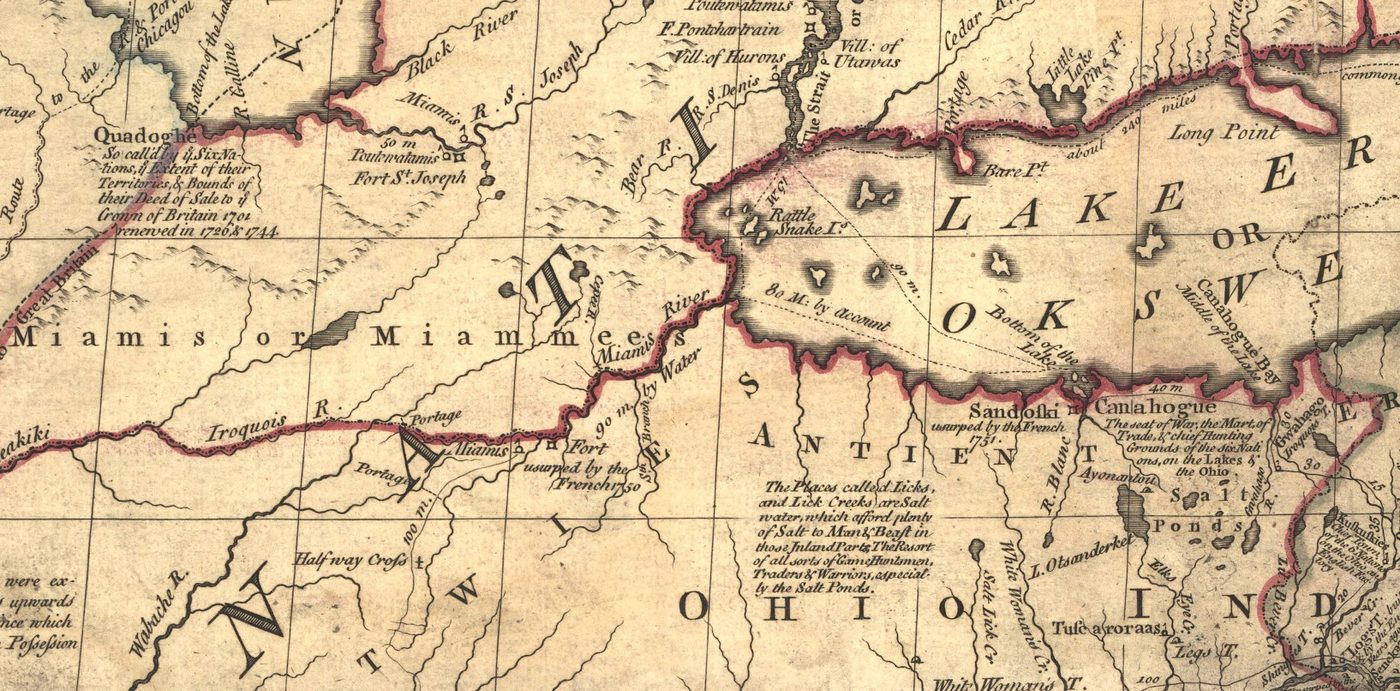
They came wanting exactly what the beaver was, and they never wanted much more than that.
This is the thing to understand about the French, and the thing that made them, of all the comers, the lightest on the ground: they did not want the valley. They wanted what could be carried out of it. A pelt weighs almost nothing; a canoe will hold a fortune in fur and still ride high; and a man who deals in furs needs not a farm but a road — a way in and a way out, and the good will of the people who do the trapping. So the French, when at last they followed the current of that want up the lakes and into the interior, did not come as settlers breaking ground. They came as traders keeping a corridor, and the valley let them keep it the way it let the beaver keep the river, which is to say without much noticing they were there.
The corridor was the whole point, and the river was the best stretch of it. A canoe could come down from Lake Erie, ascend the Maumee to its head, carry a few miles overland to the Wabash, and float on to the Ohio, the Mississippi, and the warm gulf at the bottom of the continent, so that whoever held this one river held the hinge between New France in the north and Louisiana in the south, the door between France’s two Americas. The French strung that door with a light chain of posts, each a trading house with a few soldiers and a flag: one at the head of the river where the Miami kept their great town, another down on the Wabash, a third beyond at Vincennes. Not forts to hold a country. Waystations to move fur. The men who ran them were often not soldiers at all but the coureurs de bois — runners of the woods, unlicensed, half-wild by the lights of Quebec, paddling their loads down out of the interior and living, many of them, more like the nations they traded with than like the king they nominally served.
The anchor of that whole light chain was Detroit, which a Gascon soldier named Cadillac planted on its strait in 1701 to command the narrows between the upper lakes and the lower — the capital of the French west, the door through which everything, this valley included, reached the deep interior. From Detroit the posts ran inland like beads strung on the rivers: the trading house at the head of the Maumee, among the Miami, burned and rebuilt more than once across the French century; Ouiatenon down on the Wabash, where the portage-goods changed hands and the traffic of the two watersheds met and mingled. But not one of these places was a fort in the sense the next century would give the word — a work thrown up to hold a country against an army. They were counting-houses with a flag over the door and a handful of soldiers to lend it dignity, and they held the whole interior only so long as the friendship of the nations allowed them to, and not one hour beyond.
Conjure, for a moment, the strange amphibious world those men made upon the water, for it is very nearly the whole of what France ever built in this country, and it left almost no ruin behind to prove it was here. Twice in the year the great canoes went up and came down — the canot du maître heavy as a loaded wagon and yet light enough for four men to shoulder, driven by crews who paddled from before the dawn to after the dark to the beat of their own songs, forty and fifty strokes to the minute, hour upon hour, and who ran their half-ton loads around every rapids at a trot, because a brigade that dawdled lost the season and the season was the year’s entire fortune. They wintered among the nations. They took wives among them by the custom of the country, and fathered children who were neither one thing nor the other and were at home in both worlds at once. They came in to the great trade fairs at Detroit and at Michilimackinac in the spring painted and greased and feathered, and were scarcely to be told, by a newcomer, from the people they had paddled a thousand miles to buy from. Quebec disapproved of them heartily and could not have held the west a single season without them. They were the actual sinew of the whole enterprise, these runners of the woods, and they held the interior for France not by the fort or the farm or the plow but by kinship and credit and the yearly miracle of the canoe — a grip so light that when at last it slipped, it left behind it, for the digger to turn up two centuries later, hardly more than a scatter of trade silver, a handful of gun-flints, and a wearing-down of names — very nearly all, as it would turn out, that the ground troubles to keep of anyone who ever believes he holds it.
That whole light amphibious world had been a long time reaching this river — a century and better, and the length of a continent — and the thread of it ran back at last to a northern sea the Maumee had never heard of. It began, as so much here did, with a mishearing. In 1534 a Breton pilot named Jacques Cartier felt his way up a great gulf and a greater river in the north, hunting, as they all then were, for a passage clean through the New World to the wealth of Asia; found no passage but found a country; and, asking its people what this place was called and catching the Iroquoian word kanata, which meant only a town, wrote it down for the name of the whole land, and so, by a plain slip of the ear, christened Canada. The same thing would happen again at the far end of this river: the first French act in the New World and very nearly the last were the identical act — a native word for a small particular thing, misheard by a European and swelled on a map into the name of a country. The naming of Canada and the naming of the Maumee are the one mistake, made two hundred years and a thousand miles apart, by men who could not hear the tongue they were writing down.
Cartier found the door; a greater man walked through it. In 1608 Samuel de Champlain raised on a narrows of Cartier’s river the handful of wooden buildings he called the Habitation, and Quebec was born, and New France with it. And in the very next summer he did the thing that set the whole future turning, though no one then could have read it so. Going to war beside the nations who had taken him in — the Huron, the Algonquin, the Montagnais — against their ancient enemies the Iroquois, he came face to face with an Iroquois war party on the lake that bears his name to this day, stepped out ahead of his allies, leveled an arquebus he had loaded with four balls, and with the single shot dropped two of the three enemy chiefs dead in their woven armor and a third man to die after; and the Iroquois, who had never met the thing before, broke and fled. It was a small skirmish and it helped decide a continent. For it wedded the French forever to the Huron and their kin, and earned the French, forever, the undying hatred of the Iroquois — who would go down to the Dutch on the Hudson for guns of their own, and nurse the grudge fifty years, and then, armed and terrible, fall upon the Huron and the Erie and the rest and break them, in the very Beaver Wars this book has already watched come rolling over the valley out of the east. The refugee nations that filled this country, the peoples named a chapter ago, were filling it in part because of a shot one Frenchman fired on a lake in 1609. Champlain’s own later editor allowed that he “has been greatly blamed for thus rousing the fury of the Iroquois.” He had been. He could scarcely have done otherwise, and it scarcely matters now; the ball, once fired, went on traveling, in a manner of speaking, for a hundred years, and came to rest at the last in the burning cornfields of the Maumee.
From Quebec the thread ran west, up the lakes, hauled hand over hand by explorers with the whole continent in their eyes, and the greatest and most doomed of them was La Salle, who meant to seize the entire Mississippi for France from the lakes to the gulf, and very nearly did, and was murdered by his own men in a Texas swamp for his trouble. It was La Salle who built, in 1679, the first ship ever to spread canvas on the upper lakes — the Griffon, a little forty-five-ton barque — loaded her with fur, and sent her back east, and never saw her again: she sailed from an island in Lake Michigan one September evening and went down that night in a storm with every soul aboard, the lakes taking a European ship and a fortune in pelts before they had once been asked to take a fort. It is to La Salle, or to his men, that the valley’s own oldest French tradition points — that in the autumn of 1680 they threw up a small stockade at the very head of this river, where the two streams meet to make the Maumee and the Miami kept their capital: the first French structure, if the tradition holds, ever set on this ground. The tradition hangs, it must be said, by a single thread — one nineteenth-century historian’s report of a private letter — and cannot be proved, and may be wrong. But whether or not La Salle’s men drove those particular posts into that particular bank in that particular fall, the sense of the story is sound: the French came to the head of this river early, and came for the trade, and set themselves down at the one spot the whole interior turned upon almost as soon as they knew that it was there.
And what the canoes carried up the river deserves a plain accounting, because the whole exchange rested on one article. The gun the trade ran on was not the soldier’s musket but a thing built to the customer’s specification — the period inventories of goods “proper for the savages” open with short and light fusils, light because the buyer was a hunter who carried his whole estate in a canoe — and it was, too often, cheap work: the nations complained in the traders’ own hearing that their fusils were “continually bursting and laming them, after they have paid sufficient prices for them.” And the prices were the quiet scandal of the empire. A French memorandum of 1689 set the comparison down in two honest columns: a gun cost an Indian two beavers at English Albany and five at Montreal; eight pounds of powder, one beaver against four; a blanket, one against two — the memo itself concluding that the English undersold the French by better than half. At Detroit the trading company’s powder went out, by Cadillac’s own admission, at four hundred per cent. Here is the fact to hold against everything said so far of the French and the nations: the loyalty was real because it could not have been bought at those prices. The nations knew both price-books to the pelt, and could paddle to Albany any season they chose, and mostly did not — because the French had bound them with the one currency the English never stocked, which was kinship. The gun itself was already doing its deeper work, whichever flag sold it: a band that shot its meat needed powder every winter after, forever, from somebody — the musket replaced skills and then held them hostage, and a trader on the lakes would later write down what that meant, from the mouths of hunters begging ammunition: without it, their families must starve.§ Everything that came after — the shut gate, the King’s storehouses, a fleet on a lake — was a long working-out of that sentence.
Where the trader went, the black robe went with him, and often enough ahead of him. The Jesuit missionaries were the other half of the French adventure, and by any honest weighing of the danger the braver half: unarmed men who walked alone into towns that had every reason under heaven to kill them, learned the hardest tongues on the continent well enough to argue the Trinity in them, and set down, in letters posted home to France year upon year, the fullest record any European kept of the nations of the interior before the flood came in over them, so that a great part of whatever can be known at all of these peoples in their own undiminished strength is known only because a priest who wanted their souls had first to trouble himself to understand their world. Some of them died for it, and died hard, and passed into the Society’s own book as martyrs. Frontenac, who cared a good deal more for the beaver than for the souls of anyone, told the priests to their faces that they thought more of the selling of skins than of the saving of the heathen — which was a slander upon the priests and very nearly a confession about the Governor. But priest and trader and governor were, in the last accounting, the one thin French thread: a few thousand souls flung across half a continent, holding it by wit and friendship and the want of a hat in Paris, and holding it, for a remarkably long while, against every odd that was gathering, unnoticed and enormous, in the east.
They left the valley their tongue, and much of it is still on the land. The great limestone rock standing in the river above the rapids, where the nations held their councils under a spreading elm, they called Roche de Bœuf — buffalo rock. The wooded point on the bay, almost cut off by the water, was Presqu’île — almost an island. The river to the north, thick with wild grapes, was the Rivière aux Raisins, and the little settlement at its mouth was simply Frenchtown. Families like the Navarres of Detroit put down roots at the river’s mouth that would outlast the flag by generations. But the deepest mark the French left in the valley’s speech was not a rock or a settlement. It was the name of the river itself, and the name of the river is the name of a people, worn nearly past knowing by three tongues in succession, which is a small history of the whole conquest folded into the name of a stream.
For the Miami had not always kept the head of this river. They had come to it the long way, out of the west, and by the time they gave the river their name they had already been a wandering people the better part of a century. When the French first found them — three generations before Céloron buried his lead — they were a thousand miles from the Maumee, off in the Wisconsin country, where the black robes Allouez and Dablon came in 1670 to a great palisaded town on the Fox River and found the Miami and the Mascoutin living within the one ring of stakes, better than three thousand souls on a fortified hill. The priests marked them at once as a people apart from their neighbors: a nation with a chief honored, one of them wrote, like a king, whose bearing toward his guests had no savor of the savage, and who was attended, another swore, by a guard of warriors day and night; the men wore their hair in long locks over each ear that Marquette, passing through in 1673, thought uncommonly becoming, and beside whom he reckoned the neighboring tribes mere boors. It was the Iroquois that set them moving. The same Beaver Wars that had emptied this valley fell on the Miami too — town after town alarmed and abandoned and fled — until the whole nation was for a while a refugee huddle under French protection down on the Illinois, thirteen hundred warriors of them, the largest single band in La Salle’s great gathering-place at Starved Rock, come lately from the sources of the Kankakee. And from there, across the next long lifetime, the slow pressure of the wars and the trade and the draw of the emptying east carried them by stages toward the sunrise, until they came at last to rest on the portage at the head of this river — the one crossing the whole interior turned upon — and settled there, and gave, without ever meaning to, their name to the water they had settled beside.
The people who kept the great town at the river’s head called themselves myaamia — a word their own scholars today render, with some dispute among them, as something near to the people of the downstream country. It was their name for themselves long before it was anyone’s name for anything, and because they were the nation the river ran down from, the river became, to everyone else, simply theirs: the Miamis’ river, the water you ascended to reach the Miami. The French, when they came to set it on their charts, did what a writer always does with a word he has only heard and never read — he guessed. He wrote the sound as it struck a French ear and fitted it to a French pen: rivière aux Miamis. But the word would not hold still under the nib. Myaamia opens with a sound that French and English both lack a clean letter for and carries a nasal vowel that neither could quite trap, and so the old maps and the soldiers’ journals became a graveyard of lunges at it — Oumami, Omaumeg, Miamis, Miammee, Aumee, Omee, Maumee — every hand grabbing at the one slippery word and missing it in a slightly different direction, and not one of them wrong, because there was as yet no right spelling for any of them to be wrong against.
You can catch the word in the very act of splitting in two. On the great map John Mitchell drew of this country in 1755 — the map at the head of this chapter, the same map whose lines would later be laid on the table at Paris to cut the boundaries of the new United States — the river is lettered, in one careful engraver’s hand, Miamis or Miammee R. That small or is the whole matter caught in a single stroke: the mapmaker, staring at the word, could not choose between the two forms of it and so cut both into the copper, side by side, the older beside the newer, one name frozen in the middle of turning into another.
What at last drove the two spellings apart and pinned them where they sit was not scholarship but bookkeeping. There were two Miami rivers. The one that ran down through the south of Ohio to the Ohio itself was the Miami of the Ohio; this one, bending north and east to the lake, was the Miami of the Lake — both of them named, and named truly, for the one nation. But a land office and a canal and a county court cannot be run with two important rivers wearing a single name, and so, as the Americans surveyed and platted and finally governed the country, they let the split that was already under way harden into law: the northern river took the worn, spoken, phonetic form for its own — Maumee — for the river and the town and the bay at its mouth, while Miami stayed fastened to the nation itself, and to the southern rivers, and to the very county in Indiana into which the nation would shortly be driven. The same word, halved to keep two rivers straight, so that a man may live today on the Maumee and drive an afternoon south to the Miami and never suspect that he has crossed from one spelling of a single name to the other.
And this is why the fort keeps the older word. Fort Miami stands on the north bank of the Maumee — the Miami upon the Maumee, the ancestor and the descendant of one word set on one bluff — because the fort was christened back when the whole river was still the Miami of the Lake, and a name, once cut into a fort, stops moving. The river went on wearing itself smooth toward Maumee; the fort’s name froze at Miami and has not aged a day since. So on that single low rise above the rapids, where so much of the valley’s blood was still to be spilled, there stand together the two ages of one native word — the form the French guessed at and the form the Americans wore down — and neither the river nor the fort remembers any longer that both of them are only the Miami, saying, in a tongue nobody on that ground now speaks, the people of the downstream country. The land collects names the way its rivers collect silt, and keeps them long after it has forgotten who dropped them, or that they were ever the names of a people at all.
Governor Frontenac, whom valley tradition would later credit with founding the first post here, almost certainly never saw the river; he ruled from Quebec, a man of such arbitrary temper that he once bullied his own intendant into barricading his house against him. But whether he came or not hardly mattered to the ground. A French flag flew over this river, in one form or another, for the better part of a century before an English one did, and in all that time the French barely marked it. They took the fur and left the forest standing. They married into the nations and were absorbed. They asked the land for passage, not possession, and the land, which had drowned a lake and would drown a swamp, scarcely registered so modest a request.
That lightness was also the whole of their weakness.
The French held the interior by alliance because they had no one else to hold it with. When the reckoning came, the arithmetic was merciless: at the outbreak of the last great war for the continent, the British colonies along the seaboard counted some two million people, and all of New France — every farm and post and mission from Louisbourg to the far Saskatchewan — counted perhaps sixty thousand. Thirty to one. No chain of trading posts on a portage could cover a gap like that. What covered it, for as long as anything did, was the friendship of the nations, and the nations were loyal to the French for one reason: the French wanted their fur and not their country. A people that comes to trade is a different visitor than a people that comes to stay, and the nations of the valley knew the difference in their bones.
That difference settled everything, for it is the hinge the whole continent turned on. A fur trade is a business, and a business wants as few hands as it can manage — a thin scatter of traders and soldiers and priests, a few hundred where a few dozen would serve, because every man shipped across an ocean and fed in the wilderness is a cost set against the profit of the pelts. Settlement is the opposite thing altogether. A people that comes to farm comes in families, and families breed, and every child born on the ground is one more body with a claim to it and, in time, a musket to hold it; so that a settling people does not merely arrive, it multiplies, doubling itself every twenty or twenty-five years by the plain arithmetic of a healthy frontier. France, wanting only the fur, sent men and kept them few, and stayed few. Britain, and the Americans after her, wanting the ground itself, sent families and grew, and grew, and grew. Set a business against a nation in a contest that is decided, in the end, by bodies standing on the ground, and the business will lose however brilliant its explorers and however faithful its allies — not because it is beaten in any one battle, but because it is simply and quietly outnumbered a little worse with every passing year. The very gentleness that made the French beloved of the nations, the fact that they wanted the trade and not the country, was the thing that doomed them to lose it. They were too light to keep what they had been clever enough to find. The nations who had welcomed that light hand precisely because it was light would come to see, too late, that they had been sheltering all along beneath the one European power too few in number to defend them from the ones who were coming next.
Be exact about that gentleness, because everything that came after was measured against it. It was real — the nations did not imagine the kindness, and the men who married in and wintered among them and learned the hard tongues were not playing a part. But it was not, at the root, a gift of the French character; it was the shape of what the French wanted. A people that comes for fur needs the trapper alive and friendly and in place, needs the forest standing and the villages full, and deals gently with them for the plainest reason a ledger ever gave — because gentleness, here, was the thing that turned a profit. The embrace Parkman praised was also, at the very same time, a transaction: the one long stretch of this whole story in which the cold arithmetic of a distant account-book happened to come out, for a while, in the nations’ favor. It would not stay that way. The same instrument that made the French kind because kindness paid would, in a heavier hand and a hungrier century, discover that emptying the country paid better. But that reckoning was still a lifetime off. For now the books balanced in tenderness, and the nations, who knew a generous visitor when one came among them, gave the French their loyalty and would spend it to the last.
But the light hand was already, in those last French decades, being forced to close into a fist, because someone else had begun to want the ground itself. The trouble came up the Ohio, out of the British colonies over the mountains, and it came in the shape this country would learn to dread: not an army, at first, but a company and a piece of paper. In 1748 a knot of Virginia gentlemen and London merchants — the Washingtons and the Lees among them — got from the Crown a charter for a thing they named the Ohio Company, and with it a grant of two hundred thousand acres of country beyond the mountains, on the single condition that they seat a hundred families upon it: land they had never seen, in a country full of people, cut into shares and entered in a ledger in Virginia. Mark the date, for it is a kind of birth. Here, in 1748 — seven years before the first shot and forty before the republic — is the earliest appearance in this whole story of the instrument that will, in the end, empty the valley: land made into paper, ground made into shares, a country turned into a line in an account-book by men who proposed to own it from a great distance and to people it with strangers. The armies are still years off. The arithmetic has already arrived.
France read the threat exactly and answered it in the only language it had. In the summer of 1749 the Governor of New France sent a soldier named Céloron de Blainville down the Ohio with two hundred men to make the French claim solid and permanent, and Céloron made it by burying lead. At the mouth of one river after another he interred an engraved plate of lead proclaiming, to whatever future should dig it up, that this country belonged to the King of France; he nailed tin copies of the notice to the trees; he ordered the English traders he met to quit the Ohio country, and got from them nothing but promises. It is one of the strange, sad, telling gestures of the whole imperial age: a European power laying formal claim to a continent by hiding engraved deeds in the dirt — deeds written in a tongue not one soul on that ground could read, asserting a title not one nation living there had ever granted, buried in a soil that had been settled and loved and fought over for a thousand years before France was so much as a word. And Céloron found, at the Miami town of Pickawillany, that the very chief the French had counted their friend had gone over to the cheaper English goods, and that the traders had got there before him, and that his plates of lead were an answer to a question the ground had already decided against him.
He knew it, and said so. He closed the journal of the whole expedition, back at Montreal, with a soldier’s flat verdict on his own errand — that the nations of these countries are very ill-disposed towards the French, and devoted entirely to the English§ — having crossed, on his way home, the long portage to the little French post at the head of the Maumee, and seen there for himself how thin the King’s hold had worn. The buried deeds did him no good and some harm: the nations who watched them go into the ground thought the strange tablets bad medicine, ill luck sunk in the earth, and one plate that never reached its hole was carried off in the end to the English agent Sir William Johnson, who read out its Latin to the Iroquois to show them what France intended by it, so that the very lead cast to claim the country was turned, before it was well cold, into a proof against the hand that had cast it. And from the Maumee post itself its commandant, a man named Raymond, wrote home that same season the barest word anyone set down of what the French century had come to on this ground: My people are leaving me for Detroit. Nobody wants to stay here and have his throat cut.§ Three years more, and the thing the lead could not do was done with the hatchet: a war party came down the Maumee from that very post and fell on Pickawillany and killed the chief the English called Old Britain, and swept the English trade out of the Miami country for a season — not by a buried claim but by the one argument this ground had ever been made to answer.
Two paper claims had now been laid across the one country, the British company’s charter and the French king’s buried lead, and neither of the peoples who drew them up had thought to ask the third, the one that actually lived there, what it made of either. That collision is the thing the muskets came to settle. Within a few years France would throw a chain of real forts down the Ohio to make the lead plates good, and the Ohio Company would send its men to make its charter good, and where the two of them met, at the forks of the Ohio where Pittsburgh stands today, the last and largest of the wars for the continent would open.
And the nations proved their loyalty at the worst possible moment for the British. In 1755, when a British army under Braddock pushed across the mountains to take the French fort at the head of the Ohio and was cut to pieces in the forest, nearly all the Indians of the west — reading, as one chronicler put it, the rising star — went over to the French, and for a season the power of France was supreme in the heart of the continent. The nations of this valley were among them. And they did not forget the choosing. The same peoples who stood with France against Braddock would stand against the Americans for another sixty years, long after the French flag was gone; the alliance outlived the empire that made it. That is the French legacy on this ground that mattered most — not the names on the rocks, but a loyalty that the land would still be paying out in blood two generations later.
But numbers tell in the end. The French era did not end on the Maumee. It ended far away, on a plateau above Quebec called the Plains of Abraham, in a battle the valley never heard, and by the peace that followed in 1763 the entire interior passed, on paper, from one European king to another. On the river nothing changed and everything changed. The same water ran over the same rapids; the same nations laid tobacco on the same rock. But the trading house at the head of the river now flew a different flag, and the people who had come to trade were being replaced by people who had come for something else, and the nations could feel it coming the way the land feels a season turn.
They did not wait to feel it fully. In the very year the peace was signed, before the ink of it was well dry, the nations of the lakes rose against the new masters in the most nearly successful war they would ever wage against a European power, and the man who lit it was an Ottawa war-chief named Pontiac, whose people camped in this valley, and whose speeches would be repeated along this river for a generation. He had grasped a thing the British had not troubled to learn: that the tribes, for all their old divisions, could be made to strike as one. In the spring of 1763 he laid siege to Detroit itself, and up and down the frontier, on a coordinated signal, the western nations fell on the chain of little posts the British had just taken over from the French and swept most of them away in a matter of weeks — fort after fort surprised and carried and burned, from the Maumee country to the far end of Lake Michigan, until for one summer the whole interior seemed on the point of being wrenched back out of English hands altogether.
The paper itself came up the river the following summer, and it came up in the mouth of a Frenchman who was expecting to be hanged. General Bradstreet, having determined to send an officer up the Maumee to take possession of the Illinois country in his Britannic Majesty’s name, told Captain Thomas Morris over dinner that he had a French prisoner in the camp who looked to be executed for treason, that the man spoke all the Indian languages, and that if Morris thought him useful he should have his pardon and go along. Godefroi was sent for, and came into the tent, and turned pale, and went down on his knees; and the General gave him his life and told him to take care of this gentleman. So the King’s claim to the country went up this water in the care of a man his own officers had been about to hang, for no other reason than that he could talk. They set out from the lake on the twenty-sixth of August and lay that night at the mouth of the river, and above the rapids, coming up to the Ottawa village, Morris found himself ringed by six hundred of Pontiac’s warriors with tomahawks in their hands. Pontiac sat down opposite him, Godefroi interpreting, and asked whether he was come to tell lies like the rest of his countrymen, and showed him a letter out of New Orleans promising that a French army had landed in Louisiana and that the French king would drive the English out of the country.
On the twenty-eighth Morris went to the grand council and told them what he had been sent to tell, in the only terms the two kings were known by on this ground: their father, the king of France, had ceded those countries to their brother the king of England. The great Miami chief got to his feet, spoke very loud in his own tongue, and laughed. Godefroi leaned over and whispered that it was lucky the news had been taken with contempt and not with anger, and desired him to say no more and sit down. He sat down, and the chief who had come up the river with him produced his belts and spoke.
It failed in the end, as such risings did, for want of the one ally it had been built to count on. The French, whose cause it was half meant to serve, had made their peace and would not come; and no confederacy of the old kind could keep an army in the field forever without powder and bread. Detroit held. The tide turned. Pontiac’s warriors drifted home to their hunting as the season closed, and the chief was brought at last to submit. But the British had been handed a lesson they would spend the next fifty years failing to learn. The loyalty the French had earned by trading, the British would have to earn all over again, or do without, and they chose, in the main, to do without. The idea Pontiac had reached for, the many nations striking as one, did not die with his rising. It went down into the ground of the valley like a seed, and it would come up again, taller, under Little Turtle, and taller still, and for the last time, under a Shawnee who was not yet born.
The land, for its part, kept no account of which king claimed it. It had held the mastodon and the beaver, the Huron and the Wyandot, and now it had held the French for a hundred years and let them go with the same indifference it had shown when they came. A flag is a small thing to a lakebed. The whole hundred-year contest had been waged to hold a corridor the river had cut, a portage the river had left, a rapids the river had barred — the river had set every term the empires fought on, and taken no side, and flown no flag of its own; and it ran on.
Behind the new flag, wanting not the fur but the fort — and the ground the fort stood on — came the British.
The ConfederacyThe Two Armies
Tyranny, like hell, is not easily conquered.
— Thomas Paine, The American Crisis
The French had wanted the fur. The British wanted the fort, and a fort is a claim on the ground it stands on, which is a different kind of wanting altogether, and the land felt the difference at once.
For thirty years after the flag changed, the change was mostly nominal. The British held the old French posts, took over the old French trade, and let the nations go on living as they had. But a war was coming down out of the east that would make this quiet river the hinge of a continent a second time, and it was the Americans’ war. In 1783, when the American colonies won their independence, the peace that ended that war drew the new nation’s border straight through the Great Lakes and handed everything south of them, this valley included, to the United States. The British posts on American soil were to be given up, the treaty said, with all convenient speed. They were not. From Detroit the British kept the trade, kept the alliances, and kept the nations armed and encouraged in a war of their own against the settlers already spilling over the mountains. For thirteen years the King’s men held forts inside another nation’s country, and the nations of the valley, who had chosen France against Braddock, now chose the British against the Americans, for the same reason as before: the British, whatever else they wanted, did not want their farms.
And the nations fought their own war, which was the truest war the valley ever saw, because it was fought by the people of the valley for the valley itself.
They built the last great confederacy of the old kind — Miami and Shawnee and Delaware and Ottawa and Wyandot and the rest, gathered at Kekionga at the head of the river, bound together under leaders the American histories would spend a century learning to fear: Little Turtle of the Miami and Blue Jacket of the Shawnee foremost among them, and in the war-councils beside them Buckongahelas of the Delaware — at whose town on the Auglaize, between the wars, the ball players had filled the field a hundred to a side and the women had carried the day — Tarhe the Crane of the Wyandot, and old Egushawa of the Ottawa, the last great war-chief of Pontiac’s nation. Blue Jacket went into the field got up half as a British colonel, which was a plain enough statement of where the confederacy believed its muskets, and its backing, came from. Little Turtle’s gift was not new. Ten years before the Americans ever marched, in 1780, a French adventurer named La Balme had come up the Wabash with sixty men, surprised Kekionga, plundered its traders, and sat down to camp near the water as though the taking of the Miami capital were a settled thing, and it was Little Turtle, then a young war-chief, who gathered the warriors and fell on that camp in the dark and left not one of the raiders to carry the story home. He had been keeping the door of the west since before most of the men who would die trying to force it were grown.
Little Turtle — Mihšihkinaahkwa in his own tongue — had been born around 1747 in the Miami country near the head of the river, at or close by the great town of Kekionga that he would give his life to defending, the son of a Miami war-chief. He came up in a world already contracting around him: the French gone, the British careless of him, the American settlers a rumor on the far side of the mountains that grew a little louder with every passing year. Those who met him — and in his later years he went east often — set down a tall, grave, well-made man of an entire self-possession, shrewd and dryly humorous; the French savant Volney sat with him through nine or ten evenings of one Philadelphia winter, taking down his language and the turn of his mind, and came away impressed as by few men he had ever met. Washington judged him worth a portrait and sent him to sit for Gilbert Stuart — and the canvas burned two years after his death, when the British put the Capitol to the torch in 1814, so that the ablest soldier the frontier ever raised has come down to us with no certain face at all, every later likeness a guess at a lost painting.
What he wanted was the plainest thing a man can want and the hardest of all to keep — to hold his people’s country, the door of the west, the crossroads his nation had held for longer than anyone alive could reckon. For that he made himself a soldier the men who fought him rated above any of their own, and for a decade and more he succeeded past anything his enemies had thought possible, breaking the raiders first and then the armies, one after another. But the same clear eye that let him read a field of battle let him read, in time, the larger field, and see the thing the younger warriors could not bear to: that behind every army he destroyed there stood another, and behind that one another still, and behind all of them a nation breeding faster than his own could ever kill. Years afterward, in Philadelphia, he would put that reading into figures of his own, for Volney, who asked why the nations did not multiply as the whites did: a white man gathers from a field a few times bigger than the room they sat in, he answered, bread enough for a whole year, while a deer that will feed a family two days must have a great range of country to grow — they spread like oil on a blanket, he said; we melt like snow before the sun. He had worked the problem down beneath the armies to the ground itself: the difference was not courage and was not muskets but acres per life, and no won battle could move it. The tragedy of Little Turtle is that he was too intelligent to be consoled by his own victories. He saw, sooner and more clearly than anyone around him, exactly where the whole thing was bound to end; and having given his youth to stopping it by war, he would give his last twenty years to softening it by peace, and be called a coward by his own people for the seeing.
That was still years off. For now he was winning: twice, when the young United States sent its armies up to break the confederacy, he did to them what the forest and the swamp had always done to invaders, only faster. The land was the confederacy’s ablest ally in those years, and the land takes no lasting side; it would let these nations go, when their hour came, exactly as it would let go of every comer who reached this valley certain it was his.
And there was a seam inside the confederacy’s own house that the wars to come would tear wide open. Little Turtle had a daughter, Wanangapeth — Sweet Breeze — and she was the wife of a white man. He had been born William Wells on the Pennsylvania frontier and carried off as a boy of twelve from a Kentucky station, and the Miami had raised him up so wholly that the adoption took to the bone: he became a warrior of his adopted nation, and then the great chief’s own son-in-law and his interpreter, at Little Turtle’s side in the councils and, through the winning years, in the field. So the truest war the valley ever saw carried in its very heart a man of the enemy’s own blood who had made himself entirely one of the people — the measure of how thin the line between the two peoples still ran, and of how much blood it would take, before the end, to harden it. That reckoning was still ahead. For now the white Miami stood with his father-in-law, and the door of the west held.
Of the woman between them the record kept almost nothing. Wanangapeth was Little Turtle’s daughter and William Wells’s wife, and she bore him four children who would carry both families forward into the American century; and everything else about her has to be inferred from the men she was attached to. She has no portrait and no reported speech. Her death goes undated in the sources that date her husband’s to the hour. Even the remembering skips her: when a county historian came to write up her daughter’s fine house at Maumee, he set down that Mrs. Wolcott was a daughter of Little Turtle§ — collapsing a generation, promoting the granddaughter, deleting the mother out of her own line; and the family genealogy, coming at it from the other side, gave her eleven words as daughter of Capt. William Wells. Between the two records she appears in neither. She is the seam this whole war ran along, the one person in the story who was both peoples at once and not by adoption or crossing but by birth and marriage together, and she survives in the sources chiefly as a preposition: whose daughter, whose wife, whose mother.
One other kind of record of the town at the head of the river survives, and it was kept in the last winter the place had of its ordinary life. Henry Hay, a young English trader, left Detroit on the ninth of December, 1789 — stopping at the River Raisin on the way up to see his uncle Baptiste Reaume, which is the kind of family an Englishman had in that country — and spent four months at Miamitown keeping a day-by-day journal for nobody but himself. What he set down was not a war capital. The French families of the place went to prayers of a Sunday, morning and evening, in the house of one of the oldest inhabitants, and were collected to it by three boys who ran through the village ringing cow bells, which made, Hay wrote, “as much noise as twenty cows would.” He played the flute and sang; John Kinzie, who would afterward be reckoned the founder of Chicago, played the fiddle; the ladies sang too, all but two of them, and one had a fine voice. They played the midnight mass at Christmas, and the mass on Christmas morning at the people’s particular desire, and left their instruments at the house where prayer was said. They drank tea and coffee about half past four and had a light supper about nine. Two of the traders came to a ball in fine fur caps trimmed with black ostrich feathers, and cockades of white tinsel ribbon, amazingly large. After the third night of dancing in a row Hay woke unable to go on, his feet too swollen for it. And Mrs. Adhemar, who had shown him every politeness, told him that it was very difficult to get clothes and linen washed at that place and begged he would send her his, for her Pawnee woman to do — the town keeping Indian slaves, most of them taken from that nation, and Hay setting it down the way he sets down the weather.
The first came in the autumn of 1790 — General Josiah Harmar, near fourteen hundred men, the most of them raw Kentucky and Pennsylvania militia stiffened with a few companies of regulars, marched up from Fort Washington on the Ohio to burn Kekionga and teach the confederacy its place. He reached the head of the Maumee in the middle of October and found the town cluster empty, the villages of the four nations abandoned ahead of him, and he burned the bark houses and thousands of bushels of standing corn and thought the thing as good as done. But the burning of empty houses is not the winning of a war, and Little Turtle had only stepped back to gather himself.
The country has kept two names for what happened next, and a people generally names a battle for whatever the battle cost it. The Americans called it Harmar’s Defeat, after the man who lost it, as though the whole engagement had been a fault in one officer’s character. The nations who won it called it the Battle of the Pumpkin Fields — for the corn and the squash and the pumpkins that had been left standing when the towns emptied, and that were burning in the bottoms while the fighting went on, and that the winter would be short by. One name remembers a general. The other remembers the food.
For the warriors had not gone far, and when Harmar sent his detachments out to find them they found instead the oldest lesson the country had to give. On the nineteenth of October a column under Colonel John Hardin, some hundred and eighty militia and thirty regulars, was drawn out into the timber after a handful of retreating warriors, and where the trap closed the militia broke and ran almost before the firing had well begun, and left the little knot of regulars to stand and be killed nearly to the last man on ground of the Miami chief’s own choosing. Three days later, on the twenty-second, after Harmar had already declared his work finished and started the army home, word came that the warriors had come back to the burned towns, and he sent a second and heavier force under Major John Wyllys to catch them at the rivers. It was the same lesson taught again and harder. The militia were decoyed off across the fords after a few warriors let themselves be seen, and the regulars were left alone at the crossing of the Maumee, and there the main body of the confederacy fell on them all at once — a hundred and twenty-nine men dead, Wyllys himself and Major Fontaine and a dozen more officers among them, and better than ninety carried off wounded, for perhaps a like number of the warriors. Harmar wrote it up as a victory, counted his dead, and marched what was left of the army back to the Ohio; and he demanded a court-martial to clear his name, which cleared him of everything but the plain fact that he had gone up strong and come down beaten, having accomplished nothing but the announcing of his own weakness.
The second came the next year, and there has never been another like it: no army of the United States, before or since, has been so wholly destroyed by this continent’s first peoples. Arthur St. Clair, governor of the whole Northwest Territory, marched north in the autumn of 1791 with the largest force yet raised for the work — a cold, half-made thing to call an army. Its men had been swept up cheap and late, “collected from the streets and prisons of the cities,”§§ said Harmar, who had seen the whole disaster coming, “hurried out into the enemy’s country” under officers who knew nothing of the business; they went hungry on the contractors’ thin rations — the ration contract lay with William Duer, a Treasury-connected New York speculator who took the government’s advances and did not deliver the goods — went unpaid, sickened, and slipped off into the dark a few more every night the whole slow way north.
It was still black on the morning of the fourth of November, frost stiff on the tents and the men stamping the cold from their feet at the breakfast fires, the parade just dismissed and the women and children of the camp still asleep, when the woods opened. The firing came in from every side at once, low and aimed, and it took the officers first — the epaulettes were what they shot for — and the gun crews at their pieces, so that inside a few minutes the army had no one left to tell it what to do and little to answer with. The militia broke back through the regulars and the regulars broke behind them, until the whole camp was one screaming press of men and horses and bayonets on a half-acre of frozen ground, and it did not let up for three hours. When it was over, better than six hundred lay dead in the leaves — a full quarter of the standing army of the United States, gone in a single morning, on ground Little Turtle had chosen and St. Clair had walked into blind. St. Clair himself, so crippled with gout that his men had had to lift him onto his horse, rode through the whole three hours of it while the army died around him and was not touched — eight balls passed through his coat and his hat, and two horses were shot dead under him — and he carried out of the leaves nothing but his life and the wreck of his name.
It was the Miami chief’s masterpiece, and the republic reeled from it as from a mortal wound. Twice now the United States had marched for this river, and twice it had been broken short of it; and for one bright, narrow season the nations held all the country they had held for a thousand years.
The nations did it twice, and so utterly, by a difference in kind; and that same difference, having won them those two mornings, is what would lose them everything after. The two armies that fought for this valley were not two versions of one thing but two different animals altogether. The nations made war the way the wolf makes war, and had perfected it over a thousand years of making it against each other: a thing of speed and surprise and the utmost economy of life. A war party moved fast and light and unseen, struck where it was not looked for, and melted back into a forest it knew the way a man knows his own house. In a stand-up fight it did not form a line and trade volleys — that was to spend warriors a small nation could never replace — but curled around a column’s flanks in the timber, poured in an aimed fire from cover, and shot, first and above all, at the men giving the orders and the men serving the guns: put out the officers and the artillery and an eighteenth-century army went blind and deaf at once, a great armed body with its head struck off. It was not a mob and it was not luck. It was a discipline of another order than the parade ground’s — every man his own captain, the whole force thinking with a single mind because every mind in it had been raised to the same hunt — and against a column that blundered into the forest tired and hungry and badly led, as Harmar’s had and St. Clair’s had, it was very nearly a law of nature.
The American way of war was the opposite in its every particular, and it was the way of a people who could afford it. It formed lines and kept them; it moved slowly and in the open; it fought by the volley and finished by the bayonet — that long triangular blade fixed to the musket’s muzzle that turned a firearm into a sixteen-inch spear, useless in a skirmish and decisive in a charge, because warriors who could dodge a ball and reload before a soldier could reload could not stand against a disciplined line coming on at a walk with the steel held level, and knew it, and would not try. The bayonet was the American answer to the forest, and even in the wreck of Harmar’s defeat it had shown, in one small savage incident an officer wrote down, how it worked when it worked: a single regular, his musket empty, keeping a ring of warriors off with the bare blade because not one of them cared to close with it. But that way of war wanted, above everything else, patience and supply and numbers — a great slow machine that had to be fed and drilled and fortified, that could not live off the country but had to carry the country with it, and that was worth exactly nothing in the hands of a general in a hurry. Twice the republic had flung that machine north in a hurry, half-built and half-fed, and twice the wolves had taken it to pieces. It would take a general who understood precisely what kind of animal that machine was — and who would not move it one mile faster than it could move and still be a machine — to change the account. The republic was about to find one.
The blow went deeper than a battle on a far river had any right to go. More men died in that one dawn than fell on any single day of the whole Revolution, and Philadelphia reeled. Out of the shock the House did a thing it had never done — named a committee to learn how an army could be so wholly lost, the first congressional inquiry the republic ever held; and when the committee sent for the War Department’s papers, Washington’s cabinet sat down to weigh how much a President must surrender to it, and kept back what they judged the public good required kept, in the first stirring of what a later age would name executive privilege. The conqueror’s own government took two of its lasting shapes that winter, at the far end of a rout a Miami war-chief had planned on a creek most of the Congress could not have found on a map.
And when that first inquiry had done its work, it returned a verdict this book has been circling since its opening page. The committee sat over the wreckage — the muster rolls, the supply returns, the testimony of the men who had run — and when it reported it did not blame the general. St. Clair’s own conduct, it found, had been marked with peculiar ability and zeal in the preparing, and in the three hours of the killing had given strong testimonies of his coolness and intrepidity§; the man who had ridden through the destruction of his army with eight balls through his coat was acquitted of the losing of it. The blame the committee laid, it laid on the supply — on a half-made army sent out too few and too green, and above all on the gross mismanagement of the quartermaster and the contractors, on Hodgdon who did not deliver and on Duer who had taken the government’s advances and not bought the goods. The republic had convened the first investigation in its history to learn how a quarter of its army came to die in the leaves of one November morning, and the answer its own committee handed back was that the army had died less of Little Turtle than of a broken contract — of tents that leaked and powder that damped and horses that starved, of a fortune drawn on the Treasury and spent anywhere but on the men marched north to be killed. It is the villain entered, once, into the official record by the government that would spend the next half-century pretending not to know his name. The Congress, when it had the finding before it, declined to adopt the thing; some verdicts are easier to reach than to sign.
The paper trail behind that verdict survives, and it shows how a contract could kill men without any one man ever standing trial for it. The ration contract had been let, that October, to a New York merchant named Theodosius Fowler, bonded at a hundred thousand dollars, and within ten weeks, before a wagon had rolled, “the contract was wholly transferred from the said Theodosius Fowler, to William Duer,”§ the same speculator already named here, who within the year would trigger the country’s first financial panic. The army that marched out on that reassigned paper carried a chest of seventeen thousand eight hundred and forty dollars and fifty cents, forwarded under a Captain Beatie to the quartermaster Hodgdon — one month’s pay, the committee found, and none of it reaching the men until Hodgdon finally arrived. When he did come, one of St. Clair’s own majors testified under oath, his arrangements were extremely defective, which increased the complaints and disgusts of the army, for “he seemed generally busy, but did nothing”;§ the tents issued that autumn were, in the same sworn testimony, truly infamous, the ends being made of crocus. St. Clair himself, writing to the contractor’s agent before the army had even reached the towns, had already named the disease by its right name: No disappointment should have happened which was in the power of money to prevent; and money could certainly have prevented any here.§ He was right, and it changed nothing; the men went hungry regardless, and no one above a quartermaster was ever made to answer for it.
Duer answered in the end, though not for this, and the other business he was running while the army starved was the same act performed twice. Before ever he held the ration contract he had gone in with a group who took an option on a great tract of the Ohio country, and sent the poet Joel Barlow to Paris to sell it. Barlow sold it. Six hundred French men and women sailed from Havre for a country none of them had seen, each of them carrying a deed — and landed in America to find, in the flat sentence of the historian who afterward went through the partners’ papers, that Duer did not own a single inch of the ground they had bought. That was not the Maumee; it was down on the Ohio, and the town those people finally scraped together out of the wreck of it is called Gallipolis to this day. But it is the identical instrument. On one desk he was selling ground he did not own to people three thousand miles off who could not check him, and on the other he was drawing government advances to feed the army sent to take that kind of ground, and not buying the food. Neither transaction required him to see anybody it fell on. The same historian, who is not unsympathetic, records what became of him: he floundered in the net of his own speculations until the prison cell and death complete§d his gigantic failure. So the ledger did close on William Duer. It closed at the suit of his creditors, who could reach him, and not on account of the men on the Wabash, who could not.
The republic was not the only body that sat down after that dawn to work out what it meant. In the same month, on the banks of this river, the confederated nations held a council of their own on the same question, and a pamphlet printed in Philadelphia the following year says what was said in it. Its standing has to be given first, because it is not certain: the pamphlet purports to be a translation of the minutes, its own editor opens by conceding that some may doubt whether the council ever met, and the library that holds it records a belief that the text was written by Alexander McKee, the British agent among the nations. It is either the nations’ own case, taken down, or an American printer’s reconstruction of it a few months later. What it is not is nothing. By its account the chiefs did what a court does: several having spoken on both sides, two speakers were named for each, and directed not to consult their resentments on§ the one hand nor their doubts on the other, but to be guided solely by the interest and honour of the nations, having due regard to and pity on their women and children. Then an old war chief rose and recited the coming of the white people in order — the party to the south who would be satisfied with nothing but silver and gold; the party on the coast of Carolina; and then Virginia, an artful people, who soon became so numerous as to justify every evil, because they had the means to commit it with§ impunity — the same recital, beginning at the same place, that the Moravian took down from the Lenape and that this book has already set beside the ledger. He asked the council to look east. Do you even see a single town within this immense extent, inhabited by red men? No; you see not§ one.
Then he came to the treaties, and gave the American record its truest name. Of Fort Harmar, the last treaty some of the nations had been invited to, he said they had known perfectly well what would be wanted of them there: more of that pen and ink witch-craft, which they can make to speak things we never intended, or had any idea of, even an hundred years hence, just as they please.§ That is the whole complaint of this book in one phrase, made by the people it was made against, and made before the paper in question had finished doing it. He counted the signers at Fort Harmar too: two Sacs, three or four Potawatomi, as many Chippewa, one Shawnee, gone to look at the treaty although their chiefs had forbidden them, and without any authority whatever from their nations. And he recalled the council six years before at the mouth of the Great Miami, where a Shawnee speaker had answered the commissioners’ claim that beating the English had conveyed the country with it — what you say is not true; you never conquered any of us — refused the hostages demanded of him, refused the land, and told them that unless they came to their senses these rivers must run with blood. Having finished, he offered his belt of wampum, and the commissioners would not take it; so he laid it down on the map of his own country that they had spread out on the table between them, and one of them, a Virginian, knocked it off with his cane. The United States then offered the Shawnee ten days’ provisions of flour, to carry them beyond the immediate reach of the tomahawk of the United States,§ after which they must look to themselves. They did not take the flour. They picked up their tomahawks and left the council fire that night and never came back to it.
And the man who printed all this in Philadelphia in 1792 put an introduction in front of it that could stand as the epigraph to this entire storehouse. Over this people we truly possess many advantages, he wrote. They have no secretary at war — no printing press — no manifestoes to enumerate unparalleled sufferings and injuries they receive — while the offences of a few irritated individuals of their party are engraved on tables of brass, the countless wrongs poured upon that enduring race are scarcely impressed even upon a bed of sand.§ He was writing in the same city, in the same season, as the man selling ground he did not own and not buying the flour. He asked his readers to consider which was likelier: that a people who lived by hunting and possessed a country adequate to all their desires would abandon it in pursuit of plunder, or that they who were forming contracts for millions of acres, and§ in the amplitude of excess still grasped for more, might be suspected of an intention to accept of any pretence to destroy whoever stood in the way. Nobody had to wait two centuries to see what this was. It was legible at the time, in print, on a bookseller’s counter at Second and Chestnut.
A wiser nation, or only a smaller one, might have read those two catastrophes as the plain verdict of the country and made what peace it could. This one could not. The settlers could no more be called back than the tide could — they were over the mountains already by the tens of thousands, squatting on the nations’ land ahead of every treaty, and a republic that could not hold its own people on ground it called its own might not live to see the century out. The money was gone besides: the government had paid its Revolutionary soldiers in paper warrants for western land it did not yet own, so that taking the Indian country was not a thing it could take or leave but a debt of honor and of solvency at once — it needed this ground to pay for the war that had made it. There was shame, which moves nations as surely as it moves men: a quarter of the army lay in the leaves on the Wabash, and no government meaning to be reckoned with in the world could let that be the last word. So it did the one thing that made all the confederacy’s dazzling victories beside the point in the end. It buried its dead, and raised a better army, and made ready to come again, and that, not any failing in the men who had beaten it, is why the winning did not save them.
Before it raised the new army it had tried to buy the peace, and the country had answered the way it answered everything sent up these rivers. In the spring of 1792, with the dead of the Wabash scarcely counted, Washington sent emissaries north under white flags to invite the nations to a treaty, and the nations, flushed with the destruction of St. Clair and in no humor to be bought, killed the men who carried the invitation. Major Alexander Truman was struck down with his servant before he ever reached the towns, on ground that is now Putnam County. The second flag was carried by Colonel John Hardin — the same Hardin whose militia had been cut to pieces in the timber for Harmar two autumns before — sent up a second time, with no gun now but a message of peace, and killed in his sleep by the very escort that had offered to see him safely in. The valley keeps his name on a town yet. He had come to it first with an army and been broken, and come to it again with a flag and been murdered; there was no third way it would let him try.
The purse was tried once more before the sword. In the summer of 1793, with Wayne’s new army drilling behind them, the government sent commissioners north with the heaviest offer it had ever laid before the nations — money, more of it than had ever been put on a council fire, for the country north of the Ohio. The confederacy heard them out, and from its great council at the foot of this river’s rapids sent down an answer that stands in the government’s own records as the clearest thinking anyone committed to paper in the whole long argument. Money, to us, is of no value, the nations wrote, and to most of us unknown; and as no consideration whatever can induce us to sell§ the lands on which we get sustenance for our women and children, they would point out a better use for the sum. The settlers crowding over the Ohio were poor men, or they would never have ventured to live in a country which has been in continual trouble ever since they crossed it. Divide the great sum among them, the council answered — add to it the fortune the government must otherwise spend raising and paying its armies — and pay the poor to go home; there was money enough in it, the council reckoned, to repay every settler for all his labor and his improvements. It was the ledger’s own arithmetic, turned around and handed back across the fire — the one budget ever drafted for this country with no lives in the debit column — and it was written at the foot of the Maumee rapids, on this river, in August of 1793. The government filed it among its state papers, where it survives to this day. The answer it sent came up the river the following August.
The WhirlwindThe Shut Gate
They have sown the wind, and they shall reap the whirlwind.
— Hosea 8:7
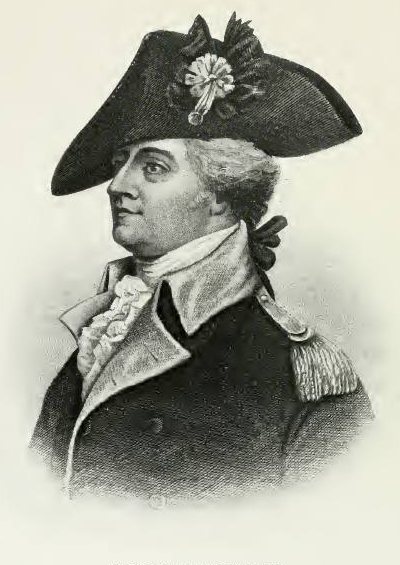
It was into that moment that the British made their gravest promise and their gravest error. Believing the confederacy could keep the valley, and wanting it kept as a barrier between the Americans and their own Canada, they came down from Detroit in the spring of 1794 — on the direct order of the governor of Upper Canada, John Graves Simcoe — and built a fort where they had never dared build one before, deep inside the ground the treaty of 1783 had signed away to the United States. It was a real fort, not a trading-house with a flag: four bastions set to rake the walls between them, a battery laid to command the river, and a dry ditch twenty and twenty-five feet deep dug down into the clay, so that the thing bristled on the north bank at the foot of the rapids, on the very ground the French had quietly traded from a century before, and announced by its every angle that the age of the light hand on the valley was over. They called it Fort Miami, and it was a promise written in log and earth and iron: stand and fight, and the King will stand behind you.
The King did not.
The Americans had learned. After the two disasters they sent, at last, a general who would not be hurried — Anthony Wayne, whom his own men called Mad Anthony, though there was nothing mad in how he came.
Anthony Wayne of Pennsylvania was nothing at all like the patient man who now came up the river. He had made his name in the Revolution as the most headlong fighting general the American cause possessed — a tanner’s grandson with a hot temper and a love of the bayonet, who at Stony Point in the summer of 1779 had stormed a British fortress in the dead of night with unloaded muskets and cold steel only, and who, asked beforehand whether he would undertake so desperate an assault, is supposed to have answered: issue the order, and I will storm Hell. The nickname grew out of that reputation, and it began as an insult — Mad Anthony, the jeer of enemies and of some on his own side who thought him too reckless by half to live long. It was not even his first nickname: the army had called him Dandy Wayne before it called him mad, for the immaculate uniforms and the parade-ground exactness he demanded of everyone including himself — and the two names together are the whole man, the perfectionist and the gambler, waiting for the one campaign that would need both. Then the republic, twice broken and out of other ideas, handed this famously rash soldier the task of taking the country the confederacy had twice defended — and he did the one thing no one who knew him would have wagered a dollar on. He became careful. The maddest general in the army made himself, for this one campaign, the most patient man alive. The nations would find their own name for the thing he was: Che-no-tin, they called him — the Whirlwind.
Where Harmar and St. Clair had blundered north in haste, Wayne spent two full years building an army he called the Legion and drilling it until it could not be surprised. He advanced by inches, throwing up a fort at every stage; and on the very ground where St. Clair’s men had died he built one and named it Fort Recovery, a word with a message in it, and when the confederacy hurled itself against that fort in the summer of 1794 it was thrown back for the first time. Wayne guarded every camp by day and by night so completely that no ambush could find a seam in him.
The man who found that sleepless army its paths through the forest was William Wells — the same white Miami who had fought at Little Turtle’s side through the winning years, red-haired by the tradition his Miami name is said to keep (Apekonit, the wild carrot). He had risen one morning, told his father-in-law plainly that he meant now to fight for the other side, and walked across to scout for Wayne against the people who had raised him.
What stood at the Glaize the word town does not carry, and village is a lie. Two boys taken captive as children left the only written accounts of living there, and between them they describe a river port. Shawnee towns on the east bank of the Auglaize and on the north bank of the Maumee; Snaketown and Occonoxee’s village and a town at Delaware Bend; and on the point itself, where Wayne would presently build his fort, the principal village and the traders’ houses. The chief trader was a Scot named George Ironside, whose wife was the daughter of Cooh-coo-che — an Iroquois woman, a priestess whom the nations consulted before any serious war party went out, widow of a Mohawk war-chief killed at Hardin’s defeat, who had buried her husband a few rods from her own door beside the war path, seated upright and facing west, with his rifle and tomahawk and blanket beside him. Simon Girty was there with his brothers, and British agents, and American prisoners living at large among the houses. Below the towns the bottom land was one unbroken field of corn, and the boy who saw it standing in tassel remembered it, long afterward, as beautiful. This was not a camp in a wilderness. It was the diplomatic and commercial capital of the confederacy, with a merchant class and a resident foreign population, standing at the fork of two rivers.
And Wayne made war on more than the warriors. As the Legion came down the Maumee that last summer it burned its way through the richest native country on the continent — the great town cluster at the Glaize, where the Auglaize comes into the Maumee, and the fields that ran for miles around it. He took that ground without a shot, and the manner of it is the whole difference between this general and the two before him. Wayne had feinted right and left as he came up, striking the Auglaize some forty miles higher some days earlier, and the chiefs had watched the places he meant them to watch. He came into the confluence on the eighth of August 1794 from the direction nobody was guarding. The towns went out ahead of him in what the record calls a good deal of precipitation — people leaving cooking fires and standing corn and going, because the army was already at the fork. Harmar and St. Clair had been ambushed on ground the nations chose. Wayne arrived where he was not expected and made the nations do the leaving. Wayne’s own dispatch, written with the smoke still going up, is half a battle report and half a farmer’s astonishment: he had never before beheld, he set down, such immense fields of corn in any part of America,§ from Canada to Florida, and he burned them, hundreds of acres of standing corn and the vegetable gardens with them, and threw up a fort in the middle of the destruction and named it Fort Defiance, and dared the confederacy and its British backers to come and take it.
The Legion ate what it burned. One of Wayne’s officers kept a daily journal of the campaign, and at the new fort in the first week of September, with the country still smoking around him, he set down the plainest sentence anybody wrote that summer: If it was not for the forage we get from the enemy’s fields, the rations would not be sufficient to keep soul and body together.§§ Three days later the troops drew no flour at all, and he was untroubled by it, because there was still corn in abundance on the river. The army that had come to destroy the nations’ food was living on it, and could not have stayed on that ground a fortnight without it. He counted the fields too, where Wayne’s dispatch had only marveled at them: not less than a thousand acres of corn about the one town, and four or five miles of it to march through coming down.
It was the other half of how the war was won, and the more lasting half. A confederacy could lose a battle and fight again; a people whose winter food stood in black stubble to the horizon could not. The bayonet broke the warriors at Fallen Timbers, but it was the fire in the cornfields that broke the nations — the deliberate turning of an army against the sustenance of women and children, which was the exact thing the confederacy had named, a year before at the council on these same rapids, as the one thing on earth no money could induce it to sell. They would not sell the ground their food grew on. It was burned from under them instead.
And Little Turtle — who had beaten two American armies and knew better than any man alive what he was looking at — watched this one come and drew the conclusion the younger warriors would not. At the general council of the tribes on the nineteenth of August, the day before the battle, he made the argument in full, and it survives close enough to his words to be worth having whole:
We have beaten the enemy twice, under separate commanders. We cannot expect the same good fortune always to attend us. The Americans are now led by a chief who never sleeps. The night and the day are alike to him. During all the time that he has been marching upon our villages, notwithstanding the watchfulness of our young men, we have never been able to surprise him. Think well of it. There is something whispers me it would be prudent to listen to his offers of peace.
It is the most clear-eyed speech in this whole history, and it is a victor’s speech, not a defeated man’s — the one commander on that ground who had beaten the Americans twice was the one arguing that it could not be done a third time. He was reading a difference in kind and asking men who had only ever seen a difference in degree to take his word for it. They would not hear it; they called it the counsel of a man whose nerve had failed, and one of the chiefs derided him openly for it; and Little Turtle, rather than lead men to a slaughter he had foreseen, stepped down from the command and let Blue Jacket take it — the Shawnee war leader who had risen beside him through all the victories, abler in the field than in the council, and readier than the older chief to believe that whatever had broken two American armies would break a third. A captive who saw Blue Jacket in his prime thought him the most noble-looking warrior of any he had met, and set down what he wore: a scarlet officer’s coat laced with gold, epaulets on his shoulders, and a King’s medal on his breast. The man who now commanded the confederacy went into its last battle dressed, in half his person, as a British colonel — the alliance worn as a uniform, the promise worn as a coat. Within the day the men who had sent the coat would shut their gate on the man wearing it.
The end came quickly then, and on ground the land itself had prepared. A few miles above the British fort, a tornado had years before flattened a swath of forest into a vast tangle of fallen trunks, and there the warriors chose to make their stand, Blue Jacket in command now, certain no army could cross such a barrier under fire. But by the custom of the war they had fasted three days to make themselves ready for the battle they believed at hand; and when Wayne held his army back a day, and then another, many of the warriors, faint with the long fasting, slipped away downriver to the British fort for food. So that when he came at last, on the morning of the twentieth of August, 1794, straight into the fallen timber, he came against a line already thinned and light-headed and half unmanned by its own waiting. He split his infantry into two wings and sent them in with the bayonet — two lines of blue-coated regulars, bearskin crests on their round hats and the long triangular blades fixed and level, two years of drill moving them forward as one animal — and they would not stop for the fallen timber or the muskets behind it; and while the foot soldiers drove the warriors out of the tangle at the point of the blade, his mounted men rode wide around the flanks and came down on them with sabers, and that charge finished what the bayonet had begun. In an hour it was over. The Legion had had fewer than forty dead. The confederacy’s own war-chiefs fell in the tangle among their warriors — Egushawa of the Ottawa, the aging successor of Pontiac, shot through the eye and carried living from the field, and Little Otter flung across the back of a white horse and borne off before the sabers could reach him. The confederacy that had broken two American armies was itself broken and running, down the river, toward the fort where the King had promised to stand behind it. The battle took its name from the ground that was supposed to save the nations and did not: Fallen Timbers.
And the beaten warriors ran for the fort the British had built them, down the river with the sabers behind them, straight for the promise in the log and the earth, and the gates were shut. They beat on the timber and called up to the men on the wall, the redcoats they had fought beside and been armed by; and the garrison looked down over the parapet at its allies streaming past under the guns and did not open, and would not fire a shot to cover them, unwilling to start a war with the United States over a battle already lost. It was the truest thing the British ever taught the nations of this valley: that the King would arm them and would not die for them. The gates that stayed shut at Fort Miami broke the confederacy’s heart more surely than the bayonets had, and within the year the nations came to Greenville and signed away the country south and east of a line, keeping the lower Maumee among their reserves — for a while.
What that winter was can be said exactly, because a boy lived it and wrote it down. John Brickell had been carried off at nine and raised in a Delaware family at the Glaize, and when Wayne fired the fields there was nothing left to winter on, so the nations went down the river to the mouth of Swan Creek — perhaps where Toledo now stands, he set down long afterward, not knowing what else to call it — and lived there on British rations, and the British did not half supply us. He watched the alliance die of hunger rather than of battle: the starving and sickly condition of the people and their animals, he wrote, made them very impatient, and they became exasperated at the British. The ground they wintered on is the ground the city stands on now. In the winter after Fallen Timbers the future Toledo was a hunger camp of people whose food had been burned, waiting on a promise that came half-filled.
The garrison was not made of cowards, and the shut gate was no failure of any one man’s nerve. It was policy, worked out long before and far away. To London and to Quebec the nations of this valley were neither friends nor subjects but an instrument — a living wall of armed tribes kept standing between the hungry American republic and the thin British provinces to the north, a buffer that cost Britain almost nothing to keep: some trade goods, some muskets, some warm words at Detroit. A buffer is a thing you are willing to spend and not a thing you are willing to die for; and the hour that holding it meant British blood in the place of Indian, the answer came back the same as it always would, and the answer was to shut the gate. Two days after the battle Wayne went and proved it on them. He burned everything standing within a hundred yards of the fort and every house and cornfield for eight miles below it, and then walked his light infantry along the walls within pistol shot of the guns — expressly, his officer’s journal says, in hopes of drawing a shot from our inveterate but silent enemies. Not one gun fired. He sent in and demanded the surrender of the post as the right of the United States, and was refused, and that was all. The garrison that would not open its gate to the people it had armed would not open fire to answer an army parading under its muzzles: the same silence, spent twice in three days, on the two parties who had each been promised something. The warriors had believed they were fighting beside an ally in a shared cause. They learned, at the shut timber, that they had been all along a line in another empire’s account-book, kept exactly and only as long as they were cheap. It was the first such account opened on this river, and neither the last nor the worst: the same cold instrument, in a heavier hand, would one day write a whole homeland down as real estate.
As for the fort itself, and the flag over it, they did not outlast the shut gate by two years. Even as Wayne broke the confederacy, the two governments were settling in London the very quarrel the nations had been dying in: by the treaty John Jay signed that same year of 1794, Britain agreed at last to give up the western posts it had held on American soil for thirteen years against the peace of 1783 — Detroit and Michilimackinac and the brand-new fort at the rapids among them. And so on the eleventh of July, 1796, the British garrison marched out of Fort Miami for good and an American company marched in, and the log-and-earth promise that had shut its gate on its own allies passed, without a shot fired, into the hands of the nation those allies had been armed and flattered and spent to hold back. The nations had been the whole reason for the fort, the living wall between two empires; and the hour the two empires composed their difference with a stroke of a pen in a European drawing-room, the wall was simply no longer wanted, and the fort changed hands over the heads of the people it had been built among — who were consulted about the transfer exactly as much as they had been consulted about the war that occasioned it, which is to say not at all.
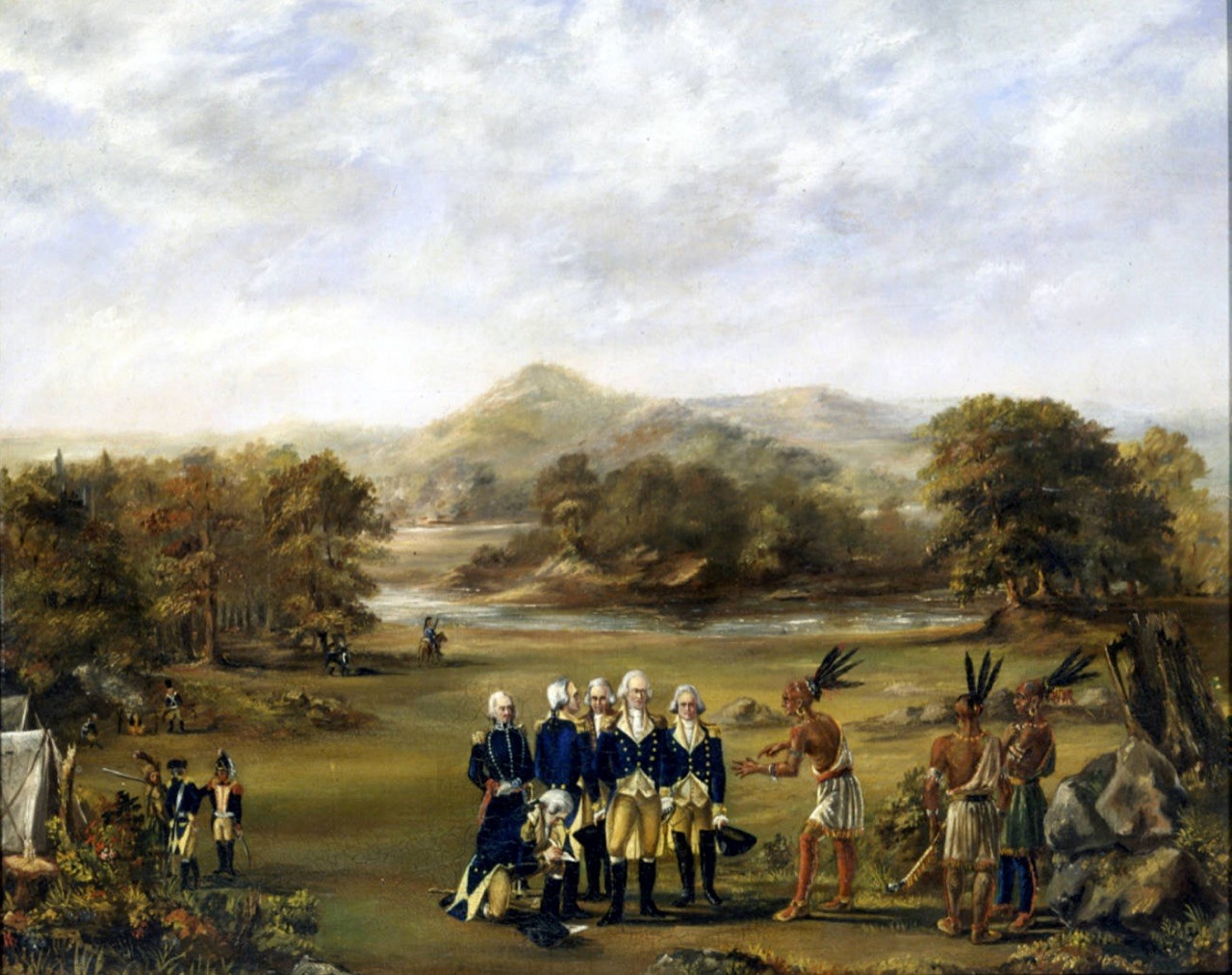
They came to Greenville in the summer of 1795 — the beaten nations, tribe by tribe, more than a thousand of them, Wyandot and Delaware and Shawnee and Miami and Ottawa and Potawatomi and the rest — and sat through the long weeks of council with the general who had at last defeated them, and signed. The line they drew that August gave away the whole southern and eastern two-thirds of the future Ohio, a boundary the nations were to keep to on their side and the Americans, the treaty swore, were never to cross; and within the ceded country the United States reserved to itself a scatter of small squares at the points that mattered — the portage at the head of the Maumee, the mouth of the river, the old crossing places — the seeds, though no man at the council said so aloud, of every fort and town and courthouse to come.
One of those small squares was argued over, and the argument is worth having whole, because the principle a Shawnee would die for eighteen years later was first offered at Greenville by a Miami and refused there. Wayne wanted two miles square at the portage. Little Turtle told him it had never been anyone’s to give: this is a request that our fathers, the French or British, never made us; it was always ours. Then he explained what the place was — the carrying-place had heretofore proved, in a great degree, the subsistence of his younger brothers, and had brought them in the course of one day the amount of a hundred dollars — and made his counter-offer, which was not a price. Let us both own this place, he said, and enjoy in common the advantages it affords.§ He was proposing a commons: not to sell the gate and not to keep it, but to hold it jointly and share what it earned. Wayne’s reply took no notice of it. He observed that he had traced the lines of two old forts at that point, and that it is ever an established rule, among the Europeans, to reserve as much ground around their forts, as their cannon can command. This is a rule as well known as any other fact. So the boundary of the ceded square was the range of the artillery standing in the middle of it, offered as a thing too obvious to argue with; and joint ownership, which is the whole of what Tecumseh would afterward be called a fanatic for demanding, went unanswered at the treaty that ended the first war.
Blue Jacket came in and signed it. The man who had been handed the confederacy at the moment it could no longer be held, who had believed a third army would break like the first two and had commanded the field on the day it did not, conducted himself at Greenville, by the account of the writer who came nearest his life, with moderation. Then he goes quiet. He lived another dozen years or so and died somewhere around 1808, before the Prophet’s town rose and the second war came down the valley; no authenticated likeness of him exists, and the record of his last years is thin enough that even the year is a guess. The Shawnee who is remembered for losing Fallen Timbers had walked into the Glaize in a scarlet officer’s coat laced with gold, with epaulets and a British medal at his breast, and a boy held captive there thought him the most noble-looking warrior he ever saw. What the record kept of him was the hour he lost.
Little Turtle signed among the last of the war-chiefs, and, having signed, kept it. He had told his people the plain truth about the sleepless general and been called a coward for it; and he took the peace he had counseled as gravely as he had taken the war, and never again in his life lifted his hand against the Americans. He went east and sat still for his portrait, took from the Polish exile Kosciuszko — one revolutionary saluting another — a pair of pistols the giver is said to have pressed on him with the charge to fire them on the first man who came to rob his people of their rights, asked of his own accord to be inoculated against the smallpox, and argued to any American who would listen against the whiskey that was doing to his people what no army ever had. On one of those eastern visits the Quakers invited him to remain among them for good, and want for nothing; and the answer he gave — set down by a French savant in the room while Wells turned it into English — is the whole predicament of the man in a handful of plain sentences. He took a long pause first, walking about, as his people’s manners asked of a serious question, and began by granting the comparison without rancor: all things considered, you are better off than we. Then he said, looking down into the market street: Here, I am deaf and dumb. I do not talk your language. When I walk the streets, I see every body busy about something; one makes shoes, another hats, a third sells cloth, and all live by their work. I say to myself, which of these things can I do? Not one. I can make a bow, catch fish, kill deer, and go to war, but none of these things are done here. To stay would be to become an idle piece of furniture, useless to myself, to you, and to my nation. What must be done with useless lumber? I must go back.§ He went back.
He died at Fort Wayne in the summer of 1812, of the gout, on the very ground of the capital he had spent his youth defending, a few weeks before the second war broke over the valley. The disease had a joke folded into it, and he took the joke gravely, as he took everything. At Fort Wayne in the spring of 1804 he was ill — but half well, as he put it himself — and the interpreter told him that the gout was a complaint belonging to great folks and gentlemen. I always thought I was a gentleman,§ Little Turtle said. The word stayed on him. Two generations later the county histories were still handing it to him as a title, the gentleman of his race, while they were calling Tecumseh a zealot and the Prophet a fanatic in the same breath — and the word was doing a job of work: it was the compliment the newcomers paid the chief who had stopped fighting them. Whether in the house the government had built him or in his own lodge in his son-in-law’s yard, the record cannot agree. The ablest mind the country ever raised did not live to see the last of what was coming for it. It may have been a mercy.
One thing he did in those years the record carries backwards nearly everywhere. In September of 1803 Little Turtle and Five Medals of the Potawatomi set their names to a letter to the Quakers of Baltimore — Brothers and friends of our hearts — asking them to send men who could teach the Miami to farm. A Friends’ party under Gerard Hopkins rode out from Maryland the next year, and a man named Philip Dennis stayed to teach practical farming. Where they put him was Little Turtle’s own decision and it says a good deal: not at Kekionga, not at any chief’s town, but off on the Wabash below Huntington at an old boatyard where Wilkinson had once knocked together flatboats — placed deliberately at nobody’s village, lest our younger brothers should be jealous of our taking him to ourselves.§ The man who is always described as the accommodationist was handling, in that one sentence, the exact problem the whole confederacy had broken on: that a thing given to one town is a thing taken from the others. Dennis fenced his ground and worked it. One or two men worked with him; the rest sat on the fence and in the trees and watched him plough, with every appearance of interest and no offer of help. He went home in the autumn discouraged, and it ran a single season and was not taken up. What the Friends had come to teach was how to feed a nation off ninety acres instead of a hunting range, at the invitation of the one man who had done the arithmetic — and to the young men on the fence it must have looked a great deal like being asked to take up the labor of the people who had just taken the country. But the letter is the thing. The accommodation that the next forty years would use against his people was not pressed on him and did not come as a gift he was too beaten to refuse. He had counted the armies, and counted the game going out of the woods, and reasoned his way to the plow the same way he had reasoned his way to the peace; and then he wrote and asked for it, in his own hand, of the gentlest people the Republic had to send. He was not converted. He had done the arithmetic, and the arithmetic said the hunting country was finished.
They buried him in the old orchard by the confluence with everything he had: his ornaments and his implements of war, and a sword General Washington had given him, and a medal with Washington’s face on it, all laid in beside the body under the sod. The muffled drum and the funeral salute were the United States Army’s: he was carried to the ground with full honors by the third army sent against him, having destroyed the first two. Then the town grew over him. When the county historians came to write him up in 1889 they could manage only one flat sentence about the place: the exact spot of his grave is now unknown.
It was found on the Fourth of July, 1912, by two brothers named Lochner who were digging a cellar. They had contracted to build a house on Lawton Place for a physician named Gillie, and the spade went into Indian graves — several of them; the ground turned out to be, in all likelihood, the last Miami burying place at Fort Wayne, and in a few years fourteen skulls came out of that one lot. The brothers had the sense to send their laborers home before the diggings could be pocketed. What told them whose grave they had was the dress sword: Washington’s gift, still in the earth where it had been laid, ten days short of a hundred years to the day since he died. Out with it came a copper kettle and knives and trinkets and a big bottle. The skull was kept out and given to a local dentist. The rest of it scattered into private collections, and the lot became a little memorial park in 1959, and some of what was taken has since come back to Miami hands under the same federal law that is returning the dead of the lower river.
So the greatest soldier this country ever produced went into the ground with his enemy’s sword and his enemy’s portrait, was lost for a century under a growing American city, and came up on Independence Day in a doctor’s basement excavation, to be identified by the sword and parcelled out among collectors, one piece of him going to a man who fixed teeth.
His son-in-law went the same summer, and went harder. William Wells had spent the years after the peace as the American Indian agent at Fort Wayne, living out his strangely divided life on the very ground of both his families, wholly trusted by neither and wanted by both. When the second war came down in 1812 he rode west to the relief of Fort Dearborn, on the Chicago portage, to help bring off its small and stranded garrison — and he rode out of that doomed fort with his face blacked in the Miami manner, the sign of a man who expects to die — dressed, for his last fight, in the customs of the people about to kill him; and there, in the massacre that caught them outside the walls, the man who had belonged to two peoples and in the end to neither was killed by the side he had been born back among — and the warriors who cut him down, honoring the courage of an enemy they had known, are said to have eaten his heart, that they might take some of it into themselves. He and Little Turtle, bound by a daughter and divided by a war, went into the ground within a few weeks of one another, in the one summer, at the raising of the curtain on the last act: the two men who had understood both worlds more deeply than anyone alive, and who found, at the close, that there was no longer any room left in either for a man who understood them both.
Simon Girty kept a refuge of his own down the river from the Glaize, and the two pieces of it carry his name still — Girty’s Point on the Maumee bank about five miles above where Napoleon stands now, and Girty’s Island in the channel off it. Every part of the Northwest was known to him, and the country he chose to be hunted in was the Black Swamp. His cabin stood on the bank; when men who had lost family to him came looking, he crossed to the island, where the wood was thick to the water and pursuit was useless and only put the pursuer in front of his rifle. Part of it was still uncleared in 1888, and the story went round the neighborhood that his ghost was on it.
The victor did not enjoy his conquest much longer, and his going was of a piece with all the rest. Anthony Wayne had done what no American before him could do: he had broken the confederacy in a single hour, thrown up a fort of his own on the very portage the Miami had held for a thousand years and named it, with no false modesty, Fort Wayne, and dictated at Greenville the peace that swung the country open. And then, scarcely a year past the summit of his life, on his way home from the west along the Lake Erie shore, he died — of the gout, of all the undramatic ends for the man who had offered to storm Hell — in a lonely lake blockhouse at Presque Isle on the Pennsylvania shore, and was buried there beneath its flagstaff, at his own asking, far from anyone he loved. The man was gone at fifty-one, almost the instant he had won. But the name would not go. It fastened itself to the ground he had taken and it stayed: to the fort at the head of the river, and to the city that rose around the fort, and to the county — Toledo’s first — that once carried it across the whole northwest, and to a broad road along the old rapids that bears it to this day. Anthony Wayne the man was in this valley for two years and never once came back to it. Anthony Wayne the name is on the green signs yet, and the maps, pointing still at a country he crossed in a single summer and left forever. He had conquered the ground as completely as any man ever did, and the ground did with him precisely what it did with all the others: it let the man go, and kept the name, and grew its gardens over the place where he had stood.
It kept one of his names. The other is on no sign anywhere in the valley. Some months after the battle a party of Potawatomi came up to Fort Wayne and said they had come to see the Wind; and being asked what they meant by it, said that at the battle he was like a hurricane, which drives and tears everything before it. The word at the head of this movement was taken out of Hosea, for what was done on the river. It was also, all along, theirs for the man who did it.
One name in that country came down from before any of it, and the Legion camped on it coming down the river to the battle. The French had called the place Prairie du Masque, from a fancied likeness in the grass-covered bank to the figure of a woman; Henry Hay, going up to Miamitown in the December of 1789, made a large fire there and spelled it Prierie des Maske. The settlers who came in afterward kept the sound of it and let the sense go, and the township in Henry County is Damascus to this day — a French word worn into a Bible word the newcomers had carried in with them.
Wayne was gone, but the army he had built was a school, and it was busy raising the men who would finish what the battle had begun. Among the young officers who drilled and marched and fought through that one campaign were several who would carry the American reach far past this valley. A Virginia lieutenant named William Clark led a company of riflemen on the left at Fallen Timbers; a year later another young Virginian, Meriwether Lewis, came up to the Legion in time for the Greenville council and was posted, that November, to Clark’s own rifle company, and so it was in the army that had just broken the confederacy on this river that the two men who would a decade later walk overland to the Pacific first met and served together. Another of Wayne’s young aides, William Henry Harrison, would come back to this river for the rest of his life and end in the President’s house. The battle made the ground American; the Legion made the Americans, and sent them on to take the rest of the West the same way they had taken this. They went for the oldest reason of all: Jefferson sent Lewis and Clark to find a commercial road to the Pacific and to win the young republic its share of the fur wealth of the far West — the very want that had first drawn the French up into this valley a hundred years before. The beaver was still reaching for the next country; it had only changed the flag of the men it sent.
There is a last irony in the victor’s story that the valley never cut into any plaque, and it runs on the same cold arithmetic as all the rest. All through the campaign — while Wayne drilled his Legion and threw up his forts and broke the confederacy by never once letting down his guard — the second-in-command at his elbow was betraying him. James Wilkinson, the brigadier who had wanted the Legion for himself and been passed over for Wayne, was the whole while a paid agent of the Spanish crown, known in his own ciphered letters only as Number Thirteen; and he spent the war working quietly for its failure, writing anonymous letters to the newspapers and to the men in Congress to blacken Wayne’s name — it is partly to Wilkinson that Wayne owes the Mad that has ridden down the two centuries with him — and leaning on the army’s own contractors to withhold the supplies that might carry the thing through. Wayne caught him at last, when Spanish couriers bearing Wilkinson’s pay were taken and the treason stood plain, and made ready to bring him to account; and then he died, that winter of 1796, before he could. The ground let the honest man go and raised the traitor over him. Wilkinson, undiscovered, rose to be the senior officer of the whole United States Army and carried his treason hidden for years. The gate that shut on the nations in 1794 was worked by a ledger kept far across the water; but the same ledger, it turns out, was keeping its quiet accounts inside the American camp as well, and it preferred there too, as it always preferred, the man who survived to the man who deserved.
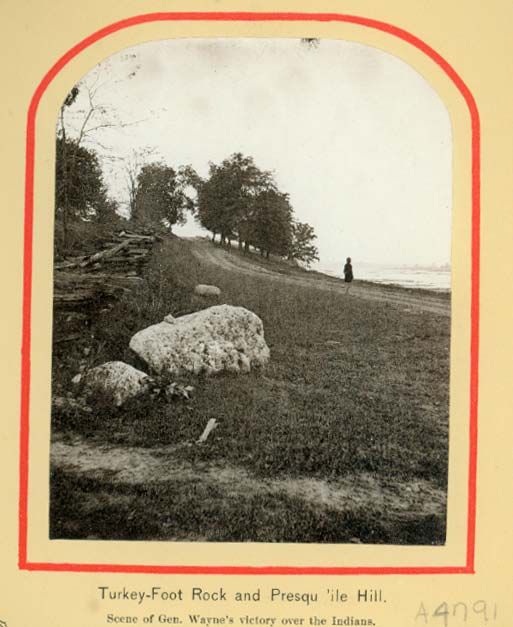
One boulder above the battlefield kept the memory the treaties would not. For a generation after the fighting the warriors who passed that way would lay a little tobacco on the stone and go by without a sound — in single file, one man who saw it wrote, without halting or uttering a word — until the summer the last of them was carried west, and there was no one left on the river who knew what the rock was for.
What the offerings were for is a harder question than the plaques allow, and the answer is the lesson this valley keeps giving on how a thing comes to be named. The earliest account anyone set down of that stone was written by a missionary, Cutting Moody Marsh, wintering over from Detroit among the Ottawa, who noted in his journal in the February of 1830 — thirty-five years after the battle, while men who had stood in it were still alive to ask — a great stone below the hill marked with the print of a turkey, and of rabbits, and of a horse’s foot; and a spirit that had stood upon it in the shape of a turkey during the fighting and was angry with the people afterward, so that they left whiskey and tobacco there whenever they passed. A turkey spirit and three kinds of print. There is no chief in it at all.
The chief arrives twelve years later, and he arrives in a poem. In 1842 a Wood County lawyer named Andrew Coffinberry published The Forest Ranger, a verse tale of the 1794 campaign, and in it brave Masasa was warring still / He stood upon a large rough stone and died upon it — the first appearance anywhere in print of a war-chief killed on that rock, and the source of the name every later teller would take up. Coffinberry was not himself sure of it; he set down that he had embraced the error of such a chief’s existence and been undeceived of it, and then persuaded back again by a friend. Which is to say the story was in dispute in the very year it was printed, by the man who printed it. Then Benson Lossing came through the valley in 1868 for his Pictorial Field-Book of the War of 1812, guided by old Judge Hosmer and by Peter Navarre, and carried Coffinberry’s Masasa out of verse and into standard reference; and when Henry Howe came to write the stone up for his Historical Collections of Ohio, better than ninety years after the battle, he reproduced Coffinberry’s poem very nearly word for word as his authority. The standard account of that boulder, in the standard Ohio reference, is a poem, retyped.
None of which settles what the Ottawa themselves held, and it is not this book’s business to tell them. The trader’s son Dresden Howard — who came to the valley as a boy, went to the mission school, and spoke Ottawa — set down late in his life, in 1888 and again in 1893, a Fallen Timbers account he credited to the Ottawa chief Kin-jo-i-no, who had been in the fighting; and in it Turkey Foot is a great chief of the Ottawas, killed at the rock that bears his name. That is the nations’ own memory, kept by the people whose ground it was, and it stands on its own footing — though it reaches the page the long way round, an old man writing down in his seventies what he had heard as a child from a man who was there. What can be said, and it is narrower, is about the newcomers: that nearly everything the settler record knows of this stone it learned from a poem — written half a century after the fact by a man who doubted it, and hardened into fact by reference works that never went back to check. The valley had spent two hundred years taking the ground and writing down what it pleased about it. Here it did the same thing to a rock, and did it, for once, without meaning any harm at all.
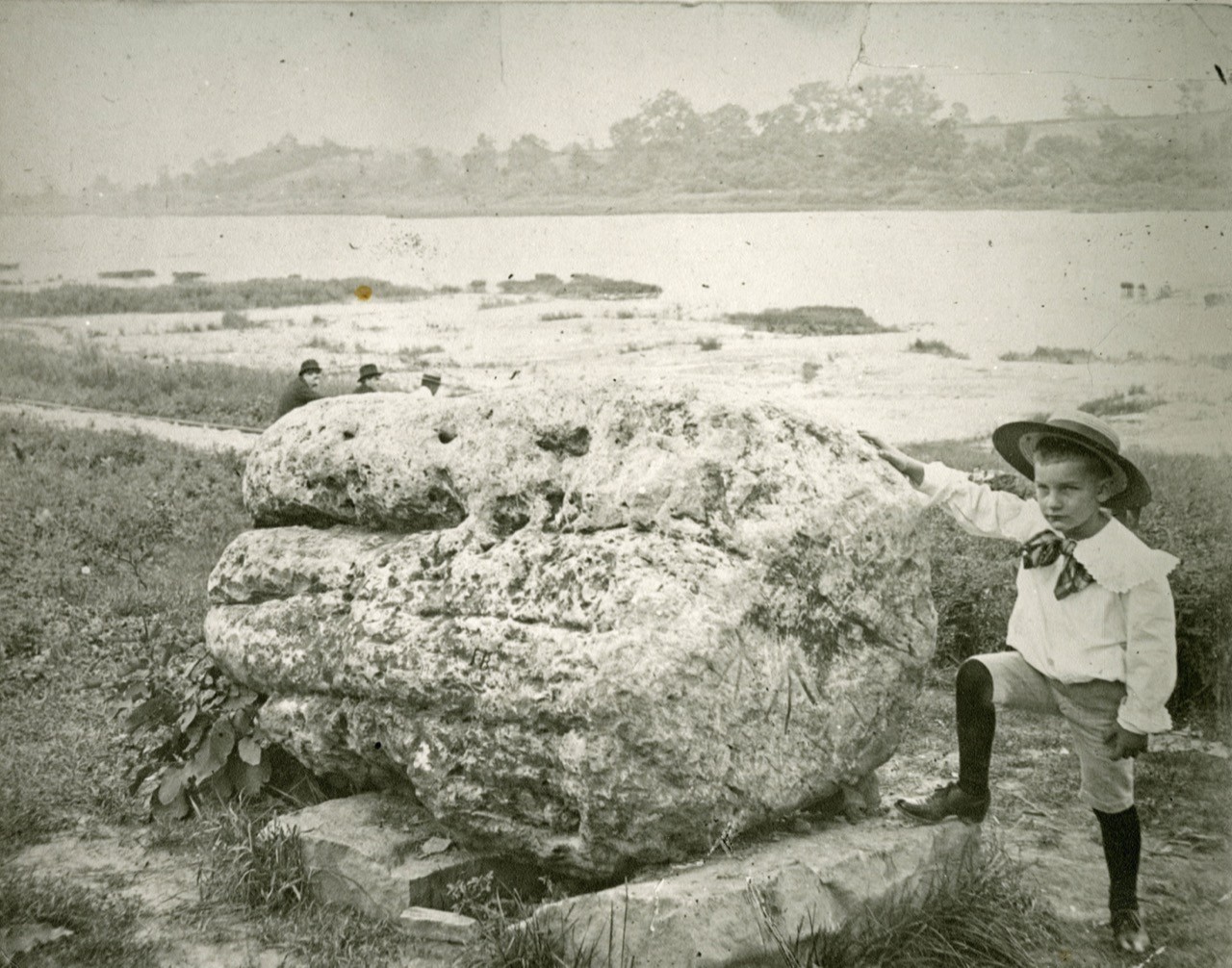
A photograph survives from near the end of that forgetting. A boy stands at the rock in his Sunday clothes — a white blouse, a straw boater, one stockinged leg cocked up on the stone and one small hand laid flat on its worn crown — posed for the camera the way a child is posed beside anything large and old, while behind him the Maumee runs wide and pale to the far trees. He does not know he is standing on a grave; no one has told him, because by then there was no longer anyone left who could. The tobacco days were done. The hollows in the top of the stone had gone back to being only hollows, and the rock a whole people had once passed in silence had become a thing a settler’s son leaned against for a likeness on a summer afternoon. That is what the shut gate finally bought, three generations on — not the rock destroyed, which would have been its own kind of remembering, but the rock made ordinary: a picnic stone above a pretty river, its meaning not denied so much as simply, wholly, no longer known.
The stone did not even keep its place. In time it was lifted off the riverbank and hauled up the hill to stand beside a bronze of the general on his horse — carried to the monument the way everything in the valley was eventually carried to serve the victor’s version — and it has been argued, by those who have gone and measured it, that in the hauling it was set down upside down, and that the turkey’s foot on its face was cut later than anyone supposes, when the rock still stood at the water and drew visitors. Its crown carries initials now, and pentagrams, and the ordinary scratchings of a century of idle hands. And for the better part of a century after it came up the hill, the only names kept at that ground were the army’s, cast on a tablet for the men who had won. Then, on the twentieth of August, 1994, two hundred years to the day after the bayonets came through the fallen timber, a second tablet was set on the hill at last, and it kept the other column of the account. In memory of all the American Indians who gave their lives at this place, it reads, and beneath it the nations named once more as a confederacy: Chippewa, Ottawa, Delaware, Potawatami, Miami, Shawnee, Mingo, Wyandot. It had taken the ledger two hundred years to enter the names it spent that August morning erasing. They are spelled in the conquerors’ English and cast in the metal of the country that shut the gate, and they came two centuries too late for any man who earned them — and they are, even so, the truest thing standing on that hill: that the people the treaties wrote out of the valley were here, and stood on this ground, and have their dead in it yet.
All of that is true but the place, and the country did not find that out for another year. For most of two centuries it had been commemorating the battle in the wrong field. The monument stands on a bluff, and the fighting was long placed on the floodplain below it; and in 1995 — twelve months after the second tablet went up with its at this place already cast in bronze — an archaeologist named G. Michael Pratt walked the higher ground a quarter of a mile north with a metal detector and found the battle there instead, on a plot then slated to be built on. The surveys that followed brought up musket balls, uniform buttons, a bayonet: the engagement itself, lying under a field nobody had thought to mark, while the wreaths were laid a quarter-mile off. The republic had set its bronze on the nearest convenient rise and called that the place — by eye, from a distance, with the confidence of a party that did not expect to be corrected, which is precisely how it had drawn the treaty lines.
What was done about it is the most honest thing in the whole business, and it is shaped like the problem. The Fallen Timbers Battlefield and Fort Miamis National Historic Site, made in 1999, could not be one place, because the things it keeps are not in one: it is three — a hundred and eighty-seven acres of the true battlefield, nine acres of monument lawn a quarter of a mile south of it, and the earthwork of the fort itself over on River Road. And to join the monument to the battle it had been standing in for, they laid a footbridge across the highway that runs between them. The highway is the Anthony Wayne Trail. Two hundred years after the general came through the fallen timber, the country he had won it for had to build a bridge over a road named after him to get from his statue to his battle.
TecumsehThe Common Ground
The hunter still the deer pursues, / The hunter and the deer — a shade!
— Philip Freneau, The Indian Burying Ground
The valley thought the thing was finished. It was not — because the one man who would never sign was still alive: a Shawnee of twenty-six who had fought at Fallen Timbers and lost a brother in it, who had stood close enough to watch the British gates stay shut on the running warriors, and who would refuse for the rest of his life to put his hand to the treaty that gave the country away. His name was Tecumseh, which his people understood to mean a shooting star, or a panther crouched and waiting, and he would spend the nineteen years left to him trying to undo, by the force of one will, what the shut gates and the signed line had done.
He had been born about 1768 on the Mad River, a few miles below where the town of Springfield in Ohio now stands, the fourth of seven children of a father killed in battle before the boy was grown; two of his brothers were the twins, one of whom would take the name Tenskwatawa and become the Prophet, and a third, Sauwaseekau, was the brother he lost in the fallen timber under Wayne.
He was not a large man — compact and hard-built, something under six feet — and by every account that survives he was commanding out of all proportion to his size, with a quickness and a gravity in him that strangers marked before they had heard him say a word. The descriptions that survive read as though they agree, and where that agreement comes from is the whole quarrel of this book: who kept the record. Nearly all of it reaches us through a single volume: a life of him put together by an Ohio writer a generation after his death, out of the recollections of men who had known him — Stephen Ruddell, the white boy raised up alongside him, and the interpreter Anthony Shane. From that book comes the face: black eyes, penetrating, under heavy arched brows; a forehead full and high; an expression uniformly grave and severe. From that same book comes the American officer who stopped his war canoes at a garrison in 1810 and wrote home, no friend to him, that the Shawnee at their head was one of the finest-looking men he had ever seen, straight, large-featured, “a daring, bold looking fellow.” Set down side by side they read as two witnesses agreeing. They are one man’s gathering of witnesses, and some part of the agreement is his. No painting of him taken from life survives, and the familiar engraving in a British uniform is a later invention; the words are the only true portrait there is, and they were written mostly by his enemies, which is its own kind of testimony.
What they remembered longest, once he spoke, was the speaking; but there was more to him than the eloquence, and the more is the reason the story keeps him at its center. From boyhood he had set his face against the one practice that the frontier on both sides took for granted, the torture of prisoners, and he forbade it wherever his voice could reach; he kept himself clear of the whiskey that was unmaking his people; and he held to a plain code of mercy and word-keeping so steadily that even his enemies, who had every reason to blacken him, could find nothing in the private man to blacken, says the one book that gathered them.
Everything he did afterward — the union he built, the massacre he rode into and stopped, the death he went knowingly to meet — was of a piece with the boy on the Mad River who would not watch a captive tortured.
For the better part of a decade he and his brother built a second confederacy, wider than the first — reaching south to the Creeks, north to the lakes, a nation of nations gathered at a town on the Wabash — on a single unbreakable principle: that the land belonged to all the peoples in common, and that no one chief and no one nation could sell what belonged to everyone, any more than they could sell the air or the river. It was, though he would not have named it so, the old idea of the Longhouse, the Iroquois peace, raised again on new ground: many peoples, one fire.
And it was the last time it would ever be tried.
Something very like it had been said in this country once already, and written down. About 1761 or 1762 a Lenape the record calls the Wolf, Neolin, went into a vision; in 1763 Pontiac laid the teaching of it before a council of Ottawa and Potawatomi and Wyandot; and a French colonist at Detroit, who had never heard Neolin himself, set down in French what Pontiac said. It was not translated and printed until 1912. What the vision meant as belief belongs to the peoples whose belief it is. The political part is short: that the land had been made for the people already upon it and not for others, and that they were asked how it came about that they permitted the whites there at all.
Forty-seven years separate that council from Tecumseh’s, and no line of teaching can be traced across them. What can be said is smaller, and it is enough. The ground his argument stood on had been put into words in this country once before, and the valley had seen what became of it: the claim of 1763 was not refused across a table but fought over for a summer, and the fighting settled the matter for that generation. What the country kept of Pontiac afterward was the tactic. The claim underneath it had to be made again from the beginning.
To see what he was attempting, and why it was very nearly impossible, a reader has to grasp the one thing that made the nations both free and fatally easy to divide: they had no kings. Power among them was scattered on purpose, down to the village and the band. A chief led by persuasion and by example and could bind no one who did not choose to follow him; a man who rose in council spoke for himself and his own people and never for the whole. That scattering of authority was the very root of their liberty — no nation of the valley had ever had to fear a tyrant risen from among itself — but it was also the exact seam the Americans had learned to pry apart.
For the whole art of American land-buying had become the art of finding, among the several tribes with a claim to a country, the one small faction that could be flattered or bribed or made drunk enough to make its mark, and then treating that mark as the sale of the entire ground. It was theft laundered into commerce with the stroke of a bribed pen — the paper doing quietly what no army in the field had ever managed, and doing it in a form a man could file away and forget he had ever done. Nation by nation, treaty by treaty, the country was going out from under all of them because no one among them had the standing to refuse on behalf of everyone.
Tecumseh’s whole insight, the single idea he gave the last years of his life to, was that there was one way and one way only to stop it: if the land were declared the common possession of all the nations together, then no lone faction could ever sell it, for the plain reason that no faction owned it to sell. In its cold logic the thing was unanswerable. It had also, and he cannot have known this, already been answered — not by argument but by an administrative decision taken years before he made it. Writing to the Secretary of War in the March of 1814, with Tecumseh five months dead, Harrison set down how the policy had been fixed at the very beginning of Jefferson’s administration: it was at once determined, that the community of interests in the lands amongst the Indian tribes, which seemed to be recognized by the treaty of Greenville, should be objected to; and that each individual§ tribe should be protected in every claim that should appear to be founded in reason and justice. Common ownership was not refuted. It was ruled inadmissible in advance, and separate title substituted for it as a matter of policy — and Harrison, in the next breath, explains what the substitution was for. Tribes with no claim to a tract were nonetheless paid into its treaty, as a measure of policy and liberality, so that they should acknowledge the title of the tribe that had one; and care was taken to leave the title of whatever might be wanted later upon a footing that would facilitate the procuring of them. That is the machinery of the faction-sale, described by the man operating it, in a letter to his own government, as forethought. The argument Tecumseh spent his life on was not lost at Vincennes or on the Wabash. It had been closed in an office before he opened it. It was also a demand that peoples who had never in their history bowed to a common authority should suddenly bow to one now, and do it quickly, inside a few short years, against an enemy that grew stronger with every season, on nothing in the world but the persuasion of a single traveling man, who rode thousands of miles from the Creek towns of the deep south to the cold lakes of the north and back again, arguing, always arguing, that they must make themselves one thing or be swallowed one at a time.
He came astonishingly close, and the Americans did not leave him time enough to cross the last of the distance.
The fire was first lit not by Tecumseh but by that brother. Once a failed and drunken man called Lalawethika, he fell into a trance in 1805, woke transformed, took the name Tenskwatawa — the Open Door — and began to preach a hard return: no whiskey, no white men’s goods, no more selling of land, the old ways or ruin. The trance came on him as he was lighting his pipe; he dropped as though dead, and they had begun the preparations for burying him when he opened his eyes and said, Be not fearful. I have been in the Land of the Blessed. Call the nation together, that I may tell them what I have seen and heard. What he told them was that two beautiful young men had been sent to him by the Great Spirit, who was angry and would destroy them all unless they left off drunkenness and lying and stealing and witchcraft and turned to him; and that he had been taken to a gate that opened into the spirit land, and had not been permitted to go through it. The man who took for his name the Open Door had stood at a shut one. Men are not easily moved by a preacher, but they are moved by a wonder, and the Prophet gave them one.
Having learned, somehow, that an eclipse was coming, he told a doubting crowd he would darken the sun on a day he named; and on the sixteenth of June, 1806, when the noon sky went to twilight and the stars came out at midday, he stood among them and pointed up. “Did I not prophecy truly?” he cried. “Behold! darkness has shrouded the sun!”
After that they came to him. But it is too easy — and the early chroniclers made it easier — to hang the whole movement on the darkened sun and call the rest credulity. The wonder opened the ear; the doctrine held it. What Tenskwatawa preached was a revival in the plain sense of the word, a turning-back and a cleansing: his people were to put away the whiskey that was killing them, and the traders’ goods, and even the dogs and the medicine bags of the old conjuring; to confess, and reform, and take up again the life their fathers had lived before, as he put it, they were debased by their dealings with the whites. It was a religion of refusal, and to a people watching themselves dissolve it answered a hunger no politician could have reached. They came for it in numbers hard to credit — the agent at Fort Wayne reckoned that fifteen hundred passed and repassed his post in a single short season on the road to the Prophet, many of them from the far lakes, while runners with pipe and wampum carried the word nation to nation until half the western country was alight with it. The awakening was Tenskwatawa’s before the confederacy was ever Tecumseh’s; the one brother lit the fire, and only then did the other organize the men it drew. There is no union of nations to tell of without the revival that gathered them first, and Prophetstown on the Wabash swelled to thousands.
And it had blood in it, as revivals of that heat often do. The same power that could turn a people from the bottle could turn a people on itself, and did: those who doubted the Prophet, or stood in his way, or held to the old chiefs’ caution, were named as witches, and the naming could be a death. Among the Delawares an old woman was roasted slowly over four days to give up a charm she did not have, and an old man called Joshua and others went into the fire after her; on the Scioto, in 1810, the aged Wyandot chief Leatherlips was run down and tomahawked on the same charge, a killing Harrison believed was ordered from Tippecanoe itself. It is no service to the Prophet to leave this out. The movement that promised the old happiness back also burned its doubters, and both things were true of it at once.
All of it — the revival and the union both, the fire the one brother lit and the men the other gathered — came at last to rest in one place, and the place was the truest thing Tecumseh ever built. On the Wabash, where a stream the Miami had named for the buffalo fish comes down to join it, the brothers raised in 1808 a town unlike any the country had seen: not a Shawnee town or a Miami town or a Potawatomi town but a town of all of them at once, a deliberate gathering of the nations onto one ground, that the Americans came to call Prophetstown. It was the idea made visible. Men came to it from peoples that had been strangers or open enemies for generations — Shawnee and Kickapoo and Winnebago and Potawatomi and Ojibwe and Ottawa, down from the far cold lakes and up out of the Illinois country — and lived there together in their thousands, three thousand at its height, under the one doctrine and around the one fire, farming the bottoms and drilling for the war that everyone could feel coming. Here was the answer to the no-kings problem in the only form it could ever take: not a king set over the nations, which they would never in this world have borne, but a place they came to of their own will — a center that held because the people chose to be held by it. For a few years Prophetstown was the largest native settlement anywhere in the west and the proof that the thing could be done, that peoples who had never bowed to a common authority could yet make themselves, by consent and a shared refusal, into something very near to one people. Everything Tecumseh believed stood up, for those few years, in log and cornfield on the Wabash, for anyone who cared to come and see it. And everything he believed was standing in a single place — which is the weakness folded into every gathered thing; and the Americans, who could not beat the idea, had only to find the town.
But the confederacy took its mortal wound before the war it was building toward ever arrived. Twice, at Vincennes, Tecumseh had sat down across from the governor of the Indiana country — William Henry Harrison, the same Harrison — and told him to his face that the land sales were void, that no nation could sign away the common ground, that his own union of tribes was nothing but the mirror of the Americans’ union of states. Men who sat in those councils never afterward forgot the manner of him. He carried a familiar and exact knowledge of every treaty ever signed in the west, and took them up one after another and tore them, in the reasoning, to shreds; and the delivery matched the argument — the utterance rapid and vehement, the manner bold and commanding, the gestures quick and violent, and behind the whole of it a face that seemed always to be holding something back, “something more in his mind,” as one hearer set it down, “struggling for utterance, than he deemed it prudent to express.”§
What else that governor was asking for in those years survives on a single sheet of paper. In December of 1802 Harrison called a convention at Vincennes, and the convention sent Congress a petition. It asked for the acquisition of Indian territory and for cheaper land. It asked, in the same document, that the Northwest Ordinance’s prohibition of slavery be suspended for ten years, and that men brought in during those ten years be kept as slaves afterward. One paper, one governor, one request: let us have the country, and let us own people in it. Congress declined the second half, and the territory took it anyway by its own law — an act of 1805 that let an owner carry slaves in for sixty days and then set them under an indenture, which was servitude with the word filed off. By 1810 there were better than six hundred black people in Indiana Territory, a great many of them slaves in everything but the naming, and the governor who was buying the nations’ country by the treaty-table owned some of them himself.
And the ledger of that territory is not a figure of speech. Under those laws, when the tax lists were drawn, bond servants and slaves were entered together among the taxables of personal property — no distinction made, the history of it says, between the status of the one and the other. The same arithmetic that could price three million acres at a fraction of a cent could price a man at all, and it did the two sums in the same book, in the same hand, in the same season. Tecumseh across the table at Vincennes was arguing with a man who had already written down what he thought the country was for. The territory itself turned on him for it in the end — an assembly that scored the laws permitting an indenture that was virtually slavery, and a repeal in 1810 that Harrison let pass, though it freed nobody already bound.
The treaty system running out of that same office had a price, and the councils that follow make little sense without it. Harrison’s own biographer, writing well over a century later and no enemy of the man, put the sum in a single sentence: For none of the land obtained by these treaties was more than one or two cents an acre paid the Indians, although at this time the minimum price accepted by the United States for public land was two dollars an acre.§ A hundred-to-one spread, on the word of a friend. The first of the Fort Wayne treaties, in 1803, pushed the arithmetic further still: it took in something over a million acres on the reasoning that the boundary was already fixed — the nations countered that what had actually been ceded, to the French, generations back, was seven or eight thousand acres, not this — and by that reading of the map, “Not a cent was paid for this land.”§ Getting the chiefs to the council to sign it had a price too, and the government set that one as plainly: the annuities a village lived on through a hard winter were withheld until its chiefs came in for the new treaty, so that, “Faced with the alternatives of attendance or suffering and possible starvation, most of the chiefs capitulated and came to the conference.”§ It was not negotiation so much as its opposite — the answer already settled, and hunger sent to fetch the other side to the table. Nor was the governor above the market he was making. Three years on, a land agent wrote to him about a purchase already closed, two sections of Harrison’s own ground near the post at Fort Wayne, and named the price without a blush: “I paid 25 cents per acre.”§ Twenty-five cents was ten times and more what his own treaties paid the nations for that same country, and an eighth of what the government charged its own citizens for it. The man who would shortly tell Tecumseh across a council fire that land once sold could never be sold again had, in the meantime, sold his own more than once.
One of those councils, in the August of 1810, came within a minute of ending the whole story where it stood. Tecumseh had come down to Vincennes to face Harrison over the Treaty of Fort Wayne — the sale, the year before, of some three million acres by a handful of village chiefs with no right to sell it — and finding the conference laid out with benches on the governor’s portico, he would not sit there, saying the earth was the fitter seat for men who loved to repose on the bosom of their mother; and the talk was carried down onto the grass. He stated his principle plainly, that the land was the common property of all the tribes together and no one faction could sign it away. And he put beside it an argument from the Americans’ own arrangements, which is the one they never answered: that the nations were as naturally one people as the seventeen fires were one people, that they had precisely the same right to come together and form a confederacy that the states had used to form theirs, and that the governor had no more right to suspect the purpose of an Indian confederacy than an Indian had to mistrust the colonial one. The chiefs of the Wyandot and the Kickapoo and the Potawatomi and the Ottawa and the Winnebago rose after him and said in short speeches that they had joined it and made him their common leader and would stand by him. And he made an offer, which is the sentence from that lawn least likely to survive in anybody’s memory of him. He would kill the village chiefs who had made the sale, he said, if the land were not given back, and he was authorized by all the tribes to do it. But: Return those lands, he said, and Tecumtha will be the friend of the Americans. He likes not the English,§ who are continually setting the Indians on the Americans. Three years later he would die in a British coat at the Thames, fighting for the people he had just said he disliked, having been refused the one condition on which he had offered to be the other side’s friend. Harrison rose and gave back the American case entire: that the tribes were not one nation at all, that the Miami owned the Wabash ground and the Shawnee, come lately up from Georgia, had no standing to speak for it — and that if the Great Spirit had meant the red men for one people, He would not have put different tongues in their heads.§ The land, he said, was not the common property of all the tribes but the separable property of the several tribes in possession of particular parts; and he told the chief candidly and firmly that the President would insist upon the separate tribal allotments of the land,§ and that the division would be supported, if necessary, by the sword. There is the whole thing, said out loud on a lawn in 1810, to the face of the man it was aimed at: not a refusal of the argument but a refusal to have it — the ground to be cut into separate parcels because the government had decided it would be, and the cutting to be done with an army if it came to that. The word he used was allotment. And as the interpreter turned those words into Shawnee, Tecumseh came off the grass to his feet and flung them back as lies, and his men rose with him, snatching at the tomahawks and war-clubs they had kept beside them; and the governor came out of his chair and drew the small sword at his hip, an officer at his side bared a dirk, a friendly chief cocked a hidden pistol, and for one held breath on the lawn at Vincennes the two peoples stood a single confused minute from settling the fate of the continent in a scuffle of clubs and steel. Then the guard came up at a run, and no gun went off, and Harrison told the Shawnee to his face that he was a bad man and must leave the town.
But the thing the governor had reached for to break that meeting was truer and falser at once than he knew. He had seized, to prove the nations hopelessly sundered, on the plainest fact about them, that they spoke in many tongues, and made of it his whole argument that they could never be one people nor jointly hold a country. Yet the two nations he had set against each other in that very sentence, the Miami whose ground it was and the Shawnee who rose to defend it, did not speak different tongues in any deep sense at all: they spoke sister languages of one Algonquian stock, near enough to cousins that a careful ear could nearly follow the one across into the other, and the students who a century on would lay the valley’s peoples out on a single family tree were to find that the very diversity of their speech, rightly read, was the surest proof of their common descent. Harrison had grasped, to divide them, the one thing that bound them; and the man across the grass from him had given his life to that binding, and would shortly give his death to it.
And once, walking the camp beside the governor the day after a hard council, he gave Harrison the truest image anyone ever found for what was being done to his people: the endless American buying of the land, he said, was a mighty water risen to overflow his country, and the union of the tribes that he was building was the dam raised to hold that water back. It was, of all the figures he might have reached for, a figure of water — the Shawnee reaching, as men on this river always have, for the river to explain the world.
As for the President far off in his capital who kept on buying the ground, Tecumseh had only contempt: he is so far off, he said, that he will not be injured by the war; he may sit still in his town and drink his wine, while you and I will have to fight it out.
Then, in the autumn of 1811, while Tecumseh was far to the south trying to raise the Creeks, Harrison marched on Prophetstown; and the Prophet, against his brother’s strict order to risk no battle, gave him one — standing safe on a rise, singing a war-song, promising his warriors the American bullets would fall from them harmless. They did not fall harmless. The town burned, the spell broke, and a warrior turned on the Prophet with the plainest verdict a failed faith ever drew: you are a liar, for you told us the white men were dead or crazy, and they were all in their senses and fought like the devil.
When Tecumseh came home from the south, he came home to ashes, and to a confederacy that would never again be whole.
There is a story out of that southern journey that the nations told for long afterward, and it deserves the telling whether or not it fell out precisely as they said. Among the Creeks, who would not rise for him, Tecumseh is remembered to have lost his patience and left them a promise got up as a threat: that when he reached his own country again he would stamp his foot upon the ground, and the earth would shake, and their houses would come down about their ears, and then they would know he had told them the truth. And some weeks later, in the dead of that same winter, the ground did shake. The great earthquakes of New Madrid — the most violent ever known in the recorded history of the country east of the mountains — came rolling up the Mississippi valley, rang church bells a thousand miles off in the steeples of Carolina, threw down chimneys, and turned the great river itself, for one horrible hour, to run backward in its bed; and among the Creeks who felt their cabins fall there were those who remembered the Shawnee’s words and were afraid.
But it came too late to be of any use. The sign, if it was a sign, arrived a month after the town on the Wabash had already burned to the ground, and a portent is poor powder.
The earth had spoken for Tecumseh at last, and spoken to no purpose whatever; and there is something in that — the very land seeming to rouse itself on his behalf, and the rousing altering nothing — that tells as much of the whole story as any battle in it.
The Prophet himself never recovered the authority that Tippecanoe had cost him. He had been a broken man before the vision — Lalawethika, one-eyed and drink-ruined, a boaster his own people had written off — and the awakening remade him, for a few short years, into the most listened-to voice in the western country; and then the single battle he had been ordered not to fight took the authority back and left him discredited among his followers, overshadowed for good by the brother whose one command he had broken. History has been content to leave him there — the drunkard who got lucky with an eclipse and then threw it away — but that is the victors’ shorthand, and it is not quite fair to the ground. Whatever he had been before it and whatever he became after, for a handful of years in the middle he lit a fire across half a continent further than the old prophets had carried it, and further than anyone would carry it again; and the confederacy remembered as his brother’s was raised on the awakening that was his. The organizer got the monuments. The revival that made the organizing possible belonged to the brother history keeps calling a failure — and the record, read plainly, does not quite bear the verdict out.
He lived on a long time in that shadow.
And in the bitterest turn the whole story has to offer, the man who had preached with the sun at his back that the nations must refuse everything the white man brought or be destroyed by it ended his own days doing the white man’s work of destruction: a paid assistant, by the 1820s, to the very Governor Cass whose office was the removal of the tribes, helping to gather his people for the road west, and dying at the last in Kansas, in the exile his brother had spent his life and his death trying to prevent.
Of the two who lit the fire, the one who believed went into the ground a failure twice over, and the one who fought went into it a legend; and the ground made no more of the legend than of the failure.
The War of 1812The Last Stand
Alas for them! their day is o’er, / Their fires are out from shore to shore.
— Charles Sprague
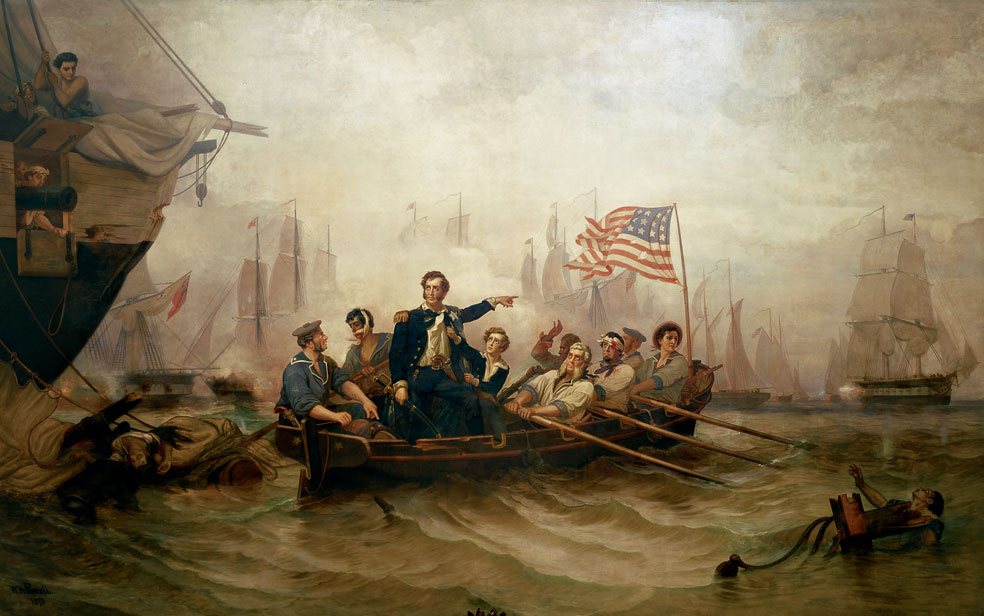
When the British came back — for they did come back, in 1812, in a second war with the Americans — Tecumseh and his confederacy came with them.
That they went with the British at all, after the lesson of the shut gates, asks a hard question, and the answer is the bleakest kind of arithmetic. Tecumseh had no illusions left about the King; he had watched those gates stay shut with his own eyes, and before the end he would tell Proctor to his face exactly what he thought a British promise was worth. But a man fighting for the survival of his people does not get to choose his allies from among the faithful. He chooses from among those that exist. And in all the world there was exactly one power large enough to stand between the nations and the American flood, and it was Britain — calculating, faithless, glad to spend native lives and loath to spend its own, but there, and armed, and already at war with the same enemy. To refuse the British was to face the United States alone, which was to lose for a certainty. To take the British was to face the United States with a treacherous friend at one’s back, which was to lose, most likely. Tecumseh, who could count as clearly as any man living, chose the most likely over the certain. It was not a hopeful choice and he did not make it in hope; he made it because it was the only course left that was not simple surrender, and he had sworn long before that whatever else he did, he would never surrender the common ground. A people with its back to the wall does not weigh the good against the bad. It weighs the bad against the worse, and takes the bad, and calls it — for want of a truer word — a chance.
Not everyone in the nations chose as he did, and the other choice has a document. It is a payroll. On the twentieth of July, 1813 — the day before Proctor came back up the river for his second try at Fort Meigs — the American army in this valley opened a roll under the column heads Names of persons, Time of entering, Of what nation, Daily Compensation, Horses, Chief, and over the following month it entered something over a hundred men on it. Wyandot, Delaware, Seneca, Mohawk, Shawnee. Long House and Between the Legs and Bloody Eyes; Civil John and Wiping Stick and Running About; Blue Eyed Boy, Spike Horn, Four Fingers, Tall Moon, Turn the Smoke, Parting the Earth, Go Through the Ground, Twelve O’Clock; Captain Pipe of the Delaware; Captain Lewis and Captain John, who brought the Shawnee names in on the second of August; and one Wyandot enrolled under the name George Washington. A chief drew a dollar and a half a day. A man who came with a horse drew a dollar. A man who came without one drew fifty cents. Against seven of the Seneca names the clerk has written on parole — men who were on that list because they had already been taken in arms — and against one man, with no further remark, quit the service.
That page is the whole difficulty of Tecumseh’s life set out in six columns. The nations he was asking to act as one people were being offered, one man at a time, a dollar a day and the winning side; and the offer came in the same arrangement of name and number this valley used for a wolf’s scalp and would shortly use for a British cannonball. It is no charge against the men whose names are on it, who had families to feed in a country at war and no better prospect on offer anywhere. It is a charge against the arithmetic. A claim held in common can only be defended in common, and the ledger has never in its life had to buy more than a few.
And for one more turning of the season the valley was again the theatre of a continental war. It went hard from the first, and for a season it went hard the other way.
In the first summer of that war the valley’s own chief did the thing no council of nations had managed in twenty years of trying: he took a fort, and a whole American army with it, and never fired a serious shot to do it. When the war opened, an aging general named Hull crossed from Detroit into Canada, lost his nerve, and drew back into his own works, and Tecumseh, with a few hundred warriors, and the young British general Brock, with a few hundred redcoats, set out between them to make Hull believe he was surrounded by thousands. Tecumseh marched his men out of the woods across a gap and back into the woods and around and out across the gap again, the same warriors passing the same opening three times over, until Hull’s watchers counted an army where there was a war-party; Brock sent in under a flag a note hinting, with elaborate regret, that once the fighting began he might not be able to answer for what the Indians did; and Hull — an old man who had seen the massacres of the last war and now saw his own daughter and grandchildren inside the fort with him — ran up a white flag over Detroit and surrendered the place, twenty-five hundred men, and with them the whole American northwest, without a battle worth the name. The British general and the Shawnee chief had taken each other’s measure in a glance and liked what they saw; the story goes that Brock unwound the sash from his own waist and gave it to Tecumseh, and that Tecumseh, honored by it, would not wear the thing over an older chief he judged more deserving, and passed it on — a plain grace between the two men that the powers standing behind each of them never learned to extend to the other’s people. It was the high-water mark of everything Tecumseh had built with his life. For a few weeks in the late summer of 1812 the confederacy and its red-coated allies held the entire frontier from the lakes to the Wabash, and it seemed, to men who did not know how thin on the ground the warriors truly were, as though the whole American flood might yet be turned back at the mountains after all. It was the last time it would ever seem so.
That autumn a warning reached the American camp from a source the general who received it never fully learned. Peter Navarre — a French scout of the river’s mouth, guiding for the British that season the way a man of the valley did when the choice was to guide for somebody or for nobody — had gone up the Maumee with a column moving to reinforce the warriors against General Winchester, and at Turkey Foot, the story he told long afterward has it, he slipped away from his own escort and rode hard for the American lines, arriving, by his own account, “some hours before they came in sight”§ — then doubled back and rejoined the British column before he was missed. Winchester had no force to spare for a fight he had not chosen, and dressed his lines to show more men than he had; the British, reading a strength that was not there, drew off toward Malden without firing a shot. Navarre told it as an old man, decades on, and the valley never troubled to check it against anyone else’s memory; but it is exactly the kind of thing this ground bred in the men who knew both of its sides at once. A warning that worked once, that autumn, would not come again.
What the tide came back in on was an army that had spent the autumn dying. Winchester’s wing lay in camp on the Maumee six miles below the mouth of the Auglaize, having crossed the river for firewood and then moved twice more looking for ground that was dry. By the first of November it was sickly. Typhus went through the tents; three and four men died in a day; upwards of three hundred were on the sick list at a time. By December there was no prospect of advancing anywhere and they were set to building huts to winter in. Many of them had no shoes. From the tenth of that month to the twenty-second there was no flour in the camp at all, and poor beef and hickory roots were the whole of what an American army ate on this river.
None of that was anybody’s doing in the room. The road that was supposed to feed them ran back south-west to Loramie’s, and a man who marched it wrote that it was one continued swamp, knee-deep to the packhorses and up to the hubs of the wagons;§ in places the empty wagons could not be got through at all, and were left standing in the mire while the drivers counted it a good day to bring the horses out alive. A convoy that tried the water instead was frozen in, offered its men extra wages to cut a channel through the ice, made one mile in two days, and gave it up; they built sleds at the last and hauled their own flour into Fort Wayne by hand.
So the men who marched to the River Raisin marched hungry, and what was sent after them did not arrive. A snowstorm had already cost twelve days on the road between Defiance and Upper Sandusky, so that Harrison learned where Winchester was going long after he had gone. Winchester wrote that a thousand men would let him hold the ground he had taken, and the reinforcement then on its way would have made him stronger than that; it was held up a day by a swamp on the road, and got within fifteen miles of the river before it met the people coming the other way.
For the tide came back in, as tides do. In the deep cold of January the Americans pushed an army down to the River Raisin, to the old French town the traders had called Frenchtown, and there they were surprised at dawn and broken; and the wounded who could not march were killed in the snow by the victors’ allies while the British looked on, so that Remember the Raisin became the cry that carried the rest of the war like a wound that would not close. And there was a bitter accident in the name itself. The Raisin was the Rivière aux Raisins, the river of grapes — the French had named it, gently, for the wild vines that hung thick along its banks — so that the softest name they ever set on the valley’s water became, in American mouths, the byword for its cruelest morning and the cry of a nation’s revenge. Of all the pretty French words the newcomers took over and wore smooth, that was the one they wore into a scream.
One of the men who got out left his own plain account of the morning, in his own hand, decades on. Peter Navarre and his brothers Robert and James had fought at the Raisin on the eighteenth, in the fight that went the Americans’ way; four days later, when Winchester’s whole army broke, the three of them ran for it dressed as Indians rather than be taken, crossed the frozen lake on foot near the river’s mouth, and struck through the woods by a roundabout way to reach their parents at Presque Isle on the bay. “Not relishing the idea of being scalped and tomahawked,”§ he wrote, “and being, moreover, good runners, we succeeded in making our escape unhurt.” The next day the brothers turned around and carried the news the other way, south to Harrison’s camp on the Portage River, and it was that same errand, the telling of what had happened at the Raisin, that put Harrison’s army on the ground at the foot of the rapids where a new fort was begun within days of hearing it.
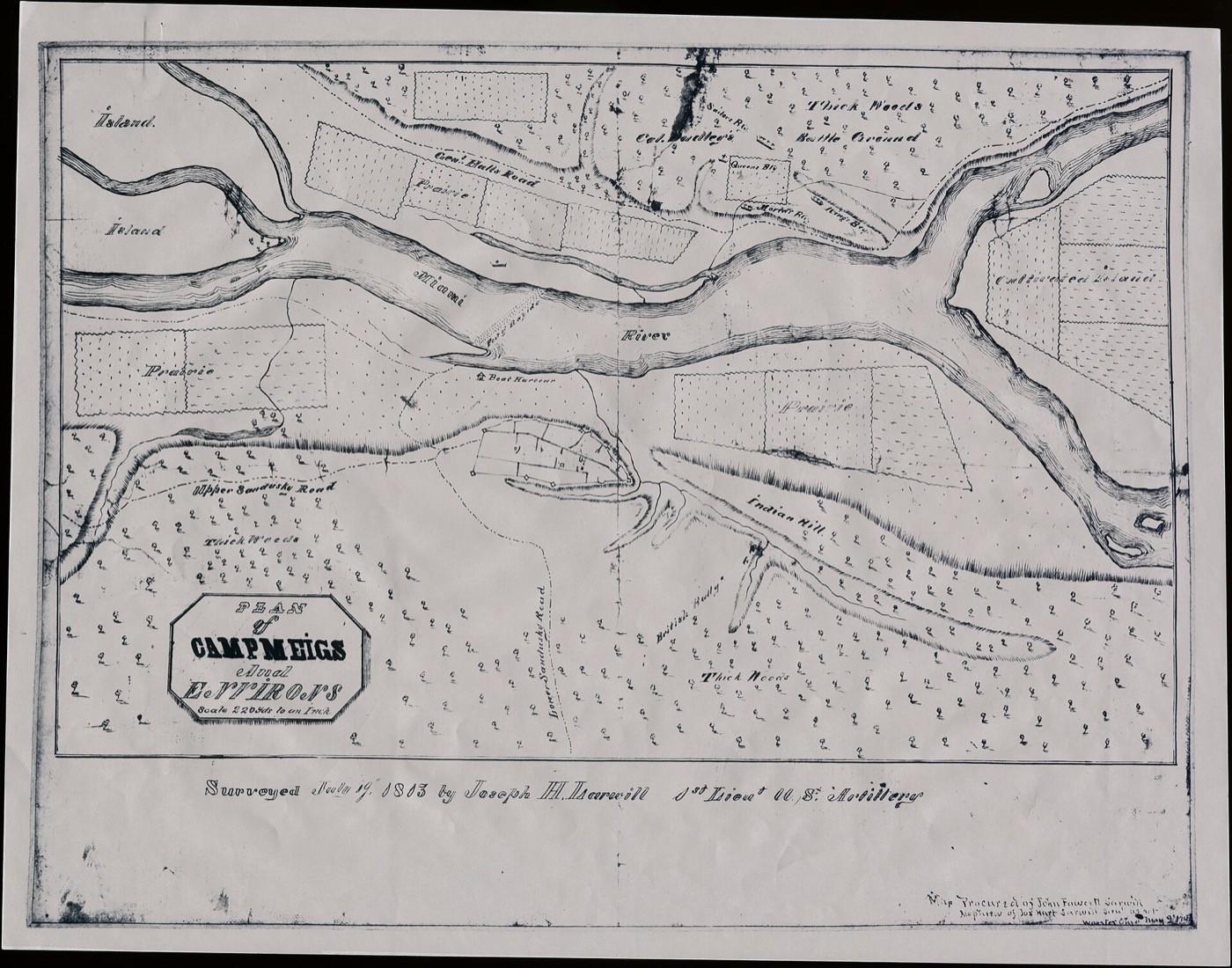
For the war in the Northwest was, before it was a war between two armies, a war against the ground — and the ground was the swamp. Everything an army needed to do in this country it had to do across the Great Black Swamp, and the swamp did to the armies of 1812 exactly what it had done to everything since the ice: it drowned them, and sickened them, and slowed them to a crawl. Hull had reached Detroit at the war’s opening only by hacking a road through the western edge of it — a corduroy of logs laid over the muck that his men cursed the whole length of, and that is sinking into the same ground yet. The supplies that were meant to feed the American war came up out of Ohio through the same morass, a mile a day when the rains were on, the wagons to the axle and the oxen to the belly and the powder wet and the men shaking with the ague that rose off the standing water; more soldiers in that northwestern war went down to the fever and the flux than to any warrior’s musket. What that cost a single body is on the record too, from a boy who paid it. Two days after Christmas of 1812, with the army’s horses starved to death and the baggage going on the men’s backs, a nineteen-year-old Kentucky volunteer named Leslie Combs was sent out from the rapids on foot to find Harrison, a hundred miles off through country with no road in it. The snow began the next morning and fell two days and nights without stopping, and by the third day it lay above his knees. He carried a musket, a blanket and four days’ provisions. Several nights he and his guide camped in the swamp and could find nowhere to lie down and rest, even on the snow, and sat upright until daylight with a little fire of dead brush at their feet. The four days’ food was gone on the sixth day. They walked three days and nights more on slippery elm bark and nothing else, and came into Fort McArthur after dark on the ninth evening with his feet frost-bitten and his arms stiffened with a rheumatism he still had forty years later. And the reason he arrived at all was that the man walking in front of him had been fifteen years a captive among the nations of this country as a boy, and could read a hundred miles of drowned forest in a snowstorm without a path or a compass to help him. The American army’s winter word got through the Black Swamp on an education the nations had given a stolen child. And in a drowned country the one thing worth an army’s blood was dry ground — a firm rise a man could stand on and build on and fight on — and there was no better dry ground in the whole lower valley than the high bank at the foot of the rapids, seventy feet up out of the wet, commanding the one place the river could be crossed and the one place the boats had to stop. That is why the whole weight of the war came down, in the end, on those few acres: not because a general chose them but because the swamp chose them, leaving the armies of two empires the same handful of firm ground it had already left the mound-builders and the nations and the French. The rapids gathered the war because, in a country bent on becoming a lake again, they were very nearly the only ground solid enough to hold it.
So it came down, as everything in this valley eventually came down, to those rapids, and to two forts that faced each other there across the water and across nineteen years. On the north bank stood the old one: Fort Miami, the fort the British had built in 1794 and shut the gates of, evacuated once and now, in 1813, reoccupied by the very army come back to try again. And on the high south bank, on a bluff seventy feet above the river, the Americans threw up the new one — a great stockade of fifteen-foot pickets and earthen traverses, nine acres of it, the largest wooden fort ever raised on the continent, and named it Fort Meigs, for the sitting governor of Ohio, Return Jonathan Meigs, who was keeping the whole campaign alive with Ohio militia and Ohio supplies. The general who built it was William Henry Harrison, who as a boy of twenty-one had drawn the battle plan for Wayne at Fallen Timbers a mile upstream, and who had come back now to finish, against Tecumseh, the war he had helped begin against Tecumseh’s teachers. The old British fort of the shut gates and the new American fort of the second war stood in plain sight of one another, a river between them, and the whole tragedy of one spring day in 1813 was played out in the space that separated them.
Late in April, Proctor and Tecumseh came up and laid Fort Meigs under siege, planting their batteries on the north bank by the old fort and throwing shot at the traverses for days. The garrison ran short of iron for its own guns and hit on a way to buy it back: it offered a gill of whiskey for every British ball brought in whole and “of a size to fit their guns,” as the bounty order ran — for the two empires’ artillery answered to the same calibers, so that the King’s shot fit the republic’s cannon as neatly as if the quarrel had been arranged by a single foundry — and soldiers hunted the mud outside the stockade by night, carried the balls to the keeper of the magazine, drank their gill, and fired the King’s own metal back across the river at the men who had sent it. Upstream, at the fort on the mouth of the Auglaize, the same iron finished differently. When Fort Winchester was given up, the garrison threw its ammunition and its bombshells and its cannonballs into the river; the settlers who came afterward fished them out and piled them on the bank at Defiance, and anybody who wanted one took one, and the rest lay about being kicked, in the county’s own words, as things of no value and matters of idle curiosity. A ball was worth precisely one gill of whiskey in the May of 1813 and worth nothing at all a few years later, on the same river, out of the same guns. Nothing about the iron had changed. Only the war had ended, and the ledger had moved on to other columns. On the worst days the shot came in by the hundred, and one volunteer took it on himself to stand up on the embankment and call each round aloud as it came, so the men below could drop clear of its path — until a ball came straight down his own line of sight, and he stood a moment silent and perplexed, and was swept into eternity where he stood. And on the fifth of May the relief came down the river — Kentuckians, eight hundred of them under a Colonel Dudley, in flatboats — not regulars but volunteers in fringed hunting shirts of linsey and buckskin, their own long rifles across their knees, men bred to obey no officer a step farther than they agreed with him — with orders as narrow as they were plain: land on the north bank, take the British batteries, spike the guns, and come straight back. The first half went like a dream. Dudley’s men swarmed the batteries and drove off the gunners and hammered their spikes home into the touchholes, and for one bright hour the thing was a triumph. Then the war-whoop went up in the woods behind them, and no order on earth could hold a Kentuckian who had heard it. Against every instruction they plunged into the forest after the warriors — and the forest closed around them, and the triumph became a trap. Cut off from the boats and the river, surrounded, they were taken, some six hundred of them, and marched down the bank to the old fort. To Fort Miami. To the same ground whose gates had stayed shut on the beaten warriors nineteen years before.
There the gates opened, and the horror began. The prisoners were stripped and made to run a gauntlet between two long lines of warriors armed with tomahawks and clubs and ramrods, and were beaten and shot and killed as they ran, near forty of them dead in the running of it before they even reached the gate; and inside the old fort the killing went on, methodically, under the eyes of the British officers who had promised the prisoners protection and now did nothing.
The books that named this ground never troubled to say what those two lines of men were. That ceremony was not invented for Dudley’s Kentuckians. Running between the lines was the oldest doorway these nations had, and for generations it had opened the other way: it was the first act of an adoption, the gate a captive passed through on the way to being washed in the river and dressed new and given the name of somebody’s dead son. It was how a grieving family was made whole again. The man the confederacy had carried in its own heart nineteen years before — William Wells, taken off a Kentucky station at twelve and raised a Miami to the bone — had come into this country through that door, and so had the Quaker child carried off the Susquehanna, and so had every white Shawnee and white Miami the valley ever held. What happened at the foot of the rapids that May was that same rite with the adoption taken out of it: a doorway into a people, used by men who had been left nothing to take anybody into, in a war that had made a son of nobody. The ledger had spent twenty years teaching this country that the nations were a cost and never a credit, and here was the arithmetic come all the way home — the ceremony that had once made a Kentucky boy into a Miami now used to beat Kentucky boys to death against a wall the King would not open. And then a horse came at a gallop.
It was Tecumseh. He had heard, miles off, what was being done in his name, and he rode in among the killers and threw two of them to the ground with his own hands and stood over the prisoners and dared the hundreds around him to strike another — I conquer to save, he is remembered to have said, and you to murder — and the killing stopped, because he had stopped it. The numbers give the act its measure, in the ledger’s own terms: by the time he came the killers had murdered near forty of the prisoners, and inside the walls stood some six hundred more who expected — we all expected, one of them would write as an old man — to be massacred where they stood. Forty dead against six hundred spared: the space between those two figures is the exact size of what one man did in that hour, and it is the one entry in this valley’s whole long account that was written against the arithmetic instead of by it. Then he went looking for Proctor, and found him, and asked the British general to his face why he had not put an end to it; and when Proctor answered that his Indians could not be commanded, Tecumseh told him what he was. Begone, the books have always had him answer. You are unfit to command. Go and put on petticoats.§ The valley had watched the British shut the gates on their own allies in 1794. Now it watched a British general stand by while helpless prisoners were butchered under his flag — and watched a Shawnee chief ride in and do, alone, the plain human thing that every officer of the King had failed to do.
Yet the ground does not bear his name. Walk the rapids today and the disaster is marked, in the books and on the plaques, as Dudley’s Defeat — fixed forever to the Kentucky colonel who blundered his men into the woods and died there, and not to the Shawnee who rode in and stopped the killing over their bodies. That is no accident of the record; it is the record doing precisely what it was always going to do. The memory of this valley was written, in the end, by the people who took it, and a people writes its disasters in its own hand and files them under its own dead. The settlers remembered the gauntlet as a wound — a thing done to them, one more Raisin to be avenged — and named the ground for the man it was done to. The mercy they kept only in private hands, because a mercy from the other side is a debt, and the ledger of this country, from the shut gate of 1794 to the last treaty still to come, kept no column for it. So even here, at the single hour when a native hand did the plainly human thing that no officer of the King would do, the book closed the way it always closed: it set down the white loss, left the native grace out of the name, and handed us a battlefield named for the man who lost it and silent about the man who redeemed it.
There is a last turn to the naming, and it comes from across the river the fight was named for. The far bank kept the day too, and kept it otherwise. To the British regulars who did the fighting on that shore — the 41st Foot, drawn up on the north bank with Proctor — the fifth of May was neither a massacre nor a colonel’s blunder but a day worth commemorating: the Battle of the Miami, after the old French name of the Maumee, the Miami of the Lake; and the 41st earned a battle honour for it, so that its descendant regiment, the Royal Welsh, carries the single word Miami on its colours to this day. Canada kept it as well, granting in our own century the honour Maumee — borne now by The Essex and Kent Scottish, of the Ontario counties just across the lake, and by the Royal Newfoundland Regiment, whose forebears had stood on that same north bank. So the valley’s own name rides two foreign armies’ flags yet, carried twice over as an honour — while on the ground where the thing was done it stays a wound, named for a dead colonel.
Three flags wrote that one day into their books under three different names — the Americans as Dudley’s Defeat, the British as Miami, the Canadians as Maumee — and across all three records, kept by the descendants of very nearly everyone who fought there, not one of the three names the man who rode in among the killers and stopped the killing. The mercy belonged to no nation, and no nation’s ledger kept it. It was kept instead by particular men, and on more than one side.
One of the British eyewitnesses — an officer of that same 41st Foot, on the ground that day — set it down long afterward that a British escort had been marching the prisoners down to the boats for safety when the warriors who had taken no part in the fighting fell upon them, and that an old soldier of the regiment named Russell was shot through the heart in the very act of wrenching an American captive out of his killer’s grip; forty of the prisoners, by that witness’s reckoning, were already dead before Tecumseh reached the spot. There was a third, and he carried the third flag. On the walk down to the fort the prisoners were stripped as they went, and one of Dudley’s captains had already lost his hat, his coat, his money, his penknife and his pocket comb when a warrior who found nothing left to take began handling him roughly; and a Canadian non-commissioned officer, a man the captain knew only by his uniform, stepped in between them and was killed for it. A Shawnee war-chief, a British private and a Canadian corporal, each spending or hazarding his life for men his own side had given up, and the ledgers of three nations with not a line to spare for any of the three. Of the three, the Canadian did not even come down to us with a name. The men who owed it their lives kept it themselves. The captain he died over was Leslie Combs of Kentucky, and the river had already tried him once that week: four nights before, he had come down these same rapids at the flood in a canoe with five men, carrying Green Clay’s dispatches to the besieged fort, lying flat on his face in the bow to read the deep channel by the glisten of the breakers in the starlight amid a roar of water that nearly deafened them, and had been shot out of the river a mile short of the walls and got away into the woods on hickory buds and creek water. Then he came back down with Dudley and was taken on the same ground he had already escaped. Fifty-eight years after the gauntlet he set it down in his own hand for a Toledo historian: that Tecumseh never allowed a prisoner to be massacred if he could prevent it; that at Fort Miami he saved the lives of all of us who had survived running the gauntlet§; and that he was satisfied the man had deserved every word of praise his enemies ever spoke of him. What the empires would not enter in their books, the prisoners carried out of the valley in their memories, and were still setting down as old men. Combs left one more detail, offered as nothing more than the plain next fact in an old soldier’s account: that he and the other survivors were “sent down to the fleet at the mouth of Swan Creek, (now Toledo),”§ and paroled across the lake at Huron. The mouth of Swan Creek is the middle of downtown Toledo today. Twenty years before there was a city on that ground, the war had already used it as the door the living went out by.
There was a third mercy that spring, and it was asked of a man in the worst hour of his life. Camped along the siege lines was Metoss, head chief of the Sacs, brought east out of the Mississippi country by the trader Robert Dickson — a tall man, and by the account of the British officer who watched him, one in whom the wrongs done his people were never far from mind. He had taken an American prisoner in the skirmishing along the river and kept him bound in his own wigwam. Then his son came out with him to the ambush ground, a boy of about thirteen who had begged to come and would not be talked out of it; and the glasses in the fort found the two of them in the timber, and the guns answered with grape, and the boy was killed where he lay.
What the father moved to do then was not lawlessness. It was the law, and it was the same law the two lines of men at the gate belonged to. A death in a family was a debt, and a captive was how such a debt got paid. Metoss took up the body and carried it down to his canoe and crossed back over the water to his wigwam, meaning to kill the man he had bound there and send him after his son.
Dickson heard of it in time, and met him on the path, and begged him off, and told him — because in that hour it was the only argument left to make — that the King would hear of the refusal with sorrow. Metoss had already torn off the head-dress he wore into battle. He stood a while, and then he gave it up. He went into the wigwam where the boy was lying and cut the cords off the American with his own knife, and took him by the hand and led him out and put him into Dickson’s keeping with the only sentence he had left: You tell me that my Great Father wishes it§ — take him. And then he wept like a child in front of all of them. He painted himself black afterward, and it was many months before anyone saw him smile. They buried the boy the next day with the honors of the British army, a lieutenant marching the funeral party up to the wigwam, and laid him out in the manner of his own people, with his little rifle beside him, and powder and ball, and food for the journey.
So on one river, in one spring, two men were handed the arithmetic and handed it back: a war chief who rode into a gauntlet and stopped it with his voice, and a father who held every right this country recognized to take a life for a life and did not take it. Neither entry stands in any ledger of the three empires that were spending this valley. The officer who set the second one down said outright why he was doing it — to redeem, as he had it, a grossly maligned character — and then in the very next breath called another nation the most degenerate of its race. The record will credit a people in one line and damn them in the next, and never once total the column.
And even as the gauntlet ran, the war was turning under them. Proctor’s siege of Fort Meigs had already failed once; he came back in July and failed again, his warriors staging a sham battle in the woods to lure the garrison out to a rescue that never came, and the garrison, wiser than the Kentuckians had been, declining the bait; and when he gave up the rapids at last and threw his whole force downriver against a little stockade on the Sandusky called Fort Stephenson, a twenty-one-year-old major named Croghan held it against him with a hundred and sixty men and a single old six-pounder the garrison had christened Betsy. Summoned to surrender or be massacred, Croghan sent back the word that if the British carried the place there would be nobody left inside it to surrender to them, and made the boast good, and broke the assault at the ditch with fearful slaughter.
The officer who led that storming party had promised a Toledo boy a souvenir. John Hunt, fifteen years old and living at Detroit on the British side of the war, boarded with a schoolmaster who also boarded Colonel Short of the 41st; and on the morning the force went down to the boats Short rose from the breakfast table, buckling on his sword belt, and said to him: Well, Yankee, I am going to fight your people, and I will bring you a scalp.§ The boy told him he had better take care, he might lose his own. At Fort Stephenson, Short got across the ditch and up onto the earthwork, waved his sword over his head and called to his men to advance and give the damned Yankees no quarter, and a ball took him in the forehead and he fell back into the ditch dead. His second, Major Muir, came into the Detroit store where Hunt was working a few days later, threw himself down across the counter and pulled off his cap to show the boy the hole a ball had cut through it: he had lain in that ditch playing dead until nightfall and then crawled out to the boats. Hunt was an old man in Toledo when he told it, and he had been careful to remember what he had said at the table. After Fort Stephenson the British and their allies never took another thing on this frontier. The high summer of Detroit was a year gone, and everything since had run the other way.
The lake was taken by a man of twenty-eight who had first to build the fleet that took it. Oliver Hazard Perry came of a Rhode Island naval family — his father a sea-captain before him — and he had gone to sea as a midshipman at thirteen. In the spring of 1813 the Navy sent him to a raw little harbor at Presque Isle, on the Pennsylvania shore, to make a fleet where there was none. He did not make it himself. The man who had told Washington that a squadron could be got out of a shore with no shipyard on it was a lake master mariner named Daniel Dobbins, who held a sailing master’s warrant and no commission at all, and who was sent back to do the thing he had proposed: to fell the standing timber of the lakeshore and build, out of the green forest itself, the ships that would decide who owned the inland seas. That is the part of Lake Erie that decided Lake Erie, and it was done by carpenters four hundred miles from the water it settled.
The race was run by tradesmen, and each side counted the other’s. The Navy sent fifty ship carpenters out from Philadelphia, and they were four weeks on the road and had still not arrived; the twenty-five who came on with the shipwright Noah Brown made the same journey in a fortnight, and it was Brown’s men who got the hulls up. Nothing, Perry’s biographer observed afterward, would have been easier that winter than for the enemy to come over and burn the vessels on the stocks — the whole campaign stood for months on the chance that nobody would. The enemy was doing the very same thing on his own shore. Prisoners taken at the River Raisin came in with word that seventy ship carpenters had been met on the road to Malden; Harrison sent it on to the War Department, and added the phrase that says what kind of war this had become out on the water — that the British were building against Perry that same winter, in harbors of which we know nothing. Two armies lay in the mud of the Maumee that spring, watching each other’s forts and counting each other’s guns. Four hundred miles away, the question that would decide which of them mattered was who had the more men that could cut a plank true, and how fast those men could walk.
Perry worked them over the bar, and on the tenth of September stood out with them among a cluster of islands at the western end of the lake to find the British squadron that had ruled that water since the war began. What he did there was the plainest kind of courage. His flagship the Lawrence — named for the dead captain James Lawrence, whose last words, Don’t give up the ship§, Perry had stitched onto a blue battle flag and flown at the mast — was shot to wreckage under him, four-fifths of her people killed or hurt, until she could not answer with a single gun; and Perry, rather than haul down that flag, had himself rowed a half-mile through the whole weight of the British fire to the Niagara, the consort that had hung unaccountably back out of the worst of it, took command of her clean and unhurt, drove her straight through the enemy’s line, and inside fifteen minutes had the entire British squadron — the first time in the history of the world that a whole British squadron struck its colors — surrendered to a man of twenty-eight on a lake that two years before had held no navy at all. He wrote the word of it to Harrison on the back of an old letter, laid against his navy cap. Everyone remembers the first sentence: We have met the enemy, and they are ours.§ Hardly anyone quotes the second, which is the one that carries the freight — Two ships, two brigs, one schooner, and one sloop. It is an inventory. That was the point of the afternoon: not glory but a list — six hulls, the whole British force on the lake, moved from one column into the other. The most famous sentence ever written on this water is a cargo manifest.
The manifest is honest about what was taken. It says nothing about the odds, and the American telling of this battle said nothing about them for the better part of a century.
They were set out at last in 1882, by a twenty-three-year-old writing his first book, who would be President of the United States inside twenty years. Theodore Roosevelt went at Lake Erie the way a clerk goes at a disputed account, and found that Perry’s nine vessels threw eight hundred and ninety-six pounds of iron at a broadside against Barclay’s four hundred and fifty-nine: nearly three to two in the weight of the long guns, and better than two to one in the carronades. The Americans, he concluded, were very greatly superior in force. Then he named the trick that had kept it out of sight, and the naming is worth more than the arithmetic. The American accounts, he wrote, sedulously conceal the comparative weight of metal, while carefully specifying the number of guns.§ Barclay had thirty-five long guns to Perry’s fifteen. Count the barrels and the British squadron looks the stronger. Weigh the shot and it is outgunned two to one. For a hundred years the barrels had been counted.
There is one detail in his reckoning that belongs in this book more than the sums do. When Roosevelt needed to know what Perry’s guns actually were, he took the figures from Barclay — the beaten man’s own return of his conqueror’s armament — on the ground that it was the most accurate account in existence and, where it erred, erred by understating the force that had destroyed him.
And why Barclay came out at all is the other half of it, and the half this valley should recognize on sight. He knew what lay across the water. He put out from Amherstburg on the ninth of September, in Roosevelt’s flat phrase, so short of provisions that he felt compelled to risk an action with the superior force opposed.§ The commissary that had failed the army in the mud of the Maumee had failed the other side too, in its own way and on its own shore; and a one-armed captain took a starving squadron out to fight a fleet he could not beat, because the alternative was to lie at anchor and watch his men go hungry. The battle that decided the lake was forced by a supply line, like nearly everything else in this war.
None of it takes anything from the afternoon, and it is not set down to. Weight of metal does not row a man half a mile through gunfire in an open boat, and the Lawrence was shot to wreckage with four-fifths of her people down before Perry ever left her. What the numbers correct is not the man but the telling. The victory was real, and decisive, and also the likely result on paper — and the century that came after preferred to call it a miracle, which required only that nobody weigh anything.
There is one figure in the tables that is not about the guns at all, and it belongs to this valley more than any of the others. Roosevelt could not fix the crews exactly and says so plainly, which is the honest part: four different numbers were in circulation for Perry’s men, and he works from the prize-money list in the American State Papers to five hundred and thirty-two. Of those, on the morning of the battle, Perry reported a hundred and sixteen unfit for duty. Lieutenant Yarnall testified two years afterward that the Lawrence carried into the action but a hundred and thirty-one men and boys of every description, and that of those only about a hundred and three were fit to work her. A fifth of the fleet that took Lake Erie could not stand to its post, and they had not been shot; they were sick, on the same lake shore that had been shaking men to pieces with the ague since the first Frenchman wintered there and would go on doing it until the ditches were cut. The sickness that thinned the armies in the mud on both banks of the Maumee was aboard the ships as well. It is in every account of this war if you look for it, and in none of the paintings.
And there was a grace in the winning that the hard courage of it had not led anyone to look for. The British commodore he had beaten, Robert Barclay, was a one-armed veteran of Trafalgar — he had left the arm in Nelson’s own great victory — and on Lake Erie he had been shot through both the thigh and the shoulder and carried below, every commander and every second of his squadron down beside him; and Perry, the battle scarcely cold, had himself rowed across to the wrecked Detroit to sit with the ruined man, gave him back his sword, advanced him money out of his own purse, and pledged his own word for the beaten enemy’s parole. The victor and the vanquished of that afternoon went out of it friends, and stayed friends for the rest of their lives. It is a small thing beside the killing, and set down here for exactly that reason: a few miles off, on the gauntlet ground, the same war had shown how cruel men could be to the helpless; here on the water it showed that the thing could run the other way as well, and that a man could break another utterly at two o’clock in the afternoon and be a brother to him by four. It ran that way once more, a month later and on dry land, and that time for somebody who had never been anybody’s enemy at all. When the fleet had finished its work Perry could not be kept aboard it: the gunboats went as far up the Thames as their draught allowed, and he left them there and volunteered as an aide to Harrison and rode in the pursuit that ended the war in the northwest, so that the two American names this valley would end up hanging on its towns were side by side on horseback in the beech woods on the morning Tecumseh was killed. A little above the battlefield stood a mission village of Christian Delawares under Moravian care, which the army occupied that night and burned when it left; and among the people fleeing out of it were the wives and children of the 41st Foot — the same regiment that had stood on the north bank at old Fort Miami in May while the gauntlet ran — who had lived years at Fort Malden, followed the retreat on foot, and waited out the fighting within hearing of the guns. At the head of them was a young woman carrying twin babies, one on each hip. Perry found her the next morning in the doorway of an emptied cabin, hired a Canadian with a cart to take her the hundred-odd miles home to Amherstburg, and gave her money to clothe the children, her husband being a prisoner bound for the States. She had to be told afterward whose money it was. He is the kindest and most generous gentleman in the world,§ she said, and has been an angel of mercy to me and my poor babes — said of a name that had been, all that month, about the most frightening thing her country knew.
It was the height of his life, and he had little of it left to spend. The victory made him a hero of the whole republic at twenty-eight, and it curdled almost at once into a long and bitter quarrel with the captain of the Niagara, Jesse Elliott, whose hanging back Perry could neither forgive nor ever quite prove; the feud gnawed at what was left of his short life, and in the end the Navy, to be rid of the noise of it, packed him off south on a diplomatic errand to the new republics of South America. There the thing the valley itself knew best of all reached out and took him: the fever. Oliver Hazard Perry died of the yellow fever off Trinidad on the twenty-third of August, 1819 — his thirty-fourth birthday — not six years from the summit of his fame, and was put into the ground among strangers in the tropics before they ever brought him home. But the valley kept his name, the way it kept them all. The town that rose on the south bank at the foot of the rapids, under the walls of Fort Meigs, across the water from the ground where Dudley’s men had run the gauntlet and the militia of Ohio would shortly pitch their bloodless camp, they called Perrysburg, for the young commodore who never once laid eyes on it, so that the man who won the lake and died at thirty-four, on his own birthday, in a fever off a foreign coast, rides the green signs of the valley to this day: one more name worn smooth over a life the ground itself never held for a single hour.
It could not last, and Tecumseh knew it could not. With the lake lost the British supply line was cut, and there was nothing left for Proctor to do but burn his stores and run for Canada; and Tecumseh, who had spent his life on the promise that the King would stand, went with them knowing what it meant. Before the retreat he stood before Proctor and spoke for all the nations, in words the Americans would find written out in the general’s own captured papers: our father, he said, is like a fat dog, that carries its tail on its back, but when frightened drops it between its legs and runs off. And then, before the whole council, he reached back nineteen years to say why he could not trust the flag above him to stand: at the battle of the Rapids in the last war, he reminded them, when the beaten warriors ran to the British fort on that very ground, the gates had been shut against them, and he had feared, he said, that they would be shut so again. The rhyme this whole story turns on, between the gate of 1794 and the gate of 1813, was not something drawn for him afterward; he heard it himself, and named it aloud, on the ground between the two forts, in the last autumn of his life.
We are determined to defend our lands, and if it be the Great Spirit’s will, we wish to leave our bones upon them. He did leave them. At a place called the Thames, a little way into Canada, the confederacy made its last stand — and most of it was not there. Proctor had three thousand warriors with him at Amherstburg when the retreat began, and two thirds of them walked away from him the moment he turned his back on the lake; within the week, deputations of Ottawas and Chippewas and Wyandots and Miamis and a band of Delawares were coming in to Harrison at Sandwich to make their peace and offer to fight their former friends. About a thousand men stayed, and they were the ones who had heard their own leader tell the British general to his face what the retreat was worth and had stayed anyway. The confederacy did not so much die at the Thames as arrive there already mostly gone, with the ones who would not leave. He seems to have gone into it knowing he would not come out. On the morning of the battle he put off the red coat of a British officer that he had been given and dressed himself again in his own deerskin; he unbuckled his sword and pressed it upon a friend, telling him to keep it for his young son until the boy was grown enough to wield it; and he told the chiefs around him, without any drama about it, that he would be killed that day. Then he went into the fight anyway. Those who were there said his voice carried his warriors from the first fire, and that as long as they could hear it above the guns they held their ground, and that the instant it fell silent the fighting stopped, as though the whole battle had only ever been the sound of that one man’s will.
He was killed there on the fifth of October, 1813. Who fired the shot was argued over for fifty years, and a claim to it helped carry an American to the vice presidency, but it never mattered which hand did it. One more claim to it came from a far quieter man, and got him nothing. Peter Navarre — the same scout who had run the Raisin’s ice — was in that charge too, riding under the same Colonel Johnson, and set it down in his old age that when an Indian sprang from behind a tree to tomahawk the fallen colonel, “I saw an Indian pouncing upon my Colonel and fired with this gun upon him.§ He fell, and the war-cry of Tecumseh was heard no more.” Harrison himself, he wrote, came the next morning to identify the body by an old scar, and told the two men who had found it, “You have buried a brave man.” Whether it was Navarre’s ball or Johnson’s or some other soldier’s entirely is exactly the kind of thing this valley’s record was never built to settle. Unlike Johnson, Navarre never rode the claim to anything beyond an old man’s memory. With Tecumseh died the last serious attempt, in arms, to hold this country as a country of many nations held in common. But be exact about what died on that Canadian field and what did not. The confederacy died there, and the war, and the man. The idea did not. That the ground belonged to all the peoples together, and could be sold by none of them, was older than Tecumseh and did not go into the earth with him; it went west with the people who were removed, and stayed in the homelands the removal missed, and it has not finished being argued yet. What ended at the Thames was the holding of the country by force. The claim underneath it was never extinguished — only driven, for a long while, out of the conqueror’s sight.
Stephen Ruddell, the captive boy raised up beside him in the Shawnee towns, who lived nearly twenty years among them and part of that time in Tecumseh’s own family, left the truest word anyone said of him: that he was a very great as well as a very good man, who, had he been given the advantages of a liberal education, would have done honor to any age or any nation.
The man who beat him ran the opposite way to the opposite end. William Henry Harrison had come into the country as nearly the reverse of Tecumseh in every particular: a Virginia aristocrat, son of a signer of the Declaration of Independence, a young officer of good family and cold ambition who had first laid eyes on this valley at twenty-one as an aide to Mad Anthony Wayne, drawing the battle plan at Fallen Timbers a mile up these same rapids. What he wanted was what such men wanted — advancement, and land, and a name — and he had understood early that on this frontier all three came to the man who could take the nations’ country and be seen to have done it. As governor of the Indiana territory he made himself the great engine of the land cessions, buying up the ground faction by faction in the way that Tecumseh rose to stop; so that it was Harrison’s treaties that in a sense created Tecumseh, and Harrison’s army that burned Prophetstown, and Harrison’s soldiers who at the Thames at last killed him. And then Harrison gathered the reward that Tecumseh’s whole life had been denied. A generation on, an old man by then, he allowed the country to be told that the aristocrat had been born in a log cabin, ran for President on the name of the battle he had won against the Prophet — Tippecanoe — and was carried into the office on the strength of it. He had not invented the cabin, either. His opponents handed it to him. When the nomination was announced a Democratic paper in Baltimore dismissed him in a sentence meant to finish him: give him a barrel of hard cider and a pension of two thousand a year,§ it said, and he will sit out the rest of his days in a log cabin by a sea-coal fire and study moral philosophy. It was an insult about a pensioner, a nobody, a man safely past use. A Whig in Harrisburg picked it up and turned it over, and inside a season the cabin and the cider barrel were on banners in every state in the union. What followed set the shape of every American campaign since — the conventions, the mass meetings, the assemblies of old soldiers, the victories re-fought as rallies, and, in his own biographer’s phrase, song after song in which truth was second to§ sense and both were second to rhyme. The battles of this river were the merchandise. Then came the office; whereupon he delivered the longest inaugural address in the history of the republic, bareheaded in a cold March rain, took a chill, and was dead of it thirty-one days later, the shortest presidency there has ever been. There is a single sheet of paper that shows how that reward was arranged, and it is in his own hand. In February of 1831 — nine years before the log cabin and the cider barrel, while he was a private citizen at North Bend with his career apparently behind him — Harrison sat down and wrote out, in a little over a hundred words, what a man ought to know about him. His father had signed the Declaration and spent his fortune in the public service. He himself had been forty years in the public service. I have been longer in active service (that is in war) than any Genl officer of the late war & have suffered more hardships. I have been perhaps oftener in action than any of them & never was in a defeat.§
He did not publish it. He handed it to Richard Mentor Johnson — the Kentuckian who had spent the years since the Thames letting it be understood that the hand which killed Tecumseh was his — and Johnson passed it along to Joseph Gales, who printed the National Intelligencer at Washington. The back of the sheet records the whole route in three lines of docket: Mem. left with R. M. Johnson & by him to J. G.§ One manufactured reputation carrying another to the press.
And there in the middle of it, in the general’s own hand, is the sentence: never was in a defeat. He wrote it eighteen years after the fifth of May, 1813, at the foot of these rapids, where the men he had ordered across the river were cut off and taken and run between two lines of tomahawks, within sight and sound of the camp he commanded. It is worth being exact about what that sentence is, because it is not a lie, and the truth of it is worse. By the only measure Harrison meant, he was clean: the siege of Fort Meigs was raised, Proctor withdrew down the lake, and no army under Harrison’s personal command was ever driven from a field. A general who counts that way has a column for armies and no column for detachments.
Nor did the record go silent about the eight hundred. In his general order after the action Harrison entered the loss, and entered it against the dead men: it rarely happens, he wrote, that a general has to complain of the excessive ardour of his men, yet such appears always to be the case whenever the Kentucky militia are engaged. It is indeed the source of all their misfortune.§ Their fault was that they thought valor could accomplish anything. Such temerity, although not as disgraceful, is scarcely less fatal than cowardice. The men who ran the gauntlet at Fort Miami were carried on the books as the authors of their own destruction, in the hand of the officer who had sent them over the water.
And the name settled the rest without anyone having to arrange it. This country had been calling its disasters after the men who died in them since Harmar and since St. Clair; a defeat took a colonel’s name the way a farm takes its owner’s. The ledger did not need to falsify anything. It only had to keep its usual habits, and the habit of the ledger is that a loss goes down under the name of whoever is no longer alive to sign for it.
Two men gave the whole of their lives to the fight for this one valley. One of them lies in an unmarked place off a Canadian river, his grave hidden on purpose by his own people so that it could never be found and defiled; the other lies in a marble tomb above the Ohio, having climbed to the very summit of his nation and held it for a month. The ground kept exactly as much of the one as of the other — which is to say, their names — and let the men themselves go down into it without appearing to weigh the difference.
The British sailed away for good, their forts on the river emptied, their war lost, their allies dead or scattered. They had wanted the fort, and the ground the fort stood on, and in the end they kept neither. They had held the valley for half a century and left it as they found it in only one respect: it was still not theirs.
But the ground was empty now in a way it had never been. The nations were broken; the confederacies were finished; the great chiefs were dead or bound for reservations in the setting sun. And into a valley emptied of everyone who had ever held it lightly came the one kind of claimant the land had not yet met — a people who did not want the fur, and did not want the fort, but wanted the ground itself, to break it and fence it and keep it and never, ever leave.
The Americans had come to stay.
The AmericansThe Ledger
The wrong-doing of one generation lives into the successive ones.
— Nathaniel Hawthorne, The House of the Seven Gables
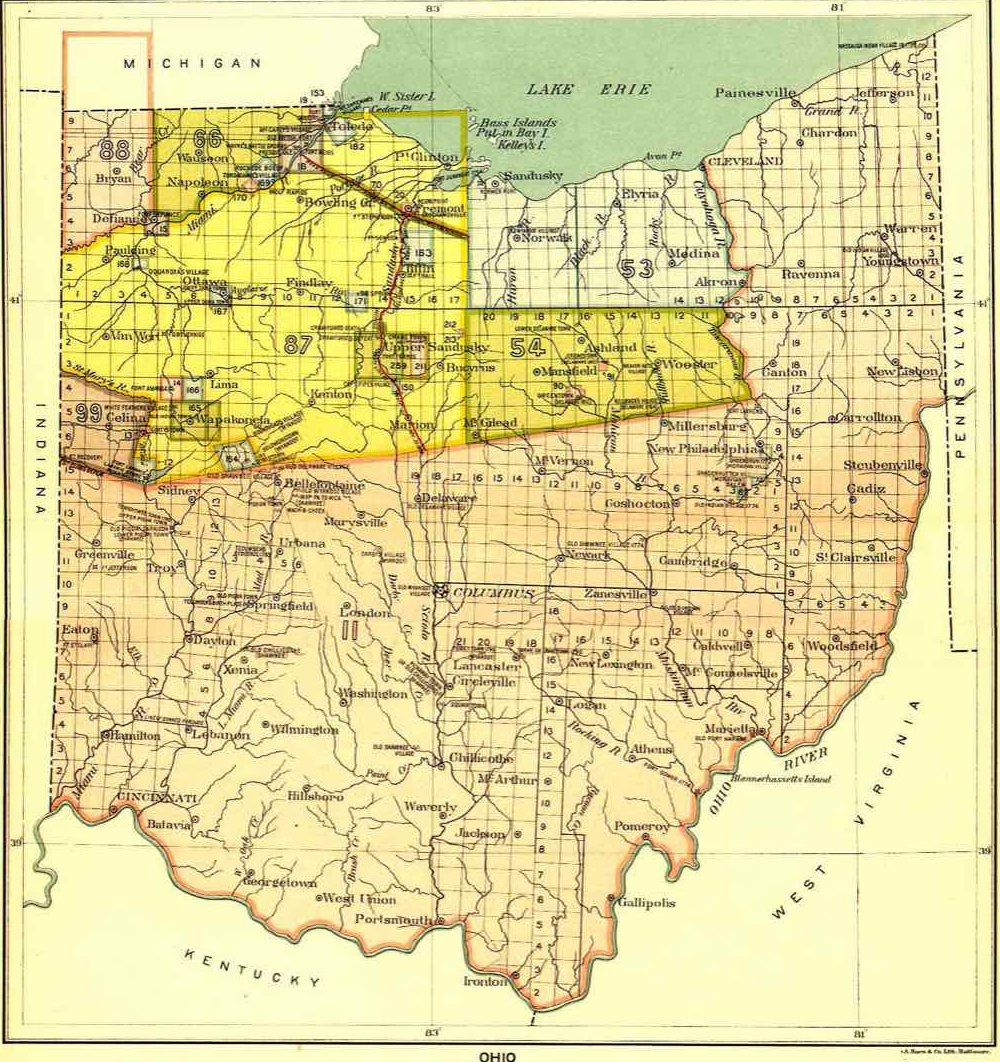
The others had all wanted something the land could give and keep giving — fur, passage, a fort on a bluff. The Americans wanted the land.
This was new, and the ground knew it was new. A trapper takes the beaver and the beaver comes back. A trader keeps a road and the forest closes over the road when he goes. Even a fort is only a scab the land will shed in a century or two. But a people that comes to break the sod and fence the fields and file a deed at a courthouse has come to change the thing itself, permanently, into private squares of ownership, and such a people does not camp on the commanding points and move with the seasons. It stays.
The wagons came down out of Pennsylvania and over from the east by the thousand, and where the nations had taken the deer and let the ground close behind them, the Americans felled the forest and drained the water and laid the black earth open to the plow, and did not leave.
What the land meant to those people has to be reckoned with, because it was not simple greed, or not only that, and the not-only is the whole of the difference. Most of them were poor. They came out of a Europe and an eastern seaboard where the ground had long ago been all spoken for, where a man without land was a tenant or a hired hand or a servant all his life and his children after him, and where the owning of land was the settled property of a class a poor man could not hope to enter. They were pouring into a new nation that had just fought a revolution partly about this very thing — that had thrown off a king who, in one of the grievances that helped kindle the war, had presumed to forbid his colonists the country beyond the mountains — and that now held out, as the founding promise of its whole experiment, the one thing the old world had always kept back from the common man: a piece of ground that was his own, in fee simple, to clear and to fence and to hand down to his sons, and with it the standing of a free and independent citizen and not anybody’s dependent. To Jefferson and the men who framed the republic, a nation of such small freeholders was the very definition of liberty. To the man in the wagon it was something plainer and more powerful still: it was the difference between being nobody and being somebody, and it was lying out here for the taking, black and level and richer than anything he had ever seen, at a dollar and a quarter the acre.
That is the force that came over the mountains — not a mood but a hunger with an entire philosophy behind it and an entire continent in front of it, and there was never the smallest chance that it would halt at the edge of another people’s country, or recognize, when it arrived, that the ground was already spoken for in a language it had no intention of learning.
The dream of the settler and the doom of the nations were the same few acres seen from two sides. And the dream was the heavier of the two.
But first the ground had to be emptied of everyone who remembered holding it another way, and that was done not with armies now but with paper. Treaty by treaty the reserves were narrowed — the greatest of them signed in 1817 on the very ground of Fort Meigs, in a single afternoon. And then, band by band, the people themselves were gathered up and carried west.
Where they were not carried from is worth putting beside where they were, because across the whole middle of the country the rule turns out to have been the same, and it was not a rule about treaties. Land that was not permanently under water was cleared of its people entirely. Land that was under water was not, or was not so soon — because cavalry could not cross a bog, and wagons and guns could pass only in a hard winter over thick ice, and a people who could disperse into reeds and live on fish and wildfowl and wild rice could stay where an army could not follow them in. A few Menomini in Wisconsin and some Chippewa in Minnesota kept tracts of tribal wetland by no other means than that. Everywhere the ground was dry enough to farm, the towns came down, the ridged fields were levelled, and the new roads went in on a square grid. The swamp had sheltered this valley’s nations from two armies and killed a third; it sheltered them from the surveyor a while longer, and then it was drained.
And when the burning stopped, the country itself changed shape. The yearly fires that had kept the openings open had been set by the people who were now gone, and the woods came in behind them at once: in the prairies and oak openings of southwest Wisconsin the grass is reckoned to have fallen by nearly three-fifths in the twenty-five years after 1829, and a botanist who measured the advance in Illinois put it at one to two miles in thirty years. Some part of the wilderness the settlers found and admired and wrote home about was not older than their own arrival. It had grown up in the space the removal made.
Ottokee, the peace chief who had owned the very land Toledo now stands on, went west with the rest.
How a people who had just built a republic on the sacredness of liberty and property brought themselves to do this to another people is the question, because they did not, on the whole, believe they were doing wrong — and the story they told themselves is one the reader ought to know, for it is a very human and a very durable kind of story. By the 1820s the taking had hardened from a scatter of local bargains into a deliberate national policy: removal, the wholesale transfer of every eastern tribe to the far side of the Mississippi, written at last into federal law under President Jackson in 1830. The men who made that policy wrapped it, most of them sincerely, in two comforting ideas. The first was that the Indian was a doomed race in any event — that he was fated by some law of nature or of Providence to melt away before the advance of civilization, so that removal was not his destruction but only the orderly managing of a disappearance already under way, and even a mercy, a means of setting the remnant somewhere safe and far from the whiskey and the swindlers of the frontier. The second idea was older and ran deeper: that a wilderness ranged by a few thousand hunters was ground going to waste, that the Creator had given the earth to man to be subdued and made to bear, and that a farmer who would raise corn and children on an acre held a better title before God than a hunter who merely passed across it. Set the two beside each other — they are vanishing anyway; the land is wasted on them; and we have need of it — and you have a machine for doing a great wrong with a clear conscience, which is the most dangerous machine there is.
Almost no one who turned its crank believed himself a villain, and that is the part to remember. The emptying of a continent was carried out, in the main, by ordinary and even kindly men who had talked themselves into the belief, on grounds that felt to them like justice and sometimes like charity, that the thing they wanted to do anyway was the right thing to do.
But to explain a wrong is not to excuse it, and the harder half of it has to be said out loud. That the men who emptied this valley did not think themselves criminals is a fact about them, not a mercy owed to them; the clear conscience was not the wrong’s excuse but its engine — the very thing that let a theft be carried out in the open, at the scale of a country, by decent men, and entered afterward in the record as lawful business. The decency was not evenly spread, and a book that will not rank these things has left its work half done. The poor family in the wagon, that wanted one acre of its own and never once saw whose grave it broke to the plow, is owed a gentler judgment than the men who built the machine and knew exactly what it was — the governors who administered the emptying, the President who wrote it into the law of the nation, the buyers who had perfected the art of finding the one hungry or half-drunk signer in a nation and calling his mark the sale of a country. Those men were not swept along by a current they could not see. They cut the channel, and drew their wages from it, and died in their beds, honored.
If you have wondered why the telling has been so slow to name a villain, this is the answer, and it is not the swamp, nor the settler, nor even the soldier: it is the ledger. It is the quiet conversion of a homeland into real estate, of a people into a line in a table, of a dispossession into a transaction — worked so smoothly that the hand that did it never had to feel the ground it took. That conversion was the whole genius of the thing and the whole crime of it at once, and it was done here, on this river, in an afternoon of signing, as thoroughly as it was ever done anywhere on the continent.
It is worth following one line of that table all the way out, because the arithmetic does something the signing could not have shown anybody in the room. Twelve years before the commissioners sat down at Fort Meigs, another set of them sat at the mouth of this same river, at a stockade called Fort Industry on the ground Toledo stands on now; and on the fourth of July, 1805, the Wyandot, Ottawa, Chippewa, Munsee, Delaware, Shawnee and Potawatomi gave up their claims to the Western Reserve, the Connecticut country east of the Cuyahoga. The price was sixteen thousand dollars from the land companies, and then a thousand dollars a year, forever.
Forever is the word to hold on to. A thousand dollars in 1805 is somewhere near twenty-eight thousand five hundred in the money of 2026 — one middling salary, once a year, shared among nations, for the northeast quarter of a state. As a bargain that is poor enough. But it is not the whole of what was done, because the sum was fixed and the dollar was not. Two hundred and twenty-one years of that perpetual annuity, paid out exactly as promised and added up, come to two hundred and twenty-one thousand dollars — less than the present worth of the first eleven years of it. The nations were not simply underpaid. They were underpaid on a schedule that got cheaper every year on its own, at no further cost or effort to anybody, under a clause nobody had to argue for because it is not written in the document at all. The treaty says forever and means, in the only terms that buy anything, less each time. It wanted no villainy: only a fixed number, and time, and the patience of an instrument that does not have to be in the room to go on collecting.
One caution about arithmetic of this kind, and it runs the way you would expect. A price index follows the cost of goods, and goods are the least of what was taken here; set against a wage, or a life, or a country, a conversion of this sort is a floor and not a measure. Every such figure in this book is an understatement, and the ones that put a price on a person are understatements of another order entirely.
The annuity had one more thing wrong with it, and it was not in the arithmetic. The money was paid out once a year at an appointed place, and the traders came in to meet it. They came with their account books. A man who had taken goods on credit against the coming payment was a debtor on the day it arrived, and the debts were settled out of the money before what was left of it was handed over. At Logansport in 1836 the Ewings of Fort Wayne and scores of others were waiting with their ledgers open. W. G. and G. W. Ewing traded out of Fort Wayne for twenty-seven years, in furs and goods and land across seven states with a New York house behind them, and in 1838 they undertook to prosecute their war against Astor’s company to the point of extermination.
The agent who took those ledgers and paid them was John Tipton, and he knew precisely what he was presiding over, because he set it down himself. The agency sat among grog shops and among traders who sold his wards whiskey, encouraged them into debts that came off the annuities afterward, and cheated them in a hundred different ways; he instanced a white woman at Fort Wayne who had bought a shawl off a drunk Miami woman for seven apples and twelve and a half cents, a shawl that had cost her three dollars and fifty. He wrote all that in order to argue that the agency ought to be moved somewhere else. He held it himself from 1823, used the treaty negotiations to secure choice land, and died one of the wealthiest men in Indiana. The United States bought a country and paid for it by instalments, and a good part of each instalment was in white hands again before the people it was owed to had left the ground.
The paper did its work in stages, and the first great stage of it was signed, with a fittingness no one present can have failed to feel, on the ground of Fort Meigs itself. There, in September of 1817, on the same bluff where Harrison’s men had stood and counted the incoming shells four years before, two American commissioners — Lewis Cass, the governor of Michigan Territory, and Duncan McArthur — sat the nations down and took from them, in a single treaty, four and a half million acres: something near a sixth of the whole state of Ohio, the largest cession of native land the state would ever see, gone in an afternoon’s signing on the very ground the nations’ own allies had died to defend. The fort that had been raised to hold the country by war had become the table on which the country was signed away by pen; and the one method having at last failed the newcomers, they turned to the other, which never failed them at all. Within the vast ceded tract the treaty penned the nations into a scatter of reserves — a few townships at Wapakoneta, at Upper Sandusky, along the Sandusky and the Auglaize — islands of the old country left standing in a rising sea of American survey, and every man who made his mark that day understood, whether he let himself say it or not, that an island in a rising sea is a temporary arrangement.
At the head of the river the same conversion was made in the same building, and the newcomers did not trouble even to put up a new one for it. The garrison at Fort Wayne — the post the general had planted at Kekionga the winter after Fallen Timbers, on the portage the whole interior had turned upon — was withdrawn in 1819, its work considered finished; and in that same year a federal surveyor came up to walk that portage and take its measure as a possible route for a canal. The soldier out and the engineer in, in the one season. Four years after that, the rooms the garrison had left standing empty were opened again as a United States land office, for the sale of public lands — public, in the phrase the government used then and the city that grew up there uses still, because the native titles to them had been eliminated by treaty. The fort that had taken the portage at the point of the bayonet became, inside a single decade and inside its own abandoned walls, the counter over which the portage was sold by the acre. There is no plainer picture of the business anywhere in the valley. The army had no reason to stay. It had only ever been sent to make the ground saleable, and the ground was saleable now.
The same treaties that took the land by the million acre left, here and there, a few small private squares of it in native hands — grants written out to particular men and particular families, many of them of mixed French and native blood, who had learned to hold ground in the newcomers’ own way, by the deed: a section to Jean Baptiste Richardville, the Miami civil chief — a broad-shouldered, unsmiling man whose face carried his parentage openly, the Roman nose and pale blue eyes of his French trader father set in the countenance of a Miami chief, and who worked the seam between his two bloods in three languages, Miami and French and English, running the old portage at Kekionga as a tollgate business until he was reckoned the richest Indian in the country at his death; grants to the Godfroy and the Lafontaine and the Shane; a tract to Peter Minor at the Wolf Rapid on the Maumee itself.
Richardville above all had mastered the newcomers’ own instrument, and turned it to his people’s account and his own. When a Miami killed an Ottawa near Fort Wayne and an Ottawa war party came down demanding blood, he settled the thing not with a life but with a payment — drew five thousand dollars out of the Miami annuity as blood-money and handed it over — and the traders who advanced the goods against that same annuity, one of them noted with satisfaction, had averted a war and turned an honest penny at the one stroke. The old law of the mourning-war, that once had covered a death with a living captive taken into the family, had become in his hands a line in an account. The man who could enter even a killing in the ledger sent to Paris for the furniture of the great house he raised on the proceeds of the portage. Those grants were the stubborn little islands the tide left behind as it drew out, and a scattering of them are islands yet — the ground under a handful of Indiana farms held to this day by the descendants of families that simply would not be moved.
But they were the exceptions that took the measure of the rule, and the rule was that the nations went.
What the paper took at Wapakoneta was not only ground. For the better part of a decade the Society of Friends had kept a school and a model farm among Black Hoof’s Shawnee there — a handful of unarmed Quakers teaching letters and the plow, in the words of their own charge, to ameliorate the condition of the band — and Henry Harvey, the Friend who kept that school, wrote that the children took to the learning beyond anything anybody had looked for. This was the thing the Republic said it wanted. The band that had chosen accommodation was accommodating, and doing it well, and doing it on the model the government itself had recommended and the government’s own gentlest citizens had come out to teach. Then the same government took the ground out from under the school and marched its pupils to the Mississippi, and provisioned the march so poorly that they went hungry on the road. The gift and the taking came off the one hand, about ten years apart.
The moving had in fact begun before the taking. The man the government found to lead the first party of Ohio Shawnee west, out on the last day of September in 1826, was Tenskwatawa — the Prophet, Tecumseh’s brother, who had spent his best years preaching that his people should have nothing whatever to do with the Americans, and who wintered destitute in Illinois for his pains. And Little Turtle had written to Baltimore for the plow in 1803, and died in 1812, and so was spared finding out what the Republic would do to the people who took it up.
The Wapakoneta island went the way of all of them, and it went under a paper that men on the ground were calling a fraud while the ink was still wet. In August of 1831 a commissioner named James Gardiner sat the Shawnee down and came away with the whole reserve; and Harvey wrote that when the old chief understood what had been done to him he wept like a child and said they were a ruined people, unless the Friends would speak for them. Harvey had kept his own record of the council, and he carried it to the Quakers’ yearly meeting, and a committee came out to Wapakoneta and sat for days taking the nation’s evidence on the whole proceeding — a second set of books opened against the government’s, in the one case where somebody thought to keep them. It changed nothing. The treaty stood and the Shawnee went; but the theft stands in the record now beside the dissent from it, which is more than most of the rest of them ever got.
How it was done is in that record too, and it is worth going slowly over, because the method is the argument. Gardiner opened the council not with an offer but with a warning. He told the Shawnee that a white man could beat an Indian or kill him and go free, unless another white man could be found to swear against him; that this was exactly how Georgia was at that moment treating the Cherokee; that Ohio would certainly do the same; and that the state had a constitutional right to do it and Congress would not lift a finger. Only when he had them frightened did he come to his terms. A rich country west of Missouri that would never lie inside any state or territory, a hundred thousand acres of it, a surveyor sent out with them to mark it, a warranty deed to hold it forever, mills built at government cost to replace the ones the Quakers had given them, cash for their improvements, guns and tools and the overplus of the sale held at interest — and a country, he told them, with buffalo and elk and deer enough that they could live well “without working at all.” That was the reward, offered by the same government, to the one band on the whole frontier that had done what it was asked and learned to farm. And then, to leave them nothing at all to hold him to, the commissioner told the council that no man in the United States had ever dealt honestly with Indians; and when they named the one exception that every nation on the continent named, William Penn, he told them Penn had cheated them too, and had acted “no better than a horse-thief.”
The treaty itself was never read aloud. It was long, Gardiner said, and the day was late, and there would not be time to go through it; he gave them his word that it contained everything he had promised. And then he recited it anyway, article by article, which is the part that makes this worse rather than better. Harvey sat through the whole council near the commissioner’s own chair, by the commissioner’s invitation, and took the offers down in writing as the interpreter delivered them; and he heard Gardiner go through the treaty by numbers on the eighth of August — the first article providing for the sale of their Ohio land, the second for securing them their hundred thousand acres adjoining their brethren in the Missouri country, and so on to the end. Every word of that recital matched what he had promised. It did not match the paper. He had laid a plat of the western country on the table before them and pointed out a tract fifty miles square that belonged to the Shawnee already settled in Missouri, and told them, as plainly as he could speak, that their hundred thousand would be run off alongside it on whichever side they liked, by a surveyor at the expense of the United States — and that they had better sell now, because if they waited, other Indians would take the ground next to their own relations and theirs would have to be laid off somewhere else. What the treaty actually did was cut their hundred thousand acres out of the inside of that same fifty-mile square: not land beside their brethren’s country, but land taken out of it. Not one word of that was said in the council, from the first day to the last. Harvey did not learn of it until he reached Washington at the end of the year, and nineteen years afterward, in a District of Columbia justice’s office, he swore to what he believed would have happened if it had been spoken aloud: the whole treaty would have, I have not the least doubt, been broken up at once. The one contemporaneous record of what was actually promised had been in his own hand, taken down as the interpreter spoke. By the time he came to swear to it, that paper was no longer in his possession. They hesitated a great while, for the plain reason Harvey set down — that if all had been right with it he would have read it to them first — and then they signed. What came after is the part the ledger keeps for itself. The traders, who had been coaching the chiefs for weeks to hold out for the government’s assuming the nation’s debts, produced a bond for twenty thousand dollars; not one claim in it was examined, because no time was allowed to examine any; the chiefs acknowledged the whole of it as justly owing; and the commissioner and the Indian agent set their names to the acknowledgment on an evening when, Harvey says, every man in that room was drunk except the traders who had drawn it. The bond was refused when it was presented for payment, the officers having by then become sober. The traders were paid in the end anyway, out of Shawnee money, without asking any Shawnee. And then, so that nothing could ever afterward be checked against anything, they burned their books.
There is one image of that leaving that has to be set down, because it holds everything the newcomers never grasped about the ground. When the Shawnee were made to quit Wapakoneta, up the Auglaize, they went first to their burying places and took down the little fences from around their fathers’ graves and laid the sod back over the mounds so smoothly that not a trace of them could be seen — hiding their dead in the earth a second time, so that no stranger coming after could find them or trouble them — and then they danced a war dance the night through, and in the morning rode west. They had buried their dead on the finest ground in the country for a thousand years. On the way out of it they gave the graves back to the earth, and asked the earth to keep the secret.
They could do nothing of the kind for the council house, and no one coming after thought there was anything to do.
The town at Wapakoneta was younger than the Republic. It was founded on the Auglaize about 1782 by a band that had come north off the Mad and the Miami — itself a refugee settlement, made by people already backing away from Kentucky before there was a United States for them to back away from. But the room they raised in it became, in the words of the county history, the Indian capital of the northwest, and the government knew precisely what it was: when Cass and McArthur drew the Shawnee their reserve in 1817, they made it a square ten miles on a side and fixed its centre, in the treaty’s own language, at the council house at Wapaughkonnetta. The room was used as a survey monument. A surveyor sets a stone and measures from it, and here the stone was the room the nations of the northwest had met in.
They were gone in fifteen. The building stood a while after them and was then taken down, and its timber went into other buildings, because timber was timber. One log was laid into an old mill as a sill and spent better than thirty years under water. When the mill was at last pulled up the log came up with it, still sound, and it was sawn into blocks and, in the historian’s phrase, divided and largely distributed throughout the community.§ One block reached his own desk, by a neighbor’s courtesy, while he was writing the chapter on the people who had built it.
Set that against the fort at the rapids that became the table the country was signed away on, and the barracks at Kekionga that became the counter it was sold over. Those were conversions: the same walls left standing and put to the new owners’ use, which is at least a kind of acknowledgment that the building was worth keeping. This was not a conversion. The council house was not repurposed but consumed — lumber, then a mill part, then souvenirs handed round a town that had grown up inside the very square the room had been the centre of. The Shawnee had gone to their graves and hidden them so that no stranger could trouble their dead. The one thing they could not hide was the room, and it was distributed.
And onto the emptied ground the towns rose, and the first and most telling of them rose exactly where the blood had been. At the foot of the rapids, on the north bank, on the very ground of old Fort Miami and the gauntlet Dudley’s men had run, the Americans laid out a town in 1817 and called it Maumee — took the river’s name, which was the Miami’s name, for a town built on the place the Miami’s allies had been slaughtered. It grew handsomely. They raised a Greek Revival courthouse on the massacre ground and held their county’s law in it; they built white-columned houses along the river, one of them, the House of Four Pillars, going up in 1835 with a hidden room where, it was told, men fleeing slavery north to Canada were sheltered, so that the same soil held, in its layers, a fort, a massacre, a courthouse, and a station of the underground road. The last layer has a turn in it. Thirty-three years earlier the governor of the neighboring territory had asked Congress, in one petition, for the Indians’ country and for the right to hold slaves upon it; he had been given the first and denied the second, and had taken the second anyway by indenture. The country he asked for is this country. And on the very ground the asking finally bought — the massacre ground, the shut gate, the gauntlet — somebody built a house with a room in it for hiding the people that petition had wanted to own. The ledger had entered them as personal property in one territory and the fugitive as a debt to be recovered in all of them; and here, in a cupboard under the eaves of a white-columned house on the Maumee, a few people declined the arithmetic. It is a small correction against a very long column.
The road that cupboard belonged to was not the settlers’ road. The western Ohio line is thought to have been laid about 1816. It crossed the Ohio near North Bend and went up the streams to the upper Auglaize and to Blanchard’s fork, and passed near Wapakoneta, and came on to Ottawa, and came down at last to the Grand Rapids of the Maumee — which could be easily forded most of the year — and from there to Malden. Every one of those names has been in this book already. Wapakoneta was Black Hoof’s town, and the paper took it in 1831. Ottawa was the Ottawa reserve. The ford at the Grand Rapids is the ford at Fallen Timbers, below the shut gate and above the gauntlet. Malden is the shore the nations crossed to when the British were done with them. The man who set the route down put it without ornament: the line used Indian villages at Wapakoneta (Shawnee Indian) and at Ottawa, and probably an Ottawa village on the Maumee.§
The road to freedom was the Indian road. That is not a figure of speech, and it is not much of a coincidence either. A route that had to go around the sheriff wanted precisely what the nations still had — country the surveys had not yet straightened, fords a man could take without asking anybody, towns that were not the settlers’ towns. So the line ran on the trails and lodged in the villages. It did that in the same handful of years the villages were being emptied. The Shawnee went out of Wapakoneta the year after the treaty of 1831, and the Ottawa off the Maumee in 1838, west, by water, under escort; and over the same ground, by night, going the other way, other people were being carried out from under the same ledger that had entered both of them — one as country to be acquired, the other as property to be recovered. Nobody arranged the rhyme. When the removal was finished the road stayed, and went on working without the people whose road it was.
And in the finest of those mansions, a fourteen-room house on the riverbank a few steps from the old battlefield, there lived a woman named Mary Wolcott — daughter of that same William Wells who had scouted for Wayne at Fallen Timbers a mile upstream, and of Sweet Breeze, who was Little Turtle’s own daughter.
The chief who had destroyed two American armies to keep this country had a granddaughter keeping a river mansion above the field where his confederacy had broken, married to an American merchant — a former judge named James Wolcott, who ran his freight on the river in a boat he had christened the General Harrison, after the officer who at twenty-one had drawn the battle plan at Fallen Timbers, a mile up the same water, that broke her grandfather’s confederacy — and presiding over the town that stood on the graves. Her children went out into their lives under the names of the republic that had overrun their great-grandfather: a Robert Fulton Wolcott, a Henry Clay Wolcott, a Frederick Calhoun Wolcott — the war-chief’s line come down, at the last, to a set of American middle names. The valley folded its conquerors and its conquered into the same few acres and ran its seasons over all of them, evenly, and gave no sign it knew the one from the other.
Mary Wolcott was one daughter of the long crossing between the two peoples, and she had gone one way across it — carried out of the nation and into the conquerors’ world, and called, by the only reckoning the conquerors kept, fortunate. But that crossing had run in both directions all through the war years, by the strange custom the nations kept of filling a dead kinsman’s place with a living captive; and out on the Mississinewa, in these very removal years, there lived the other daughter, who had gone the opposite way — carried as a child into the nation and grown so wholly into it that she would refuse, at the end of everything, to be carried back out. Her white name was Frances Slocum. The Miami called her Maconaquah, the Little Bear Woman, and by the time the record found her again she had answered to nothing else for the better part of sixty years.
She had been a Quaker child of five on the Susquehanna, in the Wyoming Valley of Pennsylvania, when the war came to her door in November of 1778: a party of Delawares killed a man on the threshold, and the little girl hid under the staircase, and was found there and carried off on a warrior’s back, and cried herself to sleep the first night in a cave, and never saw her mother’s house again. Her family hunted her the rest of their lives and could not find her. Once they came within arm’s reach of her without knowing it — a colonel passing through the Seneca towns in 1791 met a young woman, paid her a small sum, wrote her name in his journal, and rode on, never dreaming he had just spoken with the Lost Sister the whole family was breaking its heart to recover. She was, by then, past recovering in any sense the family would have wished. She had been adopted and had grown up Miami; she had married a Miami, and buried him, and married another; she had daughters and grandchildren, and a double log house on the Mississinewa with horses and cattle around it, and she had not spoken a word of English since childhood and had no wish to learn it again.
The finding, when it came at last, came by a scar. In the autumn of 1837, fifty-nine years after the raid, an old man — one of the brothers, grown gray in the hunting of her — was brought to her house and could not know his own sister in the small brown-faced Miami widow before him, until he thought of the one mark all the years could not have altered. As children in the Wyoming smithy, a brother had struck the nail off her left forefinger with a hammer. He took the old woman’s hand to the light and asked her, through the interpreter, how the finger had been hurt. My brother struck it with a hammer, she answered, in the shop, a long time ago — and the room knew her. They had their sister back after a lifetime, and they wanted to take her home, and she would not go. Asked in the formal conference whether she had ever grown tired of living among the Indians, she answered plainly: No; I always had enough to live on, and have lived well. The Indians always used me kindly.§ Asked whether she had known her white relations were seeking her, she said no one had ever told her, and that she had never thought anything about her white relations at all. She was home. This was home. She had been home for fifty-nine years — and it was her brothers who had come the long way into a strange country to find her, not she who had been lost.
What the family could not carry home, they carried home a likeness of: at their urging she sat for a traveling portrait-painter, and the picture survives — a small, straight old woman, gray hair clubbed up in calico and chestnut eyes that an observer called clear and sprightly, in a blue calico short gown and a white Mackinaw blanket and red leggings and buckskin moccasins, looking out of the canvas as Miami as any woman ever painted. And here the ledger did, for once, a curious and half-decent thing. Because Frances Slocum’s birth as a white American could be proved on paper, the government exempted her and her daughters from the removal that was even then loading the rest of her nation onto the canal boats, and let them keep a section of ground on the Mississinewa, so that the one Miami family the paper permitted to remain in Indiana was the family headed by a stolen white child who had become, in every way a life can be lived, a Miami. The record spent a whole nation to clear the country and made a single exception, and the exception was a captive. It is the mourning-war custom’s last and strangest fruit: the white girl the nations had taken to fill a dead child’s place became, sixty years on, the one thread of the Miami that the removal could not pull loose from the ground — kept in her own country by the very whiteness she had spent her entire life forgetting. It is no accident, either, that the fullest early history of this whole river basin would be written by a man named Slocum — Charles Elihu Slocum, of the same New England stock, who set down her life and the valley’s in the one long inquiry, the family’s lost daughter and the country that had swallowed her being, to him, a single question.
Mary Wells Wolcott, born Miami and carried out into the American world, kept her house and her comfort and her husband’s respectable name — and lost, in the keeping of them, the language and the nation and very nearly the memory, the settler record keeping eleven words of her and a fine house and letting the rest go down under the ink. Frances Slocum, born white and carried into the Miami world, kept the nation and the tongue and the ground — and lost the family and the name she was born to, and never once counted the loss a loss. One was carried out of the nation, and the record called her fortunate. One was carried into it, and the record called her lost. They lived their two lives a hard day’s ride apart, in the same years, on the same emptying frontier, each of them a child handed across the very line the war was drawing between the two peoples; and the ledger, which decided everything else on this ground, decided this too — which of the two women history would afterward call by her own true name, and which it would let vanish into a husband’s. The one who stayed Miami is remembered as Maconaquah. The one who was made American is remembered, if she is remembered at all, as Mrs. Wolcott. The record kept the convert and lost the daughter, and never noticed that it had done the crueler thing to the very one it called the luckier.
And as fast as the nations were emptied out of it, the newcomers poured in to fill the vacancy, for the land, drained and undrained alike, was going now at a dollar and a quarter the acre, and a dollar and a quarter was a price a poor man could let himself dream on. The ground had been readied for the dreaming years before the dreamers reached it, ruled off on paper — the drowned country and the dry alike — into the old survey grid of six-mile townships and mile-square sections, the sixteenth section of every one held back to raise a school for the children of whoever bought the rest, so that a man might buy his piece of the Maumee country by its number on a plat before he had ever seen the black water standing in the woods that grew on it. In 1823 the Congress closed a loop on the swamp too neat almost to credit: it gave Ohio sixty thousand acres of the public land to pay for a road — a straight forty-six-mile cut from Perrysburg at the foot of the rapids to the edge of the Western Reserve, driven at last clean through the heart of the Great Black Swamp. The swamp was sold, by the acre, to buy the road across the swamp.
They came down the new canal and over the corduroy roads and in across the lake by steamer — Yankees off the worn-out hill farms of New England, Pennsylvanians with German names, and behind them the first of the great wave then cresting out of Germany and Ireland: families who could not have found the Maumee on a map a year before, and who now meant to die on it and leave it to their children’s children.
They came into a hard country and it used them hard. The fever of the swamp took the newcomer exactly as it had taken everyone before him; whole settlements shook through their first summers with the ague, and a hopeful little canal town named Providence, up at the head of the rapids, was scoured off the face of the earth inside a decade by fire and the cholera together and never rebuilt. Justice itself came to them by water and by barter: a circuit judge and his handful of lawyers paddled the sixty miles down from Findlay to Defiance in a dugout canoe they had christened, with frontier gravity, the good pirogue Jurisprudence; and one whole county away to the west, having not a dollar in its treasury the year it was organized, paid its entire assessment of state tax in certificates for wolf scalps. The very mud became an economy of its own: along the swamp roads the tavern-keepers kept spare yokes of oxen to drag the mired emigrant wagons out at a dollar the pull, and a man’s claim to the nearest mud-hole was recognized among neighbors as a piece of real property, so that one departing landlord is said to have sold his cultivated mud-hole, as a going concern, to the man who would inherit the hauling.
It was a rough filling of an emptied land. But it was a permanent filling, which was the point, and the difference from every comer who had gone before. This time the wagons did not turn around.
If the settled valley had a single figure who tied the whole long story together in one man’s life, it was Peter Navarre. He was of the old valley to the bone — born at Detroit in 1785 into one of the French-and-Indian trading families that the earliest chapters left rooted at the river’s mouth, at home in the woods and in the tongues of the nations as few white men ever were. In the second war with the British he scouted for Harrison with a price of a thousand dollars on his head, and carried the general’s dispatches on foot through the drowned country when no other road was open, swimming the flooded Sandusky twice in a single night to reach the little fort at its mouth. And then the war ended, and the nations he had grown up among were gathered up and carried west, and the swamp he had waded was cut into farms, and the frog-pond landing at the rapids swelled into a city, and Peter Navarre lived through all of it, an old French scout grown gray in a made American county, down to the last time the surviving graybeards of Fort Meigs came together at Perrysburg, where he was among them.
Near the end of his life he set his own account of it down on paper, in his own voice — the first time, his editor noted, that anyone had troubled to ask him. He still had the gun Harrison had issued him at Fort Meigs, fifty-six years on, and the powderhorn and strap that went with it, and he gave them away to a friend with a line that closes the whole long argument better than the book itself has managed to: I wish you to keep it in remembrance of your old and true friend, Peter Navarre.§ He called the giving of that account, and of the gun, his last service to his countrymen. It was not quite his last.
That came in the November before he died. A Toledo lawyer who needed to know something about the descendants of Little Turtle went looking for the one man living who might be able to tell him, and found him in a shanty among the bayous and marshes of Cedar Point: sick, and by then altogether blind, sitting alone over the remnant of a stove that scarcely held fire enough against the November wind off the lake. Navarre knew the voice and was glad of the company. Asked whether he had ever known the old Miami chief, the blind man brightened as though something pleasant had come into the room. What, Little Turtle, the great Indian? I knew him well§ — he was a gentleman. He had reason to know: as a young fur-buyer he had wintered among the Miami at the head of the river four years running from 1807, and had been the chief’s own guest for the last of them. And the lawyer, setting the visit down afterward, caught the thing that makes it worth keeping. Without knowing that he did it, Peter Navarre had repeated the character that Volney, the French philosopher, had given the same man in a Philadelphia drawing room three-quarters of a century earlier, out of nine or ten winter evenings in his company. A savant of the European Enlightenment and an illiterate voyageur dying blind in a marsh, given the same acquaintance and asked the same question, reached for the same word.
The last of all came at the east side of Toledo in the March of 1874: the living memory of a valley that by then existed nowhere on earth but inside the heads of a dwindling handful of very old men.
The valley’s own last boatload has a date and a place, and neither is much remembered. On the twenty-fourth of June, 1838, the last eight hundred Indians of seven nations still in the valley were gathered on Buttonwood Island, in the river a little above Fort Meigs, within sight of the works the Americans had thrown up to hold this water against them; and from there they were taken west to the Neosho. The man who took them was Dresden Howard, a trader’s son who had grown up among them and had spoken their languages since boyhood, and who called it the saddest duty of his life. Eight hundred people and seven nations, off one island, in a single morning, away down the river that carries their name and out of it. A few old chiefs remained§, his account says, and says nothing further of them — not who they were, nor how long they lasted, nor where they lie. It is the closing line of the longest column in the ledger, and it is five words long.
And the same man kept the other column. Fifty years on, an old man by then, Howard wrote out the account of the fighting at the rock above the rapids that he had heard as a boy from the Ottawa chief Kin-jo-i-no, so that nearly all the settler record preserved of the Ottawa’s own memory of Fallen Timbers was preserved by the agent who had carried the last of the Ottawa out of the valley. He emptied the country and then spent his old age writing down what it had held. Both of those stand in the record under the one name, and the record does not appear to have found it strange.
There was a third thing, and it is the one still standing. A village laid out in Fulton County in 1850 under the name of Centre was renamed, shortly after and at Howard’s suggestion, Ottokee. The chief was still living then, out west. The man who had been made to carry him out put his name back onto the country.
Ottokee had a half-brother, a chief of the same Ottawa, who went west in the same removal and died out there in 1849. His name was Wauseon, and the word means far off. He was sent there. Before he went he said the thing the county still repeats, that he would rather go than stay and watch the white farmers plow up the graves of his people.§ Then the county went under the plow, and its seat was named for him.
The last of the Ohio nations to go were the Wyandot, keepers of the western door, who held their reserve at Upper Sandusky a few years longer than the rest and gave it up only in 1843; and it happened that a famous stranger passed through the year before they went. Charles Dickens, touring America in 1842 and finding little enough in it to admire, came through Upper Sandusky and took his breakfast with the old Indian agent there, Colonel John Johnston, who had just concluded the treaty that would carry the Wyandot west. Dickens, who missed very little, set down how the nation had voted the question in a council house built for the purpose — a hut whose logs, by the time he sat down to his breakfast, had already been pulled apart and were lying in the road in front of the inn — and how, the decision once made, the large minority who had lost the vote gave way to the rest and withdrew all opposition without a word. He set down, too, what the old agent said about the work he had spent his life at: that he had witnessed many such removals, and always with pain, though he knew that they departed for their own good.§ The grief in that is real, and so is the certainty, and it is the certainty that does the removing. It is a strange small immortality: the going of the last nation in Ohio caught in passing by the most famous novelist alive, on his way to somewhere he expected to find more interesting, and preserved in a paragraph set down between his complaints of the American roads.
The Wyandot made one more provision before they went, and it answers the Shawnee’s at Wapakoneta from the opposite direction. Their church at Upper Sandusky had been founded neither by the government nor by the mission societies but by a free Black man named John Stewart — an itinerant robbed of everything at Marietta, who had stood once at the edge of the Ohio meaning to drown himself, and in 1816 walked northwest instead and came in among the Wyandot, and stayed. There were two plows in the whole nation when he arrived; out of his six years’ work grew the congregation the Methodists would come to count their first mission anywhere. He died of consumption in 1823, thirty-seven years old, and was buried in his own garden. And when the nation gathered itself to leave, it went and took up his bones and buried them again beside the mission church, under a marble slab, where whoever came after could find them. The Shawnee, going, had hidden their dead from the strangers; the Wyandot, going, set their adopted dead where the strangers must see him. Two nations answered the same going in two opposite ways, and the answers were one answer: the dead were the last thing either would leave to chance. The strangers’ half of the bargain ran true to form — vandals carried the stone off entire in 1866 — and then, a generation later, at the restoration of the old church, a new marker was cut for him at last.
And the people the river itself was named for were among the last to go, and went in the cruelest way the land could have devised. The Miami — myaamia, their own word for themselves, the word worn down the centuries into the name the whole valley wears — held on in Indiana another eight years. Then, on an October day in 1846, the Army loaded them onto three canal boats and drew them west down the Wabash and Erie Canal toward Kansas. The people whose name the river carries were carried out of their own country on the canal, and there was a crueler thing folded into the route than into the bare fact of it. The canal did not run west at random. It climbed the Maumee to its head and crossed to the Wabash by the one low notch at Fort Wayne — the old portage at Kekionga, the continental carrying-place the Miami had held and taken their toll upon in the days of their strength, the one lock on the whole passage between the northern lakes and the southern gulf. The nation that had grown rich as the keeper of that gate was drawn out of its homeland as freight along the very ground of it, poled west on an artificial river dug straight down the line of the portage that had once made it a power.
It was at that gate the loading was finished: three boats came up from Peru, and at the head of the river, at Kekionga, more Myaamia were forced aboard, and three boats became five. The nation’s own community history keeps the far end of that journey rather than the near one. Three hundred and twenty-five souls were put ashore at Kanza Landing on the first of November, a month and a day after the loading. How many had been counted onto the boats at the start, the record does not say. And not quite the whole nation went, for the paper that emptied it had its seams: the mixed-blood families that held their treaty grants as outright deeds could not be moved off land they owned, and stayed; Frances Slocum and her daughters, proved white on paper, stayed; and a remnant slipped the muster into the Indiana country and stayed. So the removal worked the people a last violence past the carrying-off itself — it cut the nation in two, along the line between those the ledger would still consent to call Miami and those it would strike from its rolls for the crime of staying where their country was; and the two halves are contesting to this day, in the government’s own hearing rooms, which of them may rightly wear the name the river carries. The boats that went, went — down the Miami’s own portage and then south, away from the lower valley, so that the towns the nation had once ruled at the foot of the rapids never so much as saw them pass.
They had been the lords of the passage. They left it as cargo.
The Same Ground
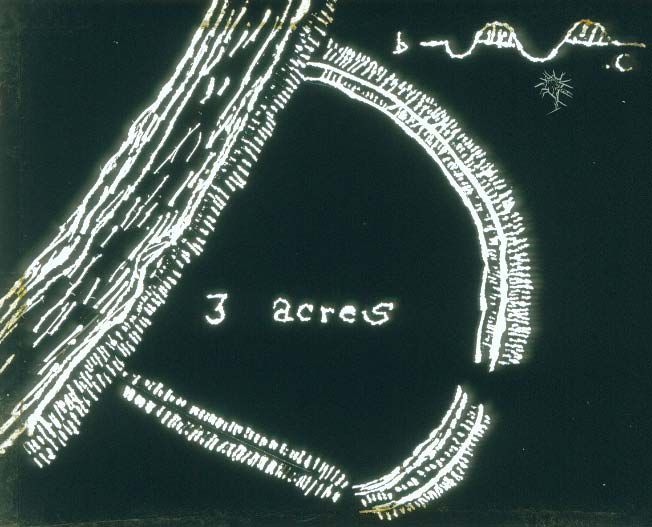
There is a low rise on the north bank at the foot of the rapids, a few acres of grass a little above the water, and very nearly everything that mattered here happened on it.
The French traded there first, quietly, a counting-house with a flag, and left scarcely a mark on it. Then the British came and dug in, four bastions and a ditch twenty feet deep and more down into the clay, and called it Fort Miami, and in the August of 1794 the beaten warriors of the confederacy ran to it for the shelter they had been promised and found the gates shut in their faces. That was the first thing the ground learned to do: to promise a people protection, and then to close.
Nineteen years later, in the very same place, it did the opposite to the other side. In the spring of 1813 six hundred Kentuckians were marched to that fort as prisoners and made to run a gauntlet between two lines of tomahawks, and were beaten and shot as they ran, under the eyes of British officers who had promised them protection and did nothing — the same silence, on the same rise, only turned around. And then a Shawnee came in at a gallop and threw the killers down with his own hands and stood over the prisoners and stopped it — I conquer to save — on the very ground where the King’s men had once refused to lift a hand for anyone. The coldest betrayal on this river and the plainest mercy on it were done on the same forty yards, nineteen years apart, and the grass could not have told you which was which.
Then, in 1835, the militia of the sovereign state of Ohio pitched their tents on the old earthwork to fight the Toledo War, and glared across a surveyor’s line, and shot at nobody at all, and went home. Four flags had stood on that one low rise — French, British, American, and the state of Ohio — and the last of them turned the bloodiest few acres in the valley into a campground for a war that killed no one.
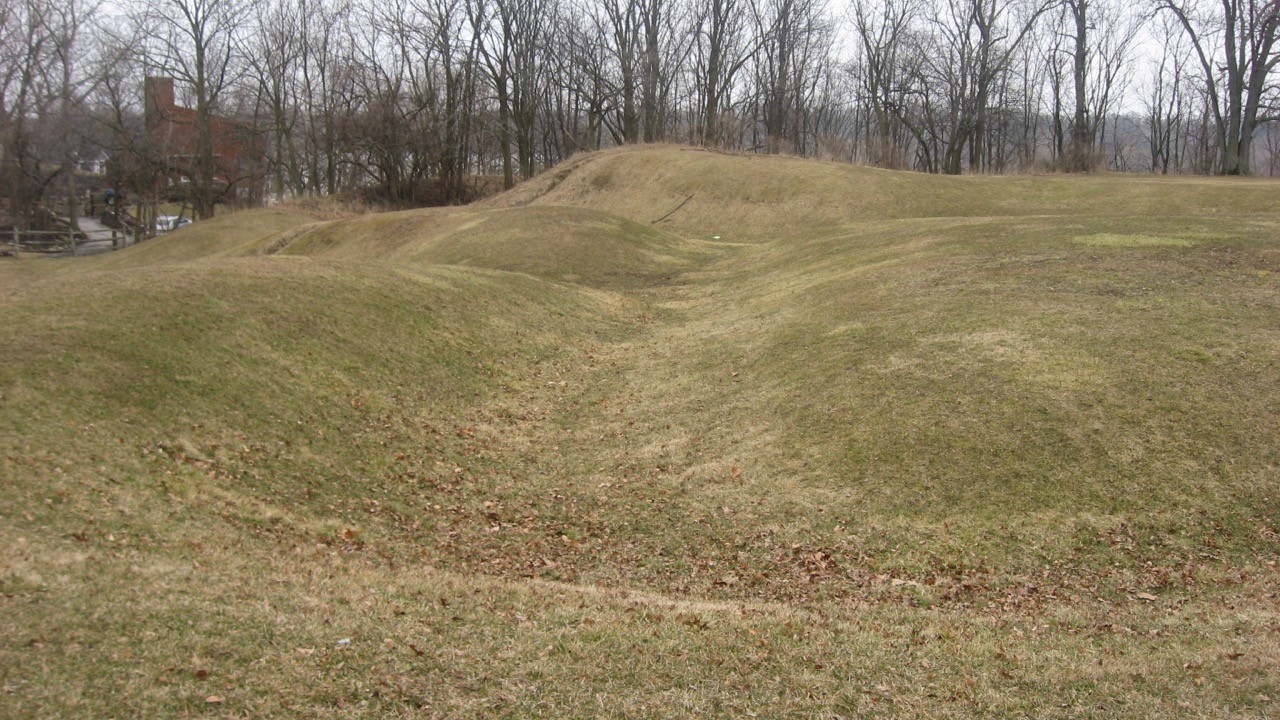
The earthwork is still there. You can walk it today: a shallow green ditch under old trees in a park above the river, a plaque or two, and nobody much about. It kept none of them — not the trade, not the fort, not the massacre, not the mercy, not the farce. It kept the shape of a ditch and the flatness of a parade ground and a great deal of grass, and it grows that grass exactly as green over the spot where the gates stayed shut as over the spot where the chief rode in. That is the land’s way, and the land is welcome to it. It is not ours. Stand on that rise long enough to feel its terrible evenness settle over you, and then walk back down remembering the one thing the ground never will: that the man who rode in to stop the killing and the men who stood and watched it were not the same, and that the grass, for all its peace, is wrong.
The Toledo WarThe Line on the Map
It could probably be shown by facts and figures that there is no distinctly native American criminal class except Congress.
— Mark Twain, Following the Equator
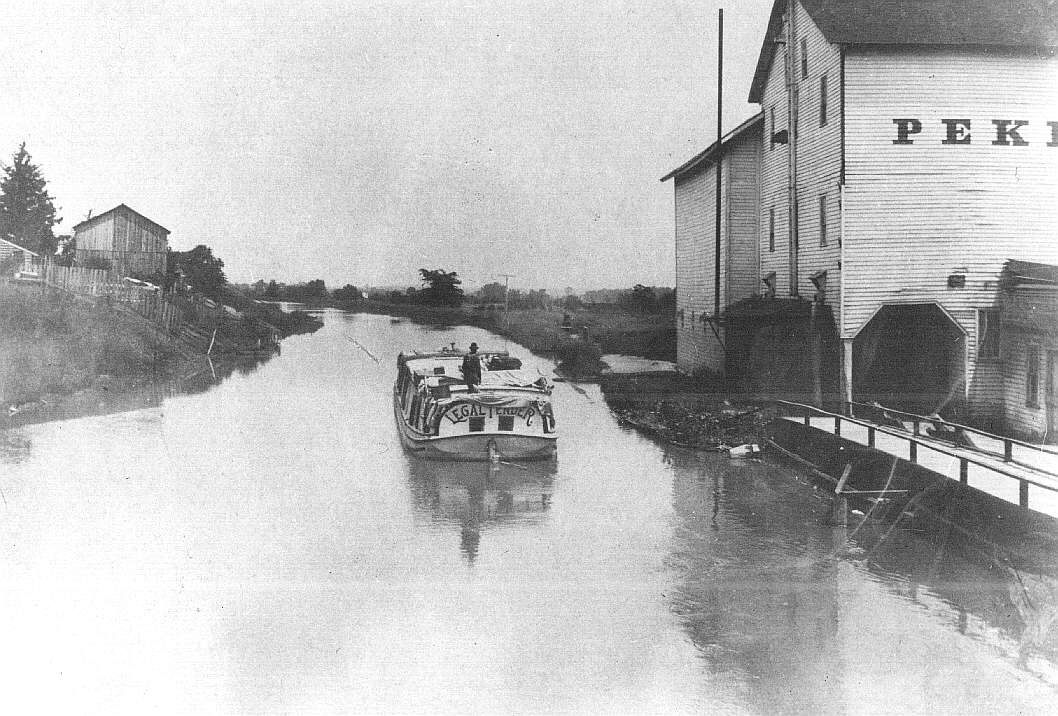
For while the nations were being emptied out of the valley by the deed and the treaty and the canal boat, the newcomers fell to fighting over the same ground, and they fought like people who had forgotten, or never known, what it had cost.
The quarrel was between two American states, and it was about eight miles of mud. A mapmaker’s error eighty years old had left the line between Ohio and the new territory of Michigan uncertain right at the mouth of the river, and both claimed the strip that held it — because the canal, that same canal, was going to end there, and everyone could see that whoever held the canal’s mouth would hold the commerce of the whole interior.
The nations had wanted the valley as home; the states wanted it as real estate.
The town they were fighting over was itself barely older than the fight, and it had been born the way everything on this emptied ground was now being born: out of the ledger, on speculation, before the fact. As early as 1817, while the ink was scarcely dry on the great cession up at Fort Meigs, a company of Cincinnati speculators had bought a tract at the mouth of the river on the plain expectation that a city must one day stand where the canal met the lake, and platted streets across the marsh, and named their paper town Port Lawrence — and when that first venture foundered and forfeited for non-payment, the fevers and the mud outrunning the dream as they generally did at the start, others took it up and revived it, and a rival company platted a second town, Vistula, on the bank just downriver, so that two paper cities lay side by side on the one fever-flat, each briskly selling lots in a metropolis that did not yet exist. The settlement at the rapids’ foot the country still called, without ceremony, Frog Town, for the frogs that sang in the marsh where the boats came in; the boys caught them by the sackful. In the hard winter of 1832 the men of Vistula, undeterred, built a nine-foot quay out over the frozen river and waited for the world to come to them, while their neighbors up at Perrysburg predicted cheerfully that docks and settlers alike would vanish with the spring ice and the July agues. And in 1833 the two rival plats buried their quarrel, merged their paper into one, and took for the joint venture a single new name — Toledo, for reasons no one has ever quite settled, a Spanish city’s name hung hopefully on an Ohio mud-flat — and set about in earnest becoming the great city their deeds already swore that they were. It was a town willed into being by the survey and the plat years before it was a town in fact, a wager on the canal’s mouth laid down in the same confident bookkeeping that was building the new country. The two states did not muster their militias over a city. They mustered them over a bet — a few hundred speculators’ faith that the mud at the river’s mouth would one day be worth a fortune, entered on the plats before a single warehouse stood to prove it. The Toledo War was, at the bottom of it, two governments come to blows over a real-estate prospectus.
And Port Lawrence and Vistula were only the two that lived. Perrysburg and Maumee City were already on the ground, laid out before the canal was so much as projected; and once it was, the lower river filled up end to end with cities that existed chiefly as candidates for its outlet. There was Manhattan, at the very mouth. There was Oregon, halfway between the mouth and the rapids, named by a nephew of Washington Irving out of his uncle’s new book about a fur colony that had also failed, and advertised on the argument that its facilities for packing pork were greater than Cincinnati’s. There was Austerlitz a mile above Oregon, and Marengo at the foot of the rocky bar, and East Marengo across from Delaware Island, and Miami City just below Maumee City, and Lucas City facing Manhattan across the river’s mouth. Read the names again. A valley emptied of its nations inside one generation was being renamed, by men who had never in their lives heard a shot fired in anger, for two of Bonaparte’s victories.
They were not, any of them, betting on the valley. They were betting against each other, because the canal could end in only one place and every plat was drawn on the assumption that the place would be theirs. The county’s own history, looking back from a settled city seventy years on, buries the whole class of them in one sentence: all of them presented some claims to future greatness, and all of them disappointed the hopes and anticipations of their founders.§
Manhattan came nearest, and Manhattan is the one to keep, because nothing beat it. In the October of 1835 a company of Buffalo men organized at three hundred and fifty thousand dollars, bought every acre between Vistula and the mouth of the river, and by spring had docks and warehouses and a commodious hotel standing on the ground. When word came that the canal’s main terminus was to be Manhattan, with mere branches down to Toledo and Maumee, the joy of the stockholders, their historian wrote, knew no bounds. On the first of July, 1837, with the panic already broken over the country, they raised the capital stock to two million dollars, and inside the week got up a second company at another nine hundred and sixty thousand to work the far bank. They founded a bank. They founded a newspaper. And then the lake steamers stopped calling at Manhattan — and the men who owned the lake steamers were the men who owned Manhattan, and had worked out that they stood to lose more by neglecting the traffic at Toledo than by sacrificing their own dividends in the town they had built. The merchants went where the boats went, and most of the five hundred inhabitants went after the merchants. In the April of 1848 the court of common pleas granted the lot owners’ petition and vacated the plat. Manhattan was ended by the same instrument that had called it into being, and there was no villain in it anywhere: only the arithmetic, followed honestly by the very men it ruined.
Marengo ran the same course in twenty-eight months. It was to stand on the military reserve at the foot of the rocky bar, the last square of ground at the rapids the government had held back from sale, and when that came to auction at Bucyrus in the April of 1836 there were, by one account, immense sums of money on the spot. Nineteen men pooled and took four hundred and forty-three acres for forty thousand dollars, and cut them into five hundred lots, and a writer that spring closed his description of the place with a flourish: he hesitated not to predict that at no distant day Marengo would be the largest town in Western Ohio. Sales were slow. In the August of 1838 the city of Marengo was closed out by order of the court. Two years and four months lay between the prediction and the judgment, and the ground it was all transacted over had been the nations’ inside the memory of men still living on it.
And in the very August when that quarrel stood at its full heat, the ground the two states were contending for changed hands in the old way one last time, and the paper survives. On the fourth of August, 1835, Ottokee — Au-to-kee, son of Fish-qua-gun, the Ottawa peace chief whose people had kept the river’s mouth longer than anyone could reckon — signed a warranty deed in the settlers’ own form: Know all men by these presents: That I, Au-to-kee, a chief of the Ottawa tribe of Indians... in consideration of the sum of $1,000, to me in hand paid... — one hundred and twenty-five acres at the mouth of the Maumee, out of the tract the treaty of 1833 had left him. The same day he sold Presque Isle itself, eighty-one acres, for another thousand. Everything was done with the greatest care: a justice of the peace counted the money into his hand and certified that there had been no circumvention or undue influence, and three federal officials endorsed the instrument up to the President as “a full and fair consideration... as we verily believe.” The county’s own memorial history, printing the deed whole seventy-five years later, explained in the next breath who the buyers were: speculators, men positioned by title to “levy tribute upon those who might subsequently desire the lands”§ — and in this, it added, they were not disappointed. So there were three prices on the mouth of the Maumee that August. The speculators’ plats said a fortune. The militias said it was worth marching for. And the man who held it under the oldest title on the ground was paid two thousand dollars, certified to the President as full and fair, and three years later went west with his nation.
The men who lit the fuse knew exactly what they were doing, and knew, most of them, that they were in the wrong. Years afterward one of the town’s early physicians remembered a young Toledo promoter named J. Baron Davis laying the whole scheme out in cold blood over the two survey lines: that Michigan, by the letter of them, had the best right — that the Fulton line, running south of the town, seemed to be the proper one — but that if the men of the strip would only declare themselves under the authority of Ohio and elect Ohio officers, it would arouse Michigan, and there will be war, and a war was the one thing that would force the Congress to settle the line at last and hand the canal’s mouth to the state that meant to build it. They did not fight because they believed the ground was theirs. They fought because they had judged, correctly, that the surest way to be given a disputed thing is to raise a quarrel over it loud enough that the referee, to buy back the peace, hands it to the party making the most noise. The whole war was a lawsuit pressed with muskets by men who suspected they were in the wrong and meant to win regardless — which is the ledger’s method exactly, carried from the treaty table to the militia field without changing a line.
And so, in the winter of 1835, the two governments went to the edge of war over a boundary. Ohio’s governor was Robert Lucas, fifty-four, stubborn, a man who as a young officer in the last war had been paddled across the great swamp by Indian guides, so that the man now claiming the country had once needed its oldest inhabitants to carry him over it. Michigan’s was Stevens T. Mason, twenty-three years old, the Boy Governor, too young to be embarrassed and too proud to yield. Lucas pushed an act through his legislature seizing the strip and naming a county for himself; Mason answered with a Pains and Penalties Act that made it a crime punishable by hard labor for anyone to accept Ohio’s authority on the disputed ground. Then both men called out their militias, six hundred on one side and a thousand on the other, and marched them into the mud to glower at each other across it.
The comedy is real, but the men who marched were not simply fools, because the thing they were fighting over looked, in 1835, like the key to a fortune, and the looking was not unreasonable. This was the age just before the railroad, when a heavy load could be moved cheaply only over water, and a canal was the most modern and most coveted thing a state could have, and the great canal then being dug to join the Ohio country to Lake Erie was going to empty at precisely this spot, at the mouth of the Maumee. Whoever’s state held that mouth would hold the one place where the grain and goods of half the interior changed from canal boat to lake ship, and would gather the tolls and the trade and the swelling growth of it; the little fever-ridden town in the mud was widely and soberly expected to become a great city, a western rival to Buffalo or even to New York, and the men who were platting its streets across the marsh believed it with their whole hearts.
That the canal would be obsolete within a dozen years, killed by the very railroads not one man in 1835 quite saw bearing down on him, is the joke the future was preparing to play on all of them. At the time, that ditch was the future of the West, and they knew it.
How the line came to be in doubt at all is a small comedy in its own right, and a characteristic one, for it turned on the oldest of American mistakes: a confident map of a country nobody had yet seen. When the Congress of the Confederation laid out the Northwest in 1787, it drew the top of the future Ohio as a line run due east from the southernmost bend of Lake Michigan — a sensible rule, if only anyone had known where the southern bend of Lake Michigan actually lay. Nobody did. The best map in existence, an Englishman’s chart of 1755 that the framers trusted, had set the bottom of the lake the better part of half a degree too far to the north; and when the surveyors at last went out and found the real lake sitting well south of where the map had sworn it would be, the line run east from it by the old rule struck Lake Erie not above the mouth of the Maumee but below it — throwing the river’s mouth, the future canal terminus, the whole coveted strip, into Ohio, or into Michigan, depending entirely on which map and which clause a man had made up his mind to believe.
Ohio ran one line, the Harris Line, by its own hopeful reading; Michigan ran another, the Fulton Line, by the letter of the Ordinance; and between the two lay a wedge of ground some five miles wide at the Indiana corner and eight at the lake, a sliver about the size of a small county, with the town of Toledo sitting squarely in the disputed middle of it.
And neither state had been waiting on a court to tell it whose the wedge was; both had been governing it for years, each in perfect confidence, and the paper each generated in doing so is the best evidence there is of how the quarrel got so hot. Ohio had platted the mouth of the river and hung a county on it. Michigan had been legislating out of the same ground since the town was scarcely a name: the Territorial Council, sitting at Detroit in the June of 1828, enacted that there should be a territorial road laid out and established commencing at Port Lawrence, in the county of Monroe§, and ran it northwest through Blissfield and Adrian to strike the Chicago road, and named its own commissioners to survey it. Port Lawrence — the speculators’ paper town on the Maumee flats, seven years before either governor called out a militia — entered in a Michigan statute as a place in a Michigan county, with a Michigan road running out of it. The territory’s very first petitions to Congress, twenty years before that, had already asked for a road from Detroit to the foot of the Maumee — the destination a later compiler of the territorial road laws would gloss, with the whole quarrel folded into a parenthesis, as Toledo (Port Lawrence, through the Black Swamp). The two governments did not fall out because the line was unclear. They fell out because each had spent a generation acting on its own answer, in ink, in the ordinary course of business, until there was too much paper on both sides for either to back down.
Two states were preparing to shed blood over the difference between two lines that a dead Englishman’s guess about a lake had set a half a degree apart.
There is a small footnote to the surveying that the future would enlarge past all proportion. When the government sent its engineers out in 1832 to run the disputed latitude one more careful time, the young lieutenant assisting the party — fresh from West Point, a Virginian of good family — was named Robert E. Lee. Three decades before the war that would make his the most fought-over name in the republic, the man who would command the armies of the South spent a season on the flat contested line between Ohio and Michigan, helping measure a boundary two states were about to take up arms over. The valley had a way of catching the great men young and turning them loose again — it had drawn the battle plan of Fallen Timbers out of a boy named Harrison a mile up these same rapids — and it caught Lee in passing too, and marked him no more than it marked anyone, and let him go on to the ground that would keep him.
Nobody died. That is the whole comedy of it.
The nearest thing to a battle came on a Sunday in April, when a Michigan posse rode up on an Ohio survey party resting for the Sabbath and fired a volley — over their heads, Michigan always swore; at them, Ohio’s men reported — and carried nine prisoners off into the interior. That, as near as the record tells, was the last volley any armed force ever fired in anger on the disputed ground: two centuries of the gun deciding this valley — the Dutch muskets that broke the nations onto it, the fusils that bought it, the King’s muskets that armed its buffer and the bayonets that took it — ending in a single ragged discharge that the shooters themselves swore, ever after, had been aimed at nobody.
The only blood spilled in the entire war was drawn by a penknife: a Michigan deputy named Wood, come to arrest a Toledo partisan, took the blade of one Two Stickney in the thigh and lived.
The Stickneys are the note the whole war is played in — their father, an old man named Benjamin Stickney who had been the government’s Indian agent in the valley in better days, had named his sons, with a straight face, One and Two. He was a stranger and larger figure than the joke of the names lets on: Benjamin Franklin Stickney, named dutifully after the great Franklin himself, married to a daughter of old General John Stark the hero of Bennington, and the man who had commanded the Indian wing of Andrew Jackson’s army at New Orleans, where the warriors called him their white father and chief — come out at the end of all that to the Maumee, to serve as its Indian agent and to number his own children like entries in a book. It was Two Stickney who did the stabbing, and Two Stickney who slipped across the line into Ohio where Michigan’s warrant could not follow, and so the one wound of the Toledo War went unavenged and its one combatant went free. It did not, however, go unremarked. The day after the stabbing the district attorney of Monroe county — a J. Q. Adams, no relation to the other one — drew up a detailed statement of the affair accompanied by numerous affidavits, and it went forward to Governor Mason and from Mason to the President, with an urgent appeal for federal help and the representation that the man who had done it was being sheltered in Ohio by Governor Lucas. Way records that the papers made a strong impression upon the President. One thigh wound from a pocket knife had generated a sworn evidentiary file, a governor’s appeal, and an impression on Andrew Jackson. That ratio is the Toledo War in a sentence: nothing whatever happened, and it was documented exhaustively.
And there is a part of this that the comedy has no room for, and it ought to be made room for, because the people it happened to were not governors. When the Michigan force came into Toledo, a man writing to Lucas from outside the town put it at not over two hundred and fifty, those of the lowest grade, led by the governor’s own aide-de-camp — a set of lawless desperadoes, under leaders that did not wish to exercise any restraint. Stickney and several others were taken and started under guard for Monroe, where, the same letter has it, it was being declared... that the first man bailing§ a Toledoan, shall be tarred and feathered. And the households on the strip believed their own state had left them to it, and told its governor so in writing: our people are getting discouraged; we have no arms, nor succor sent us, which they construe into neglect.§ I endeavored to cheer them, but it is difficult to comfort them. The continued harrassing, together with the frowns of our neighbors, are surely hard things to bear up against. The writer meant to go back for his family the next day and would not bring them where he was sheltering, because the actions of most here seem to say we rejoice in your troubles.
That nobody died is what makes the thing tellable as a joke, and it is a joke available only from this end of it. Nobody living on that strip in the summer of 1835 knew in advance how it would come out, and the arrests and the guard to Monroe and the neighbors’ quiet pleasure were not comic to the people receiving them.
The war produced heroes, but of a distinctly reduced kind. When the federal government, alarmed, sent two commissioners — Richard Rush and Benjamin Howard — to broker a peace, they proposed the mildest terms imaginable: rerun the disputed line unmolested, and let the people of the strip obey whichever state they preferred until Congress could settle the thing. Old Governor Lucas of Ohio, having already gotten most of what he was after, graciously assented; the Boy Governor of Michigan, having gotten none of it, refused, and went on refusing, until President Jackson, out of all patience with a twenty-three-year-old who would not be governed, simply removed him from his office.
The rest of the war was fought in the same key. A drummer named Odle, sent to beat up recruits at Perrysburg and ordered by the sitting Ohio court to hold his noise, was clapped in jail for drumming; whereupon his captain threatened the judge with martial law and the arrest of the entire bench; whereupon the judge thought better of it and let the boy go; whereupon Odle, vindicated, took up his sticks and resumed his drumming more vigorously than ever. And across the line at Monroe, where Michigan men had raided old Major Stickney’s garden in his absence and carried off his vegetables, the wits of the town raised their glasses to the only casualties either side could name with confidence: Here’s to Major Stickney’s potatoes and onions§ — we drafted their tops, and their bottoms volunteered.
The decisive engagement of the war was fought at three o’clock in the morning. Ohio’s law required that a county court sit at Toledo on a certain September day in 1835 to fix its jurisdiction on the record; Mason’s militia held the town to prevent it. So in the small hours, while the soldiers slept, three Ohio judges and a handful of men rode quietly into Toledo, let themselves into a schoolhouse, lit candles, opened court, appointed a clerk, transacted the least business the law would accept as a court having sat, and — by the story the valley has always loved to tell — stuffed the records into the clerk’s tall bell-crowned hat and galloped for the county line before the town woke. The comedy was not quite finished with them. Clear of Toledo they stopped at a tavern up the road to toast the majesty of Ohio law, and a wag put his head in at the door and cried that the Michigan men were riding down on them; whereupon the whole court of the sovereign state dropped its glasses, spilling the liquor untasted, and bolted for its horses, and somewhere in the black flight the clerk’s tall hat, with the one and only record of the one and only session of that court folded up inside it, was swept off his head by a low branch and lost in the dark. So the officers of Ohio spent the small hours down on their hands and knees in the weeds of a Michigan roadside, feeling for the hat that held the entire legal existence of Lucas County, and did not breathe until they had found it.
Court had been held. The jurisdiction was on the record. The whole war had produced exactly one wound, no graves, and a lawsuit conducted at a gallop.
And the whole small war went forward, besides, under a sky the rest of the country was watching for graver reasons: Halley’s comet hung over the Maumee that autumn of 1835; and in the very months the boundary act was being drafted and passed, far away to the southwest the Alamo fell and was avenged at San Jacinto, and a real war, with real graves, settled the fate of a vastly larger piece of contested ground. The republic bled in Texas and postured in the Ohio mud in the same season, and got itself a new state out of each.
The absurdity ran all the way down. In the very months the two states were mustering militia over the strip, Michigan was busy chartering and building the first railroad west of the Alleghenies — the Erie and Kalamazoo — to run from the disputed town of Toledo out to Adrian in undisputed Michigan, as if to settle by commerce what the muskets would not: a line of flat oak rails capped with thin strap iron, its cars drawn at first by horses, the loose ends of the strap curling up now and then under the wheels into what the passengers uneasily called “snake heads,” which could tear straight up through the floor of a coach. Michigan, in short, was laying track into Toledo with one hand while claiming to besiege it with the other.
And there survives, from the year before the war, a map — the only one the county historians ever found — that simply draws the line where Michigan wished it and prints the word Toledo squarely inside the territory of Michigan: a paper conquest of the ground that the paper, in the end, could not keep. The whole war was of that character throughout — loud, cheap, litigious, and faintly ridiculous, and carried on the entire time over a town that both sides were already racing each other to build.
Congress settled it in the end, and settled it as a joke settles. Ohio got the strip and its canal mouth. Michigan, as consolation for the ground it had lost, was handed a wild and frozen peninsula on Lake Superior that its own delegates cursed from the floor as a sterile waste, fit by soil and climate to remain a wilderness forever; and Michigan, sulking, refused the bargain until a hard winter and an empty treasury and the discovery that only a state could collect its share of a federal surplus drove a second, humiliated convention — the Frostbitten Convention, the histories name it — to swallow the terms. Within a decade that “sterile waste” of a peninsula was found to hold more copper and iron than all the rest of the old Northwest combined.
And the verdict of the disinterested, when it was pronounced, was that Ohio had been in the wrong from the beginning. John Quincy Adams, who held no stake in the strip and spoke for Michigan’s cause in the Congress, called it a controversy in which all the right was so clearly on one side and all the power so overwhelmingly on the other§ — the right with Michigan, the power with Ohio; and when the question of the old land titles at last came before the Supreme Court, the court treated the disputed ground as having been rightfully Michigan’s until the day the Congress moved the line. Ohio did not win the Toledo War because its claim was sound. It won because it was the older and the larger and the louder party, and because the men on the strip had raised precisely the quarrel that would force the referee, to be quit of the trouble, to hand the prize to the side most able to go on making it. The bet had come in exactly as it was laid. The promoters had read the game to the letter: make noise enough over a thing, and the arbiter, for the sake of peace, will give it to you — whether or not it was ever yours to take.
The schoolhouse had a second life, and it is the part of this war that ought to outlast the comedy. The building stood on Erie Street between Monroe and Washington, a plain frame house, and it was a schoolhouse doing duty that September as the first courthouse Lucas County ever had, which is precisely why the judges chose it. A generation later the same room was the city’s school for Black children. The law of Ohio obliged every city in the state to keep them in separate schools wherever there were more than twenty of them, and allowed no local option and no escape; Toledo had begun by seating the two races together, and found out how little that was worth the first time a single white parent used his statutory right to object, which was by itself enough to put every Black child out of the schools and into the street. What the Board of Education provided instead was the old courthouse: illy lighted and poorly supplied with facilities, the city’s own historian wrote, and in strong contrast with the superb provision made for the whites§ — one room, off center, too far for most of them to walk to, holding every pupil from the youngest lawful age up to grown adults. So the room where three judges lit candles at three in the morning to fix Ohio’s jurisdiction over this ground is the room where Ohio afterward kept the children it would not teach. The state won its strip. It is worth knowing what it did with the building it won it in.
And then, once, the instrument cut the other way. The statute that commanded the separate schools commanded also that they afford Black children, as far as practicable, the advantages of a common school education; and on the twenty-sixth of June, 1871, a committee of the Toledo board reported the plain truth, that the separate schools did nothing of the kind and that it was not practicable to build separate schools for every grade — so that the condition failed, and with it the requirement, and the Black children of the city were entitled from that day to attend any public school in the ward where they lived. It carried four votes to three, the president of the board voting no. In the whole of this long account it is very nearly the only time the ledger’s own language was picked up and turned around and made to do justice, and it was done by one vote, in a room the state had built its case in thirty-six years before.
The canal that two states had nearly gone to war to possess was already dying almost before it began. The Wabash and Erie reached the lake at last in 1843, the grandest public work the young West had yet dared, and it was obsolete within a dozen years of reaching the water it had been aimed at — drained and derelict, and at the finish literally blown apart by the farmers it had flooded.
The prize was never the prize. It never had been, for anyone. The nations had bled for a homeland; the states had marched for a ditch that a dozen years made worthless, and traded away for it a wilderness that turned out to be a fortune. And under the whole farce lay the fact of it: the thing two governments had mustered armies to possess was the single spot where the river had chosen to meet the lake, and would never once trouble to call its own.
The CanalThe Ten Years’ Wonder
We do not ride on the railroad; it rides upon us.
— Henry David Thoreau, Walden
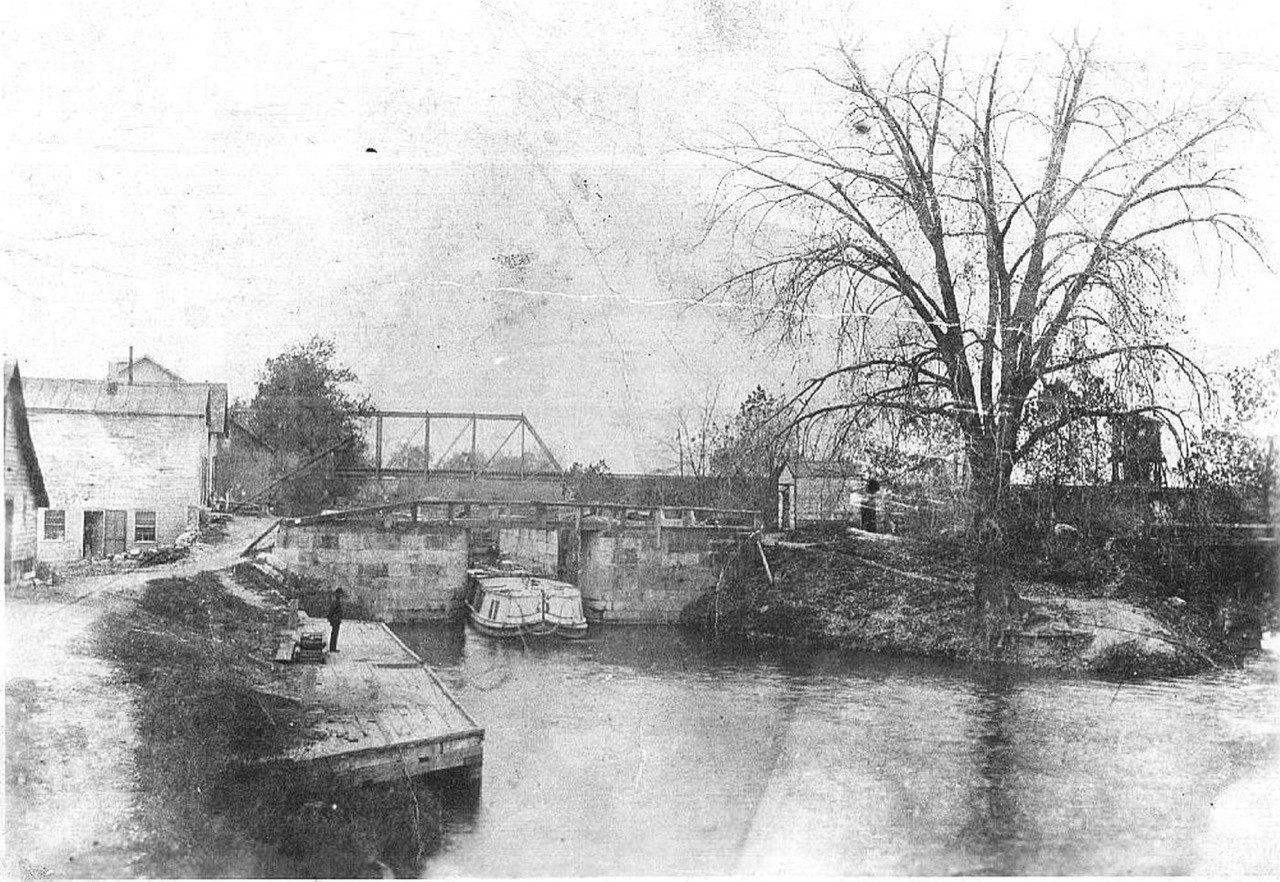
The taking was done, and now came the making, and the first great thing the Americans made in the emptied valley was a ditch.
They had wanted the ground and they had it: the nations carried west, the reserves signed away, the survey run across the drowned country in its six-mile squares. But land is worth only what a man can carry off it to a market, and the market lay a thousand miles away over roads that for half the year were no roads at all. The richest black ground on the continent was worth very little to the farmer who could not get his corn out of the swamp that grew it. So the state set out to build the road the country would not provide — a road of water, cut by hand clear across the width of Ohio to join the Ohio River in the south to Lake Erie in the north, and by the lake to the seaboard and the sea.
And it began, as everything on this ground began, on the ledger. The canal that would make Toledo was paid for in the nations’ own country: the federal government granted three hundred and eighty-four thousand acres of the public land, the old documents say, to be appropriated, exclusively, to extending the Miami Canal from Dayton to lake Erie§ — the very country the treaties had just emptied, sold off by the acre to dig the ditch that would carry the emptied land’s harvest to the water. The same arithmetic that had sold the swamp to pay for the road across the swamp now sold the nations’ ground to pay for the canal through it. The instrument never changed; only the works it raised grew larger.
The first ground was broken at Fort Wayne,§ at the head of the Maumee, on the twenty-second of February, 1832 — Washington’s birthday — and for a dozen years and more the digging went on, down the valley of the Maumee toward the lake and up the Wabash toward the Ohio, until the finished thing, when it was done at last in 1853, ran from the mouth of the Maumee at Toledo clear to the Ohio at Evansville: the longest canal ever dug on the continent, and one of the longest men had dug anywhere on the earth. It was cut with the shovel and the barrow and the one-horse cart, four feet of water in it and sixty across on the busy lower Maumee — half again the width of its southern miles — through the standing timber and the black water of the very swamp that had turned back every army sent into it; and where the height of land rose between the two waters the diggers drove a great trench, the Deep Cut, straight through a ridge of gravel the last glacier had heaped at its melting edge — four hundred men and better, the best part of four years at the one cut — so that the ditch of the 1830s ran clean through the moraine of the Ice Age, the newest wound in the ground laid open through the oldest.
And while it was still an argument about where the water would run, the ground beside it was already being sold twice over. Nobody at Defiance knew for certain which way the two canals would be locked together, and a decision about elevation was worth a city; so a man platted a large one called East Defiance on the bottom opposite the town on the strength of one engineering guess, and the canal went the next year on the high level instead, and that was the end of it. Up the Tiffin, the lands on both banks for miles were laid out into prospective Detroits and Lowells and Manchesters. A steamboat was built for the trade; a toll bridge went up; a dam was thrown across to make the slack water that would drive the mills. The speculators failed, leaving, in the county’s own phrase, the laborers and farmers much the losers. The steamboat went over the rapids in a freshet and an ice jam and could not be brought back. The bridge fell. Lowell, with its thousand lots and its streets with high-sounding names, was vacated and turned out to hoop-poles, and Detroit went the same way save half a dozen lots, and of a dozen more towns platted along Bean Creek the county historian could write within fifty years that even the names are now clean gone out of mind. Every one of them had been drawn on paper before the water came, by men who were certain they knew where it would go.
And the hands that dug it were not the hands that had emptied the valley. The men who swung the shovels were the poor of another continent, come over in the same years and for the same hunger — the Irish off the failing land and the Germans off their crowded states — so that of all the people who came to settle the canal line, one who counted them wrote, the Irish and Germans predominated; the former came to a large extent as laborers on the canal during the period of construction.§ They lived the hard, penned life the canal navvy lived everywhere in those years, and that the historians of that labor have set down plainly: strung along the line in shanty camps, paid a wage and a daily ration of ardent spirits — three or four jiggers of raw whiskey a day, to keep a man digging in water to his knees and to kill him a little faster for it — in a rough, hard-drinking, brawling camp world all its own. They died as canal men died on every low and wet line in the country: of the malaria and the cholera and the summer fevers that ran through a shanty camp like fire through a barn, and of the powder and the caving banks. What the swamp had always done to the newcomer it did to them, and had the more chance at them, for they lived in the wettest of it on purpose; they dug through the ague as every comer had sickened in it before, and a good many did not dig back out, and left no monument but the ditch.
But the ones the fevers spared did the thing the nations never got to do: they stayed. When the digging was done the Germans especially did not go home nor go on, but took up the drained and half-drained ground along the very line they had cut, and made of it a country of their own — canal fever, one of their own historians called the thing that drew them — and left behind them a whole German quarter of the northwest, the tidy Catholic towns strung along the canal’s summit up in Auglaize and Mercer, New Bremen and Minster and New Knoxville, that kept the old language in the pulpit and the schoolroom three generations after. From Fort Wayne down to Toledo the German families alone came to be a tenth of everyone and more. So the valley the ledger had emptied of its nations was re-dug, inside a single generation, and re-peopled by the very people the ledgers of Europe had emptied out of somewhere else: the second gathering of the driven this ground would see, and not the last.
The day the canal reached the lake, in the summer of 1843, the whole town at the river’s mouth turned out to meet it: the boats came in one after another through the Fourth of July, a reception committee to greet each at the landing, the Toledo Guards under arms to salute the ditch that everyone still believed would make the mud-flat at the river’s mouth the great city of the lakes. Up at the other end, at Fort Wayne on the head of the Maumee, the jubilee was grander still — Lewis Cass himself came down to orate, and the canal boats lay two tiers deep from the upper basin to the lower — and in the long procession that wound through the town that Fourth of July, among the bands and the militia and the men of commerce, there marched a company of Miami warriors, the Kekionga Band, turned out in the parade for the canal. What Cass said from the platform that day is worth setting down beside them, because he was not a bystander to any of this: he was the commissioner who had sat the nations down at the foot of the rapids in 1817 and taken four and a half million acres in an afternoon, and the ditch he had come to open ran across the ground he had bought. He began with the ground. For many years during the frontier history of this place and region,§ he told them, the line of your canal was a bloody war-path, which has seen many a deed of horror. Then he went on, at length, to fix a monstrous institution on the Miami by name and to assure his audience that the records of human depravity furnished no more terrible examples of cruelty than had been offered on the very spot where they were standing. The Miami were in the procession while he said it. That is the whole arrangement of this valley compressed into one summer afternoon: a canal dug across ceded ground, opened with a speech about the savagery of the people who ceded it, delivered by the man who took it, to a crowd that had come out to watch them march.
It was the summer of 1843. Three years later the Miami would be gathered up and carried west to Kansas by the same government whose ditch they had marched to celebrate — the nation that had held the portage at the head of the river since before anyone could reckon, walking in the procession for the very cut that had drowned the old carrying-place and would shortly carry them out of the country for good. No one on that ground appears to have felt the weight of it.
And then, for one bright decade, it very nearly was everything they had dreamed of it. The country the swamp had walled off from the world for ten thousand years poured its harvest down the canal to the lake in a flood that no one had quite let himself believe would come. In 1844 Toledo shipped out something over five thousand bushels of corn from the Maumee and Wabash valleys; two years later the figure had risen a hundredfold, and by 1851 it stood near three million — all of it come down the single ditch to the single lake town at the river’s mouth. The packet boats ran the length of it at eight miles an hour, gliding down from Fort Wayne to Toledo for three dollars and a quarter, a thing of curtained windows and hot meals that the pioneers who had crossed that same country in a week of drowning mud took for a kind of sorcery. At the canal heads the farm wagons stood in lines a quarter-mile deep — four hundred of them counted unloading at Lafayette in a single day of 1844 — and the whole face of the West swung round on its hinge: where the Wabash country had always floated its goods south to New Orleans and the gulf, now, the historian of the route wrote, the last cord binding Indiana economically to the southwest was severed,§ and the valley looked instead east and north, to Toledo and Buffalo and New York. For ten years the ditch was the thoroughfare of the West, and the fever-flat at the river’s mouth that two states had mustered their militias over began, at last, to be the city they had gambled it would grow to be.
It lasted ten years, and the thing that ended it was already being built while the canal was still digging. For the one quality that made the canal a wonder — that it could move a heavy load cheaply where no wagon could go — was a quality the railroad had too, and more of it, and in every weather and at five times the speed. The men with capital who had watched the ditch make Toledo now laid a railroad down the canal’s own valley, running parallel to it, west out of Toledo toward the Wabash country; and it reached Lafayette in June of 1856, and from that hour the canal’s death was written in the timetables. In one stretch of twenty-four hours that August the new road carried a hundred carloads of farm produce into Toledo — a hundred carloads in a day, where the canal boat crept its eight miles an hour behind a mule. The canal’s tolls had already fallen by half in 1855, and fell by half again in 1857, and its tonnage went the same way. The rail took the fast freight and the valuable freight and every passenger who would pay to save a day, and left the canal the cheap and heavy things that paid the lightest tolls — the corn, the lumber, the stone — so that the boats came down to Toledo loaded and, the good merchandise all gone over to the rails, went home empty. A thing that must run empty half of every journey does not run long. There is a small joke in the timing that the valley never noticed. In 1800, in the fort at the head of this river, an officer of the garrison had a son and named him George Washington Whistler. The father had been a British soldier: he came to America in Burgoyne’s army and was taken prisoner at§ Saratoga, stayed, took the other side’s uniform, and was in St. Clair’s army on the Wabash on the morning it was destroyed. He lived to build the first fort at Chicago and then to come back and rebuild this one. The son born inside those pickets went to West Point at nineteen, left the army, and became one of the great civil engineers of the century; and in 1842, the year before the canal came down to the lake and Toledo turned out to cheer it, he sailed for Russia to build the Czar a railroad from St. Petersburg to Moscow. The Emperor Nicholas gave him the Order of St. Anne for it in 1847, four years into the canal’s ten years’ wonder. The valley dug the ditch and a boy born at the head of the ditch was off putting down the thing that would bury it, four thousand miles away, on the same schedule.
And here is the entry the ledger would rather not have made, though it made it, dutifully, in its own books: the canal never, in a single year of its life, paid for itself. It had cost the state better than eight million dollars to dig, and in 1838, with only the first miles open above Fort Wayne, its whole take in tolls came to thirteen hundred and ninety-eight dollars and thirty-seven cents — a sum, its historian noted dryly, scarcely sufficient to pay the salary of one of the fund commissioners who had borrowed the millions to build it. It carried a fortune in other men’s corn down its length for twenty years and never once earned its own keep. And when it died, it was not the swamp that killed it, nor the ice, nor any act of the indifferent land; it was the state itself. The same government that had dug the canal in the emptied country turned and chartered the railroads that made the canal worthless, and let the men who had lent their money on the ditch be ruined to the last dollar; it was not nature, the creditors said when they added up their loss, but deliberate acts and authorization by charter to railroads§ that had destroyed them. The largest public work the valley had ever seen was obsolete before it was paid for, killed by its own maker’s next enthusiasm, and the towns it had raised went down with it. Lagro and Lockport, Georgetown and Americus, canal towns of great promise a dozen years before, emptied and fell in and were gone; the canal had made them out of nothing in a season, and unmade them as quickly when the arithmetic that made them changed.
Long before the weeds, though, the state had already found the canal’s second use, and it is the one the ledger would have chosen. In March of 1864, with the boats still running, the General Assembly passed an act authorizing the city of Toledo to enter upon and occupy the lower reach of the Miami and Erie — the Manhattan branch, from the aqueduct at Swan Creek down to the river — as a public highway, and for sewerage and water purposes, and to hold it forever. Cincinnati had been handed its own canal outlet on the same terms thirteen months earlier. The water road that a whole valley had bent its back to dig, and that two states had come within a militia muster of fighting over, was signed away to carry the town’s sewage.
The state was careful on the way out. The act gave nothing by itself: the city could have the ditch only after a two-thirds vote of its whole council, and only on lodging with the governor either a written release from the men who leased the public works or a bond indemnifying the state against every liability the vacation might raise. Then, and not before, the governor would sign. The commonwealth that had borrowed itself half to death to dig the thing made certain it could not be sued for giving it away. And even then it took six more years: the section between the Toledo locks and the river at Manhattan was not actually vacated until 1870, and Waggoner’s verdict on it is four words long — its traffic had never been such, on the score of business, to warrant its construction§.
So the ditch that two states had nearly come to blows to own, and that a whole valley had bent its back to dig, had its ten years and its long dwindling and then its weeds. The dwindling was itself a small monument to the ledger’s genius for spending: for years after the boats had all but stopped, the state went on paying salaries to lock-tenders who had no locks left to open, and built new locks so small they were of use to no one, and kept a roll of canal commissioners and officers drawing their pay for work of next to no value at all — good money laid out, to the very end, on the solemn tending of a corpse.
Some of it was drained and filled; some ran on in a shrinking, silting way another lifetime, hauling gravel and ice while the trains roared past it on the bank, until the great flood of 1913 wrecked the whole upper line in a week — the ditch dug to master the valley’s water undone, at the last, by the valley’s water. Only the lowest reach, from the rapids down to Toledo, ran on a little longer, turning a few mill-wheels and floating a few pleasure boats, until the state gave up the last of it in 1929 and set a day to drain the bed for an automobile road. The ground kept its own kind of faith to the end: one night that summer, days before the officials were to gather and ceremoniously let the water out, some unknown hand went up the towpath to the Utz farm above Waterville and cut the bank in the dark, so that the canal drained itself days ahead of its own funeral — breached at the last, as it had been breached at its birth by the farmers of Mercer and in its prime by the masked men at Antwerp, by a neighbor with a spade who would not wait for the ceremony.
The man with the spade was, in the strict legal sense, cutting a bank that no longer belonged to the state, and had not for six years; the paperwork had gone well ahead of the water. In 1922 the General Assembly declared the Lucas County reach abandoned and offered it for sale to the town at its mouth. The federal government, asked whether it wanted the ditch for any scheme of its own to join the two lakes, answered that it did not — declared not needed, the city’s own property card sets it down, by United States Government in any plan to connect Lakes Erie & Michigan — and with that the last public purpose the canal might yet have served was struck through. What remained was appraised. Three hundred thousand dollars was the figure; the council voted the money, the governor and the attorney general signed for the state and the mayor and the director of public service for the city, and on the fifth of January, 1923, the thing went on the record at volume five hundred and eighty-nine, page six hundred and three, as deed number four thousand two hundred and two. The description of what was sold is the ledger’s own poetry: from the foot of the outlet lock — lock fifty-two, counted north from the Loramie summit — along the bed and banks of the canal for forty-five thousand six hundred and eighty-three feet, to the tenth of a foot, by a survey a man named Buchanan had made in the summer of 1909, up to a point just below the head of the Maumee side cut. Eight and a half miles of dead water, measured off like a bolt of cloth. The purpose recited is for park and boulevard purposes§. There is one small careful exception kept back in the wording, in case the arithmetic should ever change again: should the United States at any time after want the ground for a ship or barge canal, it may have it.
They laid the new road down on the drained bed, and at the first they named it for the ditch — Canal Boulevard, widened in 1932 with a strip of ground bought for eight thousand dollars from a railway that had helped to kill the thing the road was named after. That name did not hold. Before long the city’s clerk was writing the plain note that stands on the card yet, Present Anthony Wayne Trail formerly was Canal§ Boulevard, and the road carried the general’s name instead — the man who had cut the first American road through this country a hundred and thirty-five years before. So the automobiles ran west on the line of the ditch that had run on the line of the river, each road laid down in its turn on the grave of the last, and all of it named at last for the soldier who had taken the ground all three of them ran through; and the road so named runs west, to this day, straight past the field where he took it.
At the head of the river the same account was closed the same way, with only the buyer changed. Fort Wayne had been raised first on the portage and then a second time on the Wabash and Erie, and it called itself the Summit City because it stood at the highest point on the whole length of the canal — a name that has now outlived by a century and a half the summit it was named for. The water road brought that town everything it had, and in 1854 it brought the last thing: the first railroad locomotive ever delivered to Fort Wayne arrived there on a canal boat, floated up the ditch to be set upon the rails that would shortly put the ditch out of business. It did not take long. By 1880 the canal’s right-of-way through the town had been bought outright by the Nickel Plate, and the trains ran where the boats had run; and the elevated tracks that railroad laid in 1955, and the freight that goes over them yet, still trace the line of the canal along the north edge of downtown. A ditch sold to a railroad at the head of the river and a ditch sold to a road at its mouth — the one corpse divided between the rails and the pavement, and both of them running, all this while and still, on a line that was surveyed for a boat.
But the railroads that had killed it did not leave the valley when the killing was done. They stayed, and multiplied, and made of the town at the river’s mouth a greater crossing than the canal had ever dreamed of being, so that Toledo grew, in the end, on the back of the very thing that had killed the thing it was first built to serve. The canal had been the ledger’s proudest monument, the largest entry it ever made on this ground: dug in taken land with borrowed money and driven by bought muscle, and then, the instant a cheaper line could be ruled beside it, let fall. The water road was the first of the valley’s great makings. It would not be the last to be raised in a hurry, worked to the bone, and abandoned the very hour the arithmetic changed.
The Swamp and the Glass CityThe Draining
Ten thousand River Commissions … cannot tame that lawless stream, cannot say to it, Go here, or Go there, and make it obey.
— Mark Twain, Life on the Mississippi
Then the Americans turned on the last thing in the valley that had beaten everyone — the swamp — and this, at least, they conquered, though it took them fifty years and it cost them what it always costs. They dug ditches and passed drainage laws and, when ditches were not enough, they mined the swamp’s own clay bottom, fired it into drainage tile, and buried a hundred thousand miles of it under the fields until the drowned forest that had turned back armies was simply gone — the beech and the ash felled for lumber, the black water run off to the river, the million acres of standing swamp become, by about 1920, the flattest and most productive farmland in Ohio. It was the most complete remaking of the ground that anyone had ever managed.
Two towns had stood on that lower river before the city did, and a county history set them down by name. At the mouth was Mis-sis-sa-nog, or Turkey Town, an Ottawa village under a principal chief called Scho-no, some six hundred people in 1810, with “fine cornfields and gardens and fine grazing country on the margin of the bay,”§ and a large tract of land held in its own right. Grazing means stock. Twenty miles up, on the ground still called Indian Island, stood Me-nish-sha-nong, Island Town: corn and beans and squashes and pumpkins in quantity, twelve miles of the left bank, and a French trader’s orchard that furnished “a never-failing crop of apples.” The two towns together came to about a thousand people. The chiefs of the island were O-to-saw and Na-wash, and after them Ot-to-kee and Wau-se-on. This is the town they were chiefs of.
Peter Navarre carried the mouth back further than that. The village there, he said, had stood since the days of Pontiac’s rising, and Pontiac’s widow Kan-tuck-ee-gun lived in it, and his son Otussa with her. The old woman was held in reverence up and down the lakes, and was the first to set her hand to the treaties: always the first one applied to by the nations for advice§. That was the ground the city was laid out over.
The draining was the one nearly clean victory anyone ever won here, and it was won not by an army but by a law and a machine and a very great deal of buried clay. The state passed its ditch laws, the decisive one in 1859, that let a county compel a man to drain his ground, and carry his neighbor’s water off through it besides; and then the newcomers hit on the thing that beat the swamp at last, which was to turn the swamp against itself. The dead blue clay that lay under the black loam and held the water up, the very curse of the country, proved to be the finest stuff in the world for the making of drainage tile. So the settlers dug up the swamp’s own cold bottom, fired it in kilns into hollow pipe by the millions of miles, and buried the pipe back down in the ground it had come from, in lines four feet deep and forty feet apart, until the water that had stood on the land since the glacier let go drained off down the clay veins of the old lake into the ditches and away to the river. The tile works multiplied like a fever in the low country — five of them in the valley counties in 1870, better than fifty by 1880 — and a clanking steam machine called the Buckeye traction ditcher came crawling across the fields laying drain faster than a gang of men with spades could have dreamed of. And the argument that sold it to a farmer was not really about standing water at all. It was about the calendar: tile at four feet warms the ground and dries it to that depth, so a man could be on his fields ten days earlier in the spring and would keep the frost out of them ten days longer in the fall — three weeks of growing season added to every year he farmed, compounding, for the price of a ditch he only had to dig once. By about 1920 the thing was done, and the price of it — though nobody then was keeping the account — was more than nine parts in ten of every wetland the state of Ohio had ever owned, run off in two generations and not missed until it was long past calling back.
What the tile let out was worth more than the men laying it understood, and the reason for it was the water they were taking away. Ground that stands wet does not rot what falls on it. Without air the decay very nearly stops, so the leaf and stem and root of several thousand years bank up in the soil instead of burning off a season at a time; and the same fine clay that would not let the water through holds the plant food against the rain besides. Under both of them lies the limestone the ice ground up and spread, which keeps the whole depth sweet and saves this ground from souring as a drained peat bog sours. The state’s own soil men measured the thing afterward, on three soils of one parent clay lying side by side and differing only in how well the water got off them: the well-drained one carried three or four parts of organic matter in the hundred, and the poorly drained one at the bottom of the slope carried six, and in places thirteen. The swamp was not sitting on rich ground. The swamp was what had made the ground rich.
And the draining spent it. Air went down into the soil behind the tile, and the banked carbon of all those centuries began at last to do what standing water had prevented it from doing, which is why the first crops were so extravagant: what looked like the fertility of the country was the account being closed. Something near a quarter of it has gone out of the top foot of Ohio’s cropland since the ploughing began — rather less from the heavy clays, which held on to more, because the same fineness that made the country impassable is what has protected what is left of it.
The state had trained men in the swamp while it was going. Ohio’s Second Geological Survey took the field in the summer of 1869, and the two assistants handed the fourth district, which took in the northwest, were young and did not stay obscure: Grove Karl Gilbert, who went on to the federal survey and to work in the western mountains that is read yet, and Newton Horace Winchell, who left Ohio in 1872 to be the first state geologist of Minnesota and was two years gone before the volume carrying his account of this country came off the press. Between them they walked the Black Swamp counties in the very years the ditch crews were cutting them, and what they set down is the last account of that country taken by men who knew what they were seeing, while there was still a country there to see.
Winchell had Paulding, and found it barely opened: about eighty-nine acres in every hundred still standing in the county books as uncultivated or wood land, timber so dense it was “but little intersected by roads,” and the whole of it serving as hunting ground for parties who came up in the fall from the middle and the south of the state after deer, and now and then a black bear or a wolf. That was 1874. Nearly forty years after the Toledo War, in a county the state was mapping for its mineral prospects, men were still shooting wolves in it. And down the river in Henry county, where no mound-builder had ever left so much as a heap of earth, the same drowned ground was refusing settlement a second time, a thousand years and more after the first refusal.
Gilbert had Williams and Fulton and Lucas, and he explained the ground as well as it has been explained since. The plain east of the old beach ridges he set down as a rich, friable clay loam, entirely stoneless, and he saw exactly why it was rich: lying so nearly level that the rain ran off it slowly, it had banked up a store of vegetable mould that quicker ground would have carried away. Then he finished the sentence the only way a man of that moment could finish it. It needs but thorough drainage, he wrote, to develop its wealth.
There is the whole of it in eight words. The man who understood better than anyone alive why this country was worth having wrote down the reason and the remedy in a single breath and felt no strain between them, because there was none yet to feel. The wet had made the ground; the wet would have to go. That the second half of that sentence would spend the first was not a thing anybody was in a position to see, least of all the man who had just measured it.
And they did the work under a running complaint. The legislature had allowed the survey three years and thirteen thousand nine hundred dollars a year to describe the state of Ohio — its economic geology, its general geology, its botany, its archaeology, its zoology and its agriculture, the whole of a state, inside of three years — and when the reports came back thick with strata and fossils the objection raised was that the work was impractical. The state geologist answered it in print, and quoted his critics to do it: there were men, he wrote, editors and members of legislature among them, who cherished the notion that nothing in this world has any value but the thing with a dollar in it, and that so plainly visible as to be seen by§ them — men who, in the words of one of their own, did not “care a row of pins for your clams and salamanders, but want something practical.” He added that the class they belonged to was rapidly passing away. It was not. In the whole of the nineteenth century the survey did real work in three stretches only — 1837 to 1838, 1869 to 1874, and 1882 to 1893 — and lay idle between them; the second of those windows, the one that produced everything said above about this valley, shut in 1874 with the swamp less than half cut. The same arithmetic that priced the country also priced the description of it, and closed the book early on both.
Once, and only once in the record, the drowned country dried out. Dr. Daniel Drake of Cincinnati came through four years afterward and took the measurements from the men who had lived it: on the bay and the lower Maumee no rain fell from the third of July to the fifteenth of October in 1838, and the town’s own physicians reckoned the drouth at four months. Every small stream in the region was exhausted and its bed went to dust. The wells at Tiffin failed before the middle of July. And the swamp itself failed with them — the marshes and pools, Drake set down, even those of the Black Swamp, from the Maumee to Sandusky River, were evaporated, their bottoms cracked open from shrinking§, and in places the trees standing in them died. The wild country came into the towns after water: deer and raccoons between Toledo and Maumee, quail crossing the town plat, and the frogs of the dried bed of Swan Creek — the frogs the settlement had been laughed at for, the frogs it was named for — migrated in countless numbers through the Streets of Toledo to the Maumee River§, going to the one water left. Frog Town watched its frogs walk out through the middle of it.
And then the fever came up out of the drying ground. It was under that process, Drake wrote, that the ordinary Autumnal fever was raised into such an epidemic as never was known before§ — which is the plain cause of the thing the county remembered afterward without the reason attached. Here is what the word ague meant in a street. The fall of 1838 was, by the county’s own reckoning, the most sickly season ever known in Toledo.§ A row of business houses caught fire that autumn and the town could not put it out — not for want of engines, but for want of arms to work them. One engine had to be run down to the river and set to feeding the other; the few men who had turned out were soon spent; and no fresh hands could be got. The reason given, over and over, up and down a burning street, was always the same one: the almost invariable excuse of every bystander was that he was too sick to pump. A town stood and watched a block of itself burn because it had not, that morning, enough well people in it to pass water along.
That was the town, in one autumn. The country had it for a decade and went on working through it. A township out in Henry County that took its first settlers in 1836 was, by the county’s own phrase, “a land of fever and ague to the very edge” until about 1845, and for several years after 1838 the larger half of its people were down with it through every summer and fall at once. The ague keeps a schedule — the shaking, then the fever, then the sweat, and then a clear interval before the next round comes on — and the clear interval is where the household went. The county’s own historian put it down as an ordinary arrangement: many a housewife kept the house and did the work of a whole family in the space between the passing of the sweating stage and the next attack, and a great deal of work was got through in those gaps, and had to be, because in such a season there was nobody well enough to hire. The men’s account of this country is in the militia rolls and the ditch contracts and the tile works. The women’s is in that one sentence, and it is the only place in the whole record where anybody says plainly how the work actually got done. Quinine, the same history adds, was the staff of life out there, and to a sick person it often meant more than bread.
The ague was the common misery. It was not the fatal one. A Findlay physician who had practised in the county through the whole of the draining set both diseases down side by side in its history, and put the ague plainly: a drawback to the early settlers which gradually disappeared as the country was cleared and drained, and not directly fatal in any case. The killer went by half a dozen homely names — milk sickness, the trembles, sick stomach, the slows — and it came into the house through the one thing on a frontier farm that everybody trusted. Cattle grazing the new ground took it up out of a plant, most likely the white snakeroot that whitened the woodland pasture in the autumn, which is the season the sickness kept; and the cows carried it to their own calves and to the family, in the meat and in the milk. The beasts stood still, or moped about feebly, and trembled hard if they were made to move, and went off their feed, and in a few days dropped and died. In people it began as a vomiting and a distress in the stomach that would not settle and went on to delirium and coma and death. It ran the whole country between the Alleghenies and the Rockies, and this doctor, who had buried his share of it, judged it especially virulent in northwestern Ohio. Nobody proved what caused it for another hundred years.
The detail in his account that belongs to this book is the one about the pasture. The cattle took the sickness on deadenings and clearings and ground newly broken, and they did not take it on ground that had been well tilled. It lived in the middle of the work. It was not a disease of the wilderness and it was not a disease of the farm; it was a disease of the half-cleared acre between them, the exact condition every county in this valley had to pass through on the way from swamp to section line — so that for a generation the ground did not punish these people for opening it, but for having opened it only partway, and the same herd that was poison in the woods pasture came back wholesome the season the field was finally broken.
The other measure of those years is in doctors. When the cholera came through in 1849 the calls for help were so many that Dr. Clark, and every other physician in the place with him, was nearly worn out by his labors, and nothing anybody knew to do for it did any good; a Dr. Green went out from Sylvania to treat it, took it, and died of it at thirty-eight. Waggoner’s medical chapter, looking back from the settled and prosperous city of 1888, gives the plain verdict on the town of those years: it was perhaps among the most unhealthful places in the universe. That is the country the ditch laws were written for.
It is hard, now, to feel about that the way the people who did it felt about it, and yet the distance must be crossed, because they were not vandals and did not think themselves anything but heroes, and by the lights of their own day they were right. To the family that had buried a child to the ague, to the farmer who had watched his first crop rot in standing water, to a whole generation that measured a country’s worth by the corn it could raise and the mouths it could feed, the draining of the Great Black Swamp was not a wound dealt to the land but a victory won over it: the hardest and most honorable labor there was, the turning of a useless, sickly, death-dealing morass into some of the richest farm ground on the face of the earth, food for millions and homes for thousands and the very picture of what human work and human ingenuity were supposed to be for. They drained it with a clear conscience and an earned pride. It is only from here — a century on, with a different set of bills coming due — that the same act shows its other face: the vanished marsh, the lost web of living things, the water that now sheds off the bare tile too fast and too foul and blooms the lake green every August. Both of those are true at once, and a reader does the story no justice who keeps only one of them. The people who drained the swamp did a great thing and a grievous thing in the very same motion, as people generally do, and could no more see the second half of what they were doing than we can see the full price of the things we ourselves are surest, this year, that we are right to do.
And no sooner was the swamp killed than the ground it had covered played its last and best joke, which was that the useless drowned bog had been floating, all the while, on a buried sea of fire. In the autumn of 1884 a well sunk after natural gas near Findlay, at the swamp’s southern edge, came in with a roar out of the same old limestone the tropical ocean had laid down four hundred million years before any living thing in the valley drew breath; and a year and more later the great Karg well blew in wild at twenty million cubic feet a day, its torch of burning gas standing a hundred feet into the air, heard five miles off and seen for fifty on a clouded night. Oil followed the gas, struck at Lima the next spring, and within a few years the old swamp counties were a black forest of derricks and the second oil field in the nation, and Mr. Rockefeller’s Standard Oil had made a western capital of Lima. It was a boom in the fullest and most wasteful American manner: gas so cheap the towns burned it day and night in open flambeaux they never troubled to shut, whole wells flared off into the sky for the pure squandering light of it, fifty-dollar farms sold for hundreds while their owners reckoned themselves princes, and all of it, gas and oil together, drawn up and burned and all but exhausted inside of thirty years, the derricks pulled and the flambeaux gone dark again before the men who had lit them were old. The ancient captured sunlight that the first sea had sealed in the stone came up in a single human lifetime, flared, and was spent.
Two things sit on either side of those thirty years, and the county wrote down both of them itself. The gas was argued for long before it was drilled: a Findlay physician named Charles Oesterlin had been convinced since about 1850 that a great deposit of it lay under the village and could be got at by drilling through the rock — but the people only laughed.§ Thirty-four years of being laughed at came before that first well. It had been burned before it was drilled, too, in the aptest fitting anybody in this valley ever devised: a householder at Findlay bored a hole through his own floor and attached a musket barrel to the pump tube, through which the gas was conducted to near the mouth of the open fireplace.§ The first natural gas used in the Maumee country came up a gun barrel. And it was not only burned before it was drilled; it was published before it was drilled. When the state geological survey worked Hancock County in the early seventies its report set down that at Findlay nearly every well had a sulphurous taste, that the inflammable gas escaping from them was used for lighting, and that the residence of Dr. Jacob Carr was lit that way — and then printed Carr’s own letter about it. He had been lighting the house nine or ten years already, he wrote in February of 1872, off a well sunk seven feet to the rock for kitchen water; the gas came up through crevices in the stone and “spoils the water for kitchen use.” He had three such wells on a lot fifty feet by two hundred. He had never once got down to the rock without striking gas, and had filled a number of holes back in on account of it. There is the whole boom running backward, one household at a time: a man digs for water, hits the fortune, finds that the fortune has ruined the water, fills the hole, and digs another. In 1865 a company had even leased the privilege on his lot and drilled a hundred and thirty-five feet into the limestone before the auger jammed and they abandoned it, and Carr had been burning their dead well ever since, the supply out of it being better than his own. Nineteen years before the well the histories credit with starting everything, somebody had found this field and walked off it over a stuck bit. When the wells did come in, the town went from five thousand people to eighteen thousand on the strength of the fire underneath it.
And on the far side of it, the consolation. A Hancock County history published in 1910, near enough to the bust to have watched it happen, sets down that the height of the boom held up on a level for a year or more and with the decline of years the gas has gone glimmering§, and then turns at once to reassure its readers that oil has taken its place and in a more permanent and staple form. That sentence is better left standing as it was written. This valley had been told once already that it was the future great city of the world, and it would be told so again in 1945, in those same words, over a scale model of itself. Here in the middle, a county historian tells it that this time the fire underneath is the permanent kind. Every one of them was believed. Not one of them was describing anything that stayed.
What the cheap gas built, in the short years before it failed, was the thing the city at the river’s mouth would carry for its name forever after. In 1888 a New England glassmaker named Edward Libbey, hunting a place with cheap fire to melt his sand and clean sand to melt, moved his whole works west to Toledo, drawn by the gas of the dead swamp and the pale sand of the lake shore; and there a mechanic in his employ named Michael Owens built across the next fifteen years a machine that did the thing every glassblower alive had sworn no machine could do — it made a bottle, gathered and blew and shaped and finished it, entirely of its own iron accord, by the hundred and the thousand an hour, and put a craft as old as Egypt out of the world inside a decade. Out of Libbey’s furnaces and Owens’s machines came the great firms — Libbey-Owens-Ford, Owens-Illinois — that made the old frog-pond landing at the foot of the rapids the Glass City, and glazed the windows and filled the shelves of half a continent out of the muck of a drained swamp.
The glass did not blow itself, whatever Owens’s machine would eventually manage, and the people who stood at the furnaces in the years the city took its name were not, in the main, the Libbeys and the Owenses. It was the immigrants. The same tide of Irish and German labor that had dug the canal and the drainage ditches now filled the glasshouses; and behind it came a newer wave off the boats — Poles and Hungarians and Slovaks out of the crowding empires of central Europe — drawn to one of the few American cities where a man with no English and no trade could get hot, dangerous, steady work at a furnace. They settled in their own wards along the river and around the works, kept their churches and their tongues, and made the glass; and the Glass City, like every made city of that iron belt, was raised as much by the strong backs that came for the wage as by the clever men whose names went up on the buildings. The valley the ledger had emptied of the nations was filled again, inside two generations, by people the ledger had emptied out of somewhere else — the Irish off the famine, the Germans off their failed revolutions, the Slavs off the crowded estates of the east: a second refugee valley, gathered this time not by the fur trade but by the furnace.
And in those furnaces worked children. The hand-blown glass trade ran, as much of American industry then ran, on the cheap quick labor of boys — the “carrying-in boys” who ran the red-hot finished ware from the blower to the annealing oven through a killing heat, hour upon hour, for a few cents and a spent childhood — and the worst of it was in the bottle and window works that had come west for the gas. One of those boys, a generation earlier, had been Michael Owens himself, an Irish immigrant’s son who went into a West Virginia glasshouse at the age of ten and carried the hot glass like the rest. And here the story folds over on itself: the iron machine Owens built, that gathered and blew and finished a bottle of its own accord and put the ancient hand-craft out of the world, put the carrying-in boys out of it in the very same motion. The child laborer grown to a mechanic built the thing that abolished the child labor he had come up through — ended it not by a law and not by a mercy but by making it, like the glassblower’s own trained lungs, suddenly worth nothing to anyone. It was very nearly the one time on this whole river that the machine and the mercy came out, by pure blind accident, on the same side of the ledger.
None of it would have made a city, though, without the thing the two states had gone to the edge of war to possess in the first place: the mouth, the harbor, the place where the water met the rail. For a long while the promise outran the fact. The boosters platted streets across the marsh and sold lots on paper, and one of them, a tireless prophet named Jesup Scott, spent his life declaring that this fever-ridden mudhole at the foot of the rapids was the destined “future great city of the world,” the natural capital of a continent whose weight was sliding westward, and for decades the river’s mouth stayed a shallow, silting bar where the lake boats grounded and the ague waited. But the promise was not wrong, only early. After the Civil War the government at last dredged the bay and cut a deep ship channel through it, until the heaviest freighters on the lakes could come to the wharves; and the railroads, which had already killed the canal, came threading into the town from every quarter until Toledo was one of the great rail crossings of the interior, where the ore and coal and grain of half a country changed from keel to rail and rail to keel. The farmers, for their part, finished the canal off with their own hands: when the state let a canal reservoir back up and drown their fields out west near Antwerp, two hundred masked men who called themselves the Dynamiters marched out in the night in 1887, blew the bulkhead and the locks, and burned the keeper’s house, and the militia the governor sent up found nobody at all to fight, and the legislature took the plain hint and gave the old ditch up for dead. The mouth that two states had mustered militia over turned out to be worth the trouble after all — not for the canal, which was obsolete before it was paid for, but for the deep-water harbor and the roundhouses that replaced it. Jesup Scott did not live to see the city he had foretold, but he came far nearer the mark than the men who had laughed at him, and he left the ground his money bought for the university that carries his name in it yet.
He had come to the place as a theory before he ever came to it as a man. Scott was a lawyer admitted to the bars of Georgia and South Carolina, and had taught in a women’s college at Columbia, and left the South in 1830 because on the one question that mattered there he was of the northern mind. Two years before he left he had already fixed on this river from a thousand miles off: in the July of 1828, still in Carolina, he wrote to the postmaster at Maumee asking for all the information in his power respecting your section of country, with the view of making it my future residence. He came west in 1831 as land agent for his father-in-law, started the valley’s first newspaper at Perrysburg in 1833 and called it the Miami of the Lake, took up the Blade at Toledo in 1844, and in 1868 set the whole theory down in a pamphlet: the weight of the world’s commerce was sliding west, and by 1900 it would come to rest at the foot of these rapids. It did not. Toledo in 1900 was a considerable city and not the capital of anything.
What he did with the theory is the part that outlasted it. In the October of 1872, sensible, the county history says, of the near approach of the end of life, Jesup Scott and Susan Scott his wife conveyed a hundred and sixty acres of Adams township — drained swamp, valued at eighty thousand dollars — to a corporation got up to receive it, in trust for the teaching of arts and trades to the children of a city that did not yet have the population he had promised it. He died fifteen months later. The school opened, and failed, and closed in 1878 for want of money; and in 1884 the family handed the whole of it to the city, which took the trust by ordinance and reopened it as a manual training school for boys of thirteen and up. In 1885 the trustees sold off part of Scott’s ground and built the east wing of the high school with the proceeds, and that wing is Scott High School, so that the school is made out of the land and not merely named for the man. The deed of 1872 carries two signatures. Only one of the two names is on anything.
The harbor and the rails did not make a city by themselves either. They made a market, and the market made a class of men the valley has almost wholly forgotten. For the forty years between the canal and the glass, Toledo was a grain port, and its first citizens were commission merchants who took a penny a bushel. The tariff the Produce Exchange had in force in 1887 sets the whole economy down in a column: a cent a bushel for selling wheat and every other grain but oats, a half cent for oats, a percentage on pork and lard and beef; and the membership printed beside it runs Walbridge, Young, Zahm, Southworth, Whitaker, name after name with the words grain commission after it. Out of that trade the town at last made money of its own, and it was a remarkably small circle. Valentine Ketcham had opened a store at the river’s mouth in 1836; by 1851 he was banking; and on the first of September, 1863, his house became the First National Bank of Toledo, which the county’s historian claimed was not only the first of its kind in the city but among the earliest in the United States. Its president was Ketcham, its vice-president Joseph Secor, its cashier John Berdan — the three largest merchant fortunes in the place sitting in one room, all three of them out of the same grocery house. Even then the local money was never the only money. When the older bank in town, a branch of the State Bank of Ohio that had got itself into trouble by 1852, was bought out of its embarrassment three years later, the buyers were four Cleveland capitalists and others, of Cleveland, with two Toledo men attached. One of the two was a lawyer named Morrison Waite, who would go from that board to Geneva as leading counsel for the United States in the Alabama arbitration, and from Geneva to the chief justiceship of the United States. The city’s other export in those years was a joke: David Ross Locke, who had gone into a printing office at ten and invented Petroleum V. Nasby at a Findlay newspaper during the war, brought him to the Toledo Blade in 1865 and made the mudhole at the foot of the rapids, for a decade or so, one of the loudest political voices in the republic — the first thing the place ever shipped out that was not weighed by the bushel.
So when Libbey came west in 1888 he was not founding a city. He was buying into one. There was a national bank on Summit Street a quarter of a century old, a produce exchange with a printed tariff, a chief justice of the United States who had come off one of its bank boards, and a grocery house turning over half a million dollars a year. What the glass brought was not commerce but scale, and the difference between those two is most of what came after. The grocery house had run for four decades on a ladder so ordinary that nobody writing it down thought to remark on it: Joseph Secor came in as a clerk in 1840 and ended a partner and a bank’s vice-president; George Secor was taken up out of the employees; James Secor and Maro Wheeler and John Ketcham were made partners in 1858 from among the salesmen; Norman Waite came off the floor into a partnership in 1877. The record lists them that way flatly, as former salesmen of the house, the way you would note where a man was born. That proves less than it seems to. The house was small, the ladder was for white men already inside the door, and the same city in the same decades drove Black laborers off its docks with clubs and would raise shot-gun companies against its own workmen. But a man behind that counter could see the top of the thing he worked in, and now and then he climbed it. A man on the floor of a glasshouse could see nothing of the kind. What he would begin to ask instead was not how to rise out of the wage but what the wage was owed — and that is a different question, and it does not get settled at a counter.
The Made CityThe Other Claim
Bowed by the weight of centuries he leans / Upon his hoe and gazes on the ground.
— Edwin Markham, The Man with the Hoe
The made city bred a new kind of comer, and it took the valley a while to notice, because they were the first in the whole long procession who did not want the ground. They wanted a share of what was made on it. The ground, meanwhile, had begun quietly to file a claim of its own.
The nation’s own great war is remembered here for the wrong thing. On a low island in Sandusky Bay the Union penned Confederate officers — three thousand at a time and fifteen thousand first and last, and a wild plot to free them by seizing a lake steamer came, in 1864, to nothing; it left behind only a scatter of gray graves on the island, which the Union veterans of the valley, when their own angers had cooled, took in time to decorating each spring beside their own. That is a story about prisoners other men had taken, happening at the valley’s edge while the valley watched. The war the valley itself fought went south, and it went out of these counties by name.
The Twenty-first Ohio
Three days after Lincoln called for seventy-five thousand men, seventy-two men of Hancock County put their names on the roll at the Findlay court house, and companies formed within the fortnight. Three of them went into the Twenty-first Ohio, and the rest of the regiment came out of Putnam, Wood, Defiance and Ottawa: farmers and farmers’ sons, in the plain words of the captain who afterward wrote their history — which is to say the men of the drowned counties, sons of the ditch and the tile, off the very ground their fathers were still pulling the water out of.
They went where the war took them and it took them a long way: Stone River, where two brothers of Company F named Stoker were killed on the same field, so that when the veterans of Findlay came home and founded a post they called it by both their names. Then Tullahoma, and then a ridge in Georgia on the twentieth of September, 1863. Three months before it, eight of the regiment’s ten companies had turned in their Springfield muskets for Colt’s revolving rifles — they had been promised horses to go with them, and the horses never came — and their own historian judged it hardly possible that without them the regiment could have thrown back the first charge made on it. They climbed Snodgrass Hill with ninety-five rounds to a man, and they fired forty-three thousand five hundred and fifty of them.
Then the rounds ran out, and what they did next is the part worth carrying. Orderlies sent back for ammunition found the brigade gone toward Chattanooga. The cartridge boxes of their own killed and wounded were searched, and then the hospitals; cartridges cut for other guns were forced into the Colt chambers; and a third assault came up the ravine to within twenty yards of the line and was thrown back with what that scavenging produced. A last search of the line turned up one round per man. Ordered then to a position on the extreme right, they took it with empty guns and captured nine prisoners at the point of the bayonet. At dark the troops to their right were withdrawn without notice, four regiments closed round them in the dusk, and the remnant was surrendered. On this river a promise of protection had been withdrawn without notice before, twice, on the same low rise at the foot of the rapids; and it had gone unowned both times.
It went unowned this time too. Their own colonel was not on the hill: an order had sent him back to Ohio three weeks earlier to bring forward the drafted men assigned to his regiment, and there were no drafted men there, and he returned in November without a single recruit. The order that put the regiment where it could not get out — sending men with empty guns to hold the open flank — was never traced to anybody at all. Their major was at great pains to find out whose it was, and never did. The whole of what the regiment ever learned is one sentence, and it is the coldest sentence in the valley’s Civil War: All we know, and probably all that will ever be known, is, the officer who gave the order wore colored glasses.§
What it cost is not a settled figure and cannot be made into one, and the honest thing is to say so. Their commander’s own report gives five hundred and thirty-nine engaged and two hundred and sixty-five lost, and of the men taken on that hill very nearly half never came out of the prison pens at Andersonville and Danville. And over the four years the regiment’s whole arithmetic says the thing this valley of all places should recognise: a hundred and seventy-two of its men were killed by the enemy, and two hundred and twenty died of disease. The sons of the drained swamp went a thousand miles south and were carried off by fever anyway, at a rate no army opposite them ever managed.
They came home and found the record would not have them. There was no official list of the battles the regiment had fought in — the War Department had not published one — so the veterans compiled their own, twenty-two engagements from Kentucky to North Carolina, and printed it themselves. Their captain wrote the regiment’s history because their colonel had begun one to correct the official reports and died before he could finish it. And in 1894, one year after that book appeared, the State of Ohio set a granite shaft on Horseshoe Ridge with a bronze tablet on the back of it, and the tablet says the regiment was relieved that afternoon to replenish its ammunition — which is precisely the thing the book exists to deny — and its casualty columns disagree with the men’s own commander on every single number. Where, then, the book had already asked, did the regiment spend the afternoon, and under what circumstances did it lose§ a hundred and forty-nine of its number either killed or wounded? No answer was made. The bronze went up regardless, and the bronze is what stands on the ground.
The ledger closed this account as it closed the others. It let a regiment be taken with empty guns, declined to name the officer who put them there, could not trouble itself to list where they had fought, and then had the last word cut in stone over them — and the men, as the men of this valley have always had to, wrote the true account out by hand and paid the printer themselves.
That was the war as the valley’s men fought it away from home. There is a page from the same war fought here, on the docks, and it goes in for the same reason the regiment’s does: an account that keeps only what flatters is not an account.
In the July of 1862, with the regiments raised at Findlay and Toledo in the field, the stevedores on the Toledo docks moved for an increase of wages. The instrument they chose to enforce it with was not the withholding of their own labor. It was the barring of other men’s: they “forbade the employment of Colored men in such capacity,”§ and on the eighth of July they went down and made it good, attacking the Black laborers with clubs and stones and driving them from the dock. Two men were seriously hurt. One of the mob was stabbed by a Black man he was assaulting. A rally of citizens, with such arms as they could find, put the riot down, but not before it had carried past the wharves to the small houses of Black families “in no way connected with the trouble.” Prominent among those who stood against it was the pastor of St. Francis de Sales, Father Boff, who hastened to the dock and to any other point where he could be of use. Several of the rioters were arrested, tried and punished. Waggoner, setting it down twenty-six years afterward, allowed that it had been attended by a degree of violence at that time without precedent in the city.
The claim of the working man against the ledger is a just claim, and it was just that July. What the men on that dock did was take the justice of it and enforce it by shutting another man out of the work — and there is nothing new in that instrument. It is the ledger’s oldest. This whole valley had been carried off by it: find the party that can be got to sign away what is not its own, and call the signature a title. The nations had been unmade that way for a century, one faction at a time. Here it was on the wharves at the foot of the rapids, wielded now by men who owned nothing but their hands, against other men who owned nothing but theirs, and not one of them could have told you where he had learned it.
The made city bred more than machines and mayors. It bred, early, a new kind of claim on the valley — and this one was unlike every claim that had come before it. Each earlier comer had wanted the ground, and had taken it from someone. In the spring of 1869, in a hired hall on Summit Street, a company of Toledo women organized to want something else. They drew Elizabeth Cady Stanton and Susan B. Anthony to the city to speak, and then they stayed and made a society of their own — the Toledo Woman Suffrage Association, among the earliest anywhere in the country — set at its head Emma Ashley, wife of the Toledo congressman who had helped drive the Thirteenth Amendment through the House, and wrote into their constitution the plain declaration that equal rights were “the natural inheritance of all.” It had been slow in coming. “The nineteenth century had passed its meridian,”§ one of them wrote, “before any public agitation had taken place in the Maumee Valley relative to the equal rights of woman” — and the one who wrote it was the truest of them, Rosa Segur, a German girl carried into Toledo as a child in 1840, grown to keep a women’s column in the Blade, and moved at seventy to set the whole story down before it was lost. What these women asked for was the one thing no claimant here had ever asked. Not to own the valley, nor to take it from anyone, but only to be counted in the governing of the ground they already lived on. They asked it, as it happened, in the very season the nation was resolving that the freedman should have the vote and the woman should keep waiting, so that their claim, like the nations’ before them, was set down long before it would be honored. Half a century would pass before Ohio let a woman vote. But the asking had begun, on the drained lakebed, in a city a single generation risen out of the swamp, and it had begun here.
What that half century actually consisted of is on record too, because at twenty-five years they stopped and counted it up. The report read at the Church of Our Father on the nineteenth of January, 1894, is very largely a list of losses, set down on purpose and without self-pity. A municipal suffrage bill carried forward and lost. A bill to put women on the trustees of the county children’s home, lost. A plank asked of the Republican state convention in 1888 and denied. Letter after letter to one Ohio governor and then the next, asking only that the question be named in an inaugural address; one governor wrote back; another, a rising man called McKinley, sent a single typewritten letter and then said nothing about it when the day came. Against all that, the things they actually got are small and practical and hold up: a paid police matron in the city of Toledo, and after her a standing arrangement to go down to the station every month and report to the meeting on the care of the women and children being held there. They hired a speaker to carry the argument to the open meetings of the Knights of Labor, in German and in English, which in that city meant reaching the sons of the men who had dug the canal. And at the end of the accounting the woman reading it reached back past every one of those years to the one argument the ledger has never found an answer for: our Revolutionary fathers lost more battles than they won, and gained their freedom at last by sheer persistence.§ She wrote that in 1894. It was twenty-six years early. It was also, word for word, the position the nations had taken on this ground and had not been given the generations to prove — that a claim set down long before it can be honored is not thereby a claim withdrawn.
Eight years after that hall on Summit Street, the made city found out what else it had bred, and the finding out took a day and a half.
In the July of 1877 the wage cuts running down every railroad in the country reached the Toledo yards: ten per cent off the top, and the top was a dollar a day for a freight-house or track man and thirty-four dollars a month for a switchman. The men struck, as men were striking that fortnight from Baltimore to Chicago. What made the Toledo rising its own came two days later, when a meeting out in the Fifth Ward stopped speaking for railroad men at all and resolved that every laboring man shall abstain from working until he receives $1.50 per day§ — and named three men from each ward, twenty-four in all, to go and say so to the proprietors of every factory, lumberyard and firm in the city.
They went the next morning. Two hundred of them formed at the United States Hotel and walked from Perry down Water Street toward the Pennsylvania depot, calling the men they passed to fall into line, and many did. At each works the leader went in and demanded that it shut. The foremen said the reasonable thing, and the answer they got is the whole argument of the coming century, spoken in a Toledo doorway by a man whose name nobody troubled to write down. But our men are satisfied with their wages, the foreman would say. What will be the result if they keep on at work? And the leader: It makes no difference whether your men are satisfied or not. No one is to work until all are satisfied,§ and all are getting uniform and equitable wages. You keep on working till further notice at your own risk. You take your chances. At another place he put it shorter. You must shut down; and don’t you open again, either. The coal yard closed, and the lumber yard, and the stone works, the saw mill, both iron foundries, the bending works, the machine works. The march ran from ten in the morning until three, when it was suspended for the reason that everything was already shut. At dark the crowd went down to the Board of Trade at Water and Madison with threats toward the dealers in grain, and did nothing; and on to the office of the Commercial, which had been loud against them, meaning to close it, and did not.
That is a general strike, in a city that had not yet been taught the phrase, and the answer to it was raised overnight. A mass meeting at Market Space that same evening asked the mayor for a Committee of Safety of not less than twenty men from every ward, and the Police Board ordered every saloon in the city closed until further notice. The next morning, on the sheriff’s call, seven companies of citizen soldiery were organized for drill and patrol, and the county history is plain about what they were made of: “made up largely of ex-Union Soldiers,” under Colonel Nat Haughton, who had taken the Twenty-fifth Ohio through the war. There was a Shot-gun Company under Major E. O. Brown and a Pistol Squad under E. H. Chase. The force “was at once armed, and took the field against the mob.” Inside twenty-four hours the city was quiet.
Twelve years after Appomattox, men who had gone out with the volunteer regiments of this valley were formed into shot-gun companies against the men who worked in their own city, and the county history prints the rosters of both without a tremor — several hundred names of the safe on one page, and on another the coal yard and the saw mill and the foundries where the unsafe had been standing the day before. Waggoner does add the thing a celebratory account would leave out, that the worst of it was not the railway employees’ work at all but that of “resident parties, who seized upon the occasion for gratifying their passions.” But the shape of the day is not in dispute. The city was shut wall to wall by its own hands in the morning and opened again at gunpoint by its own veterans the next.
What the marchers had asked for was not a thing a shot-gun company could answer, and it did not go home when the streets did. It was still standing twenty years on.
Thirteen years after the city’s school board voted, four to three, to let Black children in at the doors of its public schools, a Black man walked onto a major-league ball field wearing Toledo’s name. Moses Fleetwood Walker was born at Mount Pleasant, Ohio, in 1856, went to Oberlin and then to Michigan, and caught for the Toledo Blue Stockings when they took their league’s pennant in 1883, at a salary of two thousand dollars; and when the club stepped up into the American Association for the season of 1884, he went up with it, and so became the first Black man to play in the major leagues of American baseball. He made his debut on the first of May against Louisville. He caught forty-two games and batted .263, and a rib he cracked that summer would not knit, and in September they let him go. His younger brother Weldy played six games in the outfield that same season, the second. After the two of them the door closed, and it stayed closed for sixty-three years.
It was drawn shut at Toledo, in person, by the most famous player alive. In the August before, Cap Anson had brought his Chicago club down for an exhibition and announced that he would not take the field against Walker; Toledo’s manager put Walker in regardless and Anson gave way, but that refusal is generally counted the opening move of the campaign that shut Black players out of organized baseball until Jackie Robinson. What it cost to be the man in the middle of it survives in a sentence from his own pitcher. Tony Mullane called Walker the best catcher he ever worked with, and said in the same breath that he used to cross him up deliberately — throwing whatever he pleased instead of the pitch Walker had signalled for — because he would not take signs from a Black man. A catcher receiving pitches he has not called, at that range and that speed, is being asked to do the most dangerous job on the field with his hands tied; and he was rated the best in the game while doing it. Walker’s own verdict came later and the plaques leave it off. He caught a few more years in the minors, was tried in 1891 for a killing in a street fight and acquitted, served a year for mail robbery, buried a wife, edited a newspaper — and in 1908 he published a book arguing that Black Americans had no future in this country at all and ought to leave it for Africa. The man who had integrated the major leagues had concluded that integration was impossible. He died at Cleveland in 1924. Toledo named a square for him in 2002.
In the made city, at the century’s turn, the next man to take up what the marchers had asked for took it up without a rifle — a new kind of man that the valley may claim for its own as fairly as anything it ever grew. Samuel Jones was a manufacturer of oil-well tools who ran his shop by a single rule posted on the wall — the Golden Rule, that a man should do by his workmen as he would be done by. He had come to it, by his own account, out of disgust at another factory’s string of rules “a yard long, at the tail of every one of which was a threat of dismissal”: I am going to have a rule for our shop, he told his wife; I am going to have the Golden Rule printed on a piece of tin and nail it up as the rule that governs the place.§ One rule of fair dealing set against a placard of threats. But he would not let the story stand as a compliment to himself, and the sentence he put after it is the one the retellings drop. It was not, he wrote, any belief in my own goodness of heart or my ability to reach the lofty ideal of doing to others as I would be done by,§ but it was the reaction that came from the contemplation of the outrageous injustice that was practiced upon my fellow-men by the iron-clad rules to which they are made abject slaves in order to gain the right to a bare living. He is refusing the credit in advance, and refusing it for a reason: he did not think he had been good, he thought he had been angry. The man who wrote the introduction to his book said what he was actually doing, and said it, as it happens, in the language of accounts — that what reached people was not the five per cent above wages so much as the distinct message that wages do not settle the account.§ He paid his men a living wage, and gave them paid holidays and a park, and was so plain a crank by the standards of his day that when he was made mayor of Toledo the bosses of his own party would not put his name up again. He ran without them, as an independent, and the city returned him in a landslide, and returned him again, and kept him in the office until he died in it in 1904, mourned by the working people of the town as few rich men have ever been mourned. Golden Rule Jones, the valley called him, half in mockery and half in love, and the reform politics he practiced ran out from the little Glass City across the country in the years that came after. The market at the foot of the rapids, that the beaver had first made worth something and the French had first come to trade at, had begun to export, along with its grain and its glass and its oil, ideas about how a people ought to live. The Americans had wanted the ground itself, and they had it, and they had made of it something none of the others who came before them could have imagined.
And still they were only the latest.
For the thing the Americans could not do, that none of them could do, was stay in the sense the land means by staying. The nations had held the valley a thousand years and were carried west in a summer. The French had held it a century and let it go for a battle they never heard. The British had held it fifty years and sailed away. The Americans drained the swamp and drilled the oil and built the city, and the swamp, it turns out, is coming back. The same drained ground that grew the corn now sends its buried water, thick with what the fields are fed, down the tile and the ditch to the river and out into the lake, where every summer it blooms green and foul. In the first days of August 2014 that bloom drew a skin of poison across the very crib of the water intake off Toledo, and half a million people on one water system woke to be told not to touch their own taps — not to drink the water, not to boil it, not to bathe a child in it — for three days, because the water the drained swamp had fouled was, for once, unfit to swallow. The marsh the tile was laid to kill had reached, a full century later, all the way into the kitchen sink.
And it was not the only made water in the valley that had turned, in the end, to poison. There was a second, and its story is the canal’s own. To carry a boat over the height of land between the lake and the Ohio, the canal needed water at the summit to feed it — more than any stream up on that flat divide could give — and so, in the years around 1840, the state set some seventeen hundred laborers, Irish and German, to make a lake by hand: to dig, with the barrow and the one-horse cart, sunup to sundown for about thirty cents a day, an inland sea nine miles long out in the low country near Celina, drowning a wide flat of the old swamp under it to hold the water that would float the boats across the seam of the continent. Grand Lake St. Marys, they called it, and when it was finished it was reckoned the largest thing of its kind that men anywhere had yet made. The canal it was dug to feed has been dead a hundred years. The lake remains — ringed now by the same fertilized fields, and become the single most poisoned large water in the state, its August surface a reeking blue-green scum too foul to touch, its bed so charged with the phosphorus of a hundred farm seasons that it feeds its own blooms and would need thirty years to clear if every field around it went fallow tomorrow. And because it sits square on the divide between the northern waters and the southern, it sheds that poison both ways at once: north by the old canal line toward Lake Erie, and south down the Wabash toward the Ohio and the Gulf, a single hand-dug lake fouling the drainage of half a continent. They had made it to join the two waters. It joins them still, in the one coin nobody wanted.
To answer it, back in the Maumee’s own country, men have begun, in our own time, to pull the tile up again and let the low fields flood, to plant the beech and the ash back, to un-drain the drained land acre by acre and coax the Great Black Swamp to return. Two centuries after Wayne’s soldiers cursed its mud, the swamp is the one party to this whole long story that is quietly, patiently, winning.
The swamp kept one other foothold besides, and the city has long since forgotten that it is a foothold. In 1896 a man named Charles Strobel bought the local ballclub — it was called the Swamp Angels then, which was already the country talking — and wanted to play on Sundays, and the city’s blue laws forbade it. So he made an arrangement with the street-car company to run a line north past the city limits, out to Bay View Park on the edge of the lake, and played his Sunday games there, where the ordinances of Toledo did not reach. The ground he had picked was marsh, and the marsh was full of American coots: a dark, white-billed, short-winged, long-legged bird of the rail family that comes north to breed in exactly the season baseball is played, and that everyone in this country called a mud hen. The name stuck to the ballclub and has never come off. So the city that spent fifty years and a hundred thousand miles of buried clay pipe killing the Great Black Swamp goes on cheering, summer after summer, for a swamp bird — the drowned country surviving, of all the places it might have survived, on the front of a baseball shirt.
And the people the valley emptied did not vanish either. They endure — the Miami and the Ottawa, the Shawnee and the Wyandot and the Potawatomi and the rest — as living nations in the west it carried them to; and the heirs of the Miami families the paper exempted in Indiana, and a clerk struck off the rolls in 1897 are, in this very decade, still petitioning a federal office to acknowledge that they exist.
One life measured the whole distance. Kil-so-quah was born in the May moon of 1810 at the forks of the Wabash, a few miles from the ground where her grandfather had won his first victory; the grandfather was Little Turtle. The settlers who wrote her name down made it Setting Sun, and it does not mean that either — Kiilhsoohkwa is sun-woman, and the granddaughter’s name was mistranslated in the same way and in the same century as the grandfather’s. Hers was one of the families the paper let stay, her husband’s government grant traded for a farm near Roanoke, and there she remained when the boats went — keeping the language, keeping the customs, keeping her wigwam until about 1905, when it fell to pieces from wear, and keeping — for the whole hundred and five years of it — a flag that was said to have been handed to her grandfather at Greenville. The council house at Wapakoneta was cut up and passed round a town as souvenirs, and the sword out of Little Turtle’s grave went to collectors and his skull to a dentist. The one thing from that treaty that stayed whole stayed in the hands of a woman who never learned the language it was written in. In a hundred and five years she learned fewer than twenty words of English, and the one she used most was rheumatism, for the ailment of her last years; the gout had killed her grandfather, and the one piece of the newcomers’ tongue his granddaughter wore smooth was the name of the family affliction. She liked to tell of the deer she had killed with a hatchet as a young wife, and how the white hunters toted the game away without offering her a mess of the venison — she told it, all her life, as an adventure, and left the arithmetic of it to the listener. Blind at the end, sewing quilts she could no longer see, she said the barest thing anyone in this book says of what the emptying left behind: When I am busy I think of my work; when I am idle I think of how poor and alone I am.§ And once, near the end, she was neither poor nor alone. On a September Sunday in 1914 — weeks after the last passenger pigeon died in its Cincinnati cage — some forty-five Miami came together at the old homestead, and there was a war-dance, and the music was an old pan and a stick, beaten by Little Turtle’s granddaughter, a hundred and four years old, in the one company on earth that could still talk with her. She died the next year, and was buried at her own arranging: beside her, in a box a country doctor had kept in his office eight years for the purpose, the bones of her husband, and on her hand the two gold rings that go with the owner on the journey.
The story that opened with nations holding this valley by right of long possession has not closed. It only moved.
The Rust CityThe Ledger Comes Home
A bar of steel — it is only / Smoke at the heart of it, smoke and the blood of a man.
— Carl Sandburg, Smoke and Steel
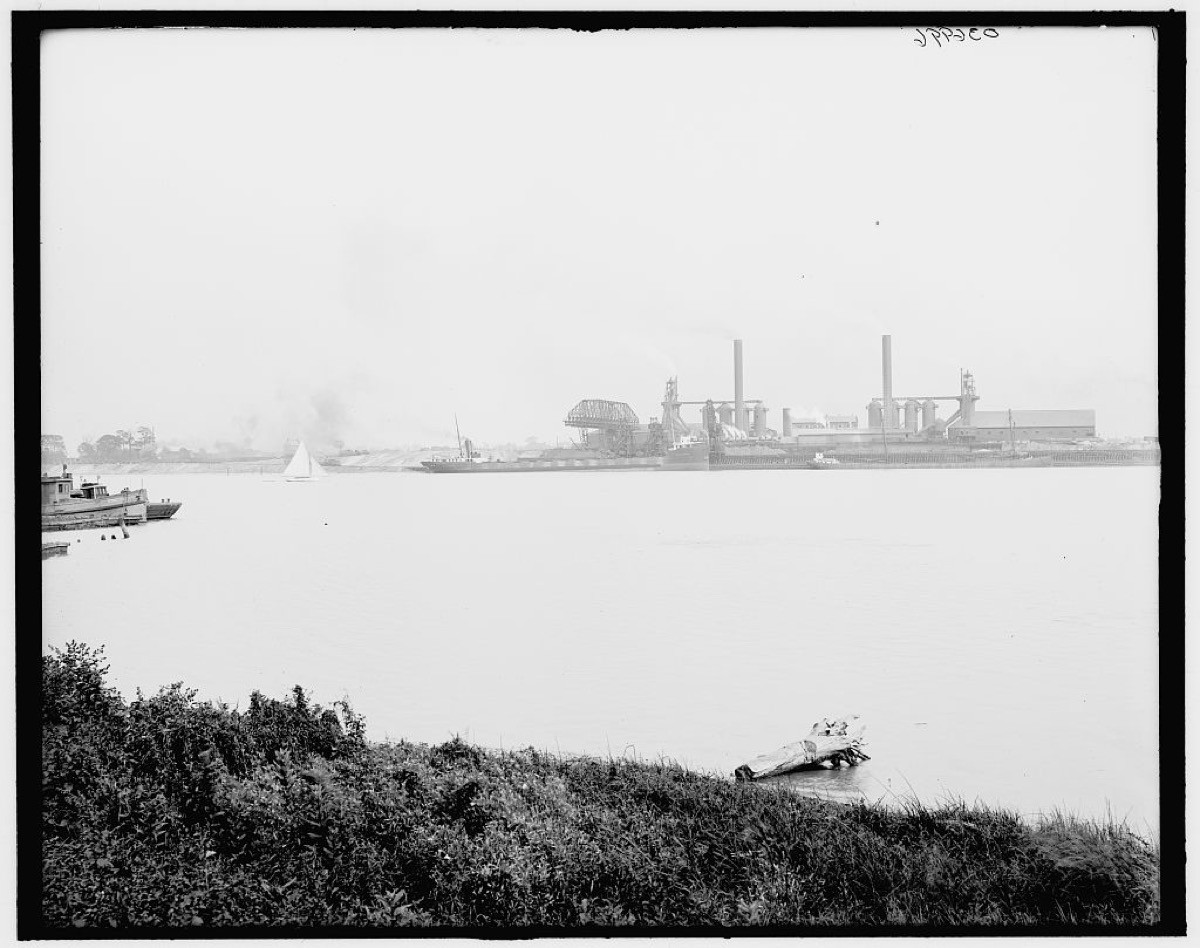
The swamp’s victory is a slow one, told in centuries, and the endurance of the nations is slower still. But there is a faster story on the same ground, and it is the last one the valley has to tell — the story of the people who drained the swamp and believed they had won it, and of the single loud century in which they made the valley more thoroughly theirs than anyone ever had, and then stood and watched it be taken back out of their hands. The strange thing, the thing that closes the long account, is who took it. It was not the water, and not the returning marsh, and not any army or any nation. It was the same cold hand that had taken the valley from everyone who held it before them, and this time it reached into the pockets of the takers themselves.
For the first half of the twentieth century the city at the foot of the rapids did the one thing three centuries had trained the valley to do: it took what the ground gave and carried it out. Only now the ground gave neither fur nor corn but the buried fire and the pale lake sand, and the thing carried out was no longer a raw material but a made object with a Toledo name upon it. The cheap gas that had pulled the glassworks west built, in two generations, an industry that put the city’s glass in the windows and on the tables and behind the headlamps of half a continent — Libbey and Owens-Illinois and Libbey-Owens-Ford, and in 1938 a company that learned to spin the very sand of the old lakeshore into a wool and called it Owens-Corning, fiberglass, a Toledo invention that would go into the walls of a nation’s houses.
And glass was the smaller half of it. The automobile came, and the crossroads that had gathered the traffic of canoes and then of canals and then of railroads gathered now the traffic of the car; the city filled with the makers of spark plugs and headlights and axles and transmissions; and a Toledo firm called Willys-Overland, which had been building automobiles on the Maumee since before the first great war, was handed in the second one a small, ugly, indestructible machine to build by the hundreds of thousands — the Jeep, the quarter-ton truck that went wherever an army had to go. So that the valley that had drowned the armies of three empires in its mud now built the machine that carried a fourth across the beaches and deserts of the world.
Toledo went to the second war an arsenal, in more than the usual figure of speech. The Jeeps went overseas by the hundreds of thousands, and the glass went with them. The same Owens-Corning fiberglass then going into the nation’s walls was spun in those years into a fine sterile filter cloth for the Army’s new blood-plasma kits, and the company said as much outright in its own wartime advertising: a new war weapon to save lives§, out of Toledo, Ohio — the claim behind it being that, for the first time in the history of war, a wounded man’s blood loss could be answered on the ground he fell on, and not a hospital ship away. On the ninth of August, 1943, on a road in Sicily, a Private Roy Humphrey of Toledo lay wounded by shrapnel and was given plasma through exactly that kind of filter, by a medic named Harvey White of Minneapolis — a soldier of the Glass City kept alive, a continent from home, by the Glass City’s own invention. Toledo came home from that war to its fattest years.
But the making of the object never did settle the old question the Glass City’s crank of a mayor had raised and lost — the question of the share. Golden Rule Jones had nailed his tin sign to the wall and asked the men who owned the shops to do by their workmen as they would be done by, and they had not, and he had died, and the shops had swelled into factories with thousands at the line and the Golden Rule nowhere on any wall in them.
No city in the country took the fall harder. It began on the sixteenth of June, 1931, when Security-Home Trust shut its doors and its ten branches with it; within nine weeks four more banks went down after it, thirty-four branches in all, and something over a hundred million dollars — seven of every ten dollars then on deposit in the city — sat frozen behind locked doors. A scholar of the whole national crisis, writing six decades on and with no stake in the story, would still name Toledo’s collapse among the recognized shocks of that August, in the same breath as Chicago’s. Four of every five of the city’s industrial workers stood idle, and by the time the relief rolls were counted, “a greater percentage of the population was on some kind of federal relief than in any other American city.”§ What came out afterward was worse than the arithmetic. In the six weeks before Security-Home fell, its own officers had quietly drawn out a million and a half dollars for themselves and their kin, while the depositors who had trusted the bank with their savings managed, between all of them, to get out six hundred and eighty thousand; three of the bank’s men were indicted that same year, and not one was ever convicted. The valley that three centuries of comers had prized above all else for what it could be made to give had, for once, nothing left to give even its own, and the men keeping its books had already helped themselves to what remained.
There was a second economy running through those same years, and it kept no books at all. Prohibition had turned liquor into an illegal commodity, and Toledo sat where Toledo had always sat: at the mouth of a river that reached Canada by way of a lake, sixty miles down the road from Detroit, on the water road that had carried peltries to Montreal and grain to Buffalo and would now carry whiskey, because it was the same door. In 1931 — the same season the banks went down — the Detroit organization came south to take the trade: Yonnie Licavoli and his brothers and cousins, out of the city where the river traffic had made liquor an industry, moving into Toledo partly to get clear of the heat from a killing at home. What came with them the valley had not seen before. Fourteen murders were laid to the Licavoli gang, and the local count puts them inside thirty-six months.
The one that finished them was a household errand. Jack Kennedy was a Toledo boy, a bootlegger and a club owner and well liked, and he would not stand aside for Detroit; at his Studio Club the band warned him that police or rivals had come in by striking up I’ll Be Glad When You’re Dead, You Rascal You. On the evening of the seventh of July, 1933, at Point Place, he and his girlfriend walked up to the neighborhood store, found the milk sour, and walked back for more. A car pulled alongside. She counted five or six shots, perhaps eight,§ fired into his head at arm’s length, and was shoved clear of it. The man convicted of the killing had grown up with him. And the ground itself had been made ready fifteen years before, by the city, for other reasons: Toledo had kept its vice in a zone — the Tenderloin, thirty-five houses down by Swan Creek where the ballpark stands now, the women registered and photographed and medically inspected under rules a police captain drew up in 1915 — until the War Department ordered it shut in the spring of 1918, and by midnight on the first of May the whole district was dark. The trade was not ended. It went where the city’s police could not follow, out to Point Place and Spielbusch and Bay View, and settled there and stayed. The ballclub had shown them the way a generation earlier, when it went out to Bay View to play the Sunday games the blue laws forbade and came home with the name of a marsh bird; the brothels merely put the same loophole to a harder use. So when men from Detroit wanted a place just past the reach of Toledo to shoot a Toledo bootlegger, the city had already built them one, twice over. The period had the verdict on the whole theory, and it runs to four words: segregation does not segregate.
What broke the gang in the end was not a gun but a ledger. Frazier Reams, the county prosecutor, took Kennedy’s murder for his opening and ordered every slot machine and gambling device in the county seized; and when the sheriff and the chief of police reported that they were unable to find any, Reams published a letter to them offering, if they did not know the addresses, to show them. Then he shut the revenue off, all of it, on the plain reasoning that an organization with no money cannot function, and inside a year the organization came apart. It is worth setting that beside the bank, and being exact about the difference. The gang had killed fourteen people and the bankers had killed nobody, and that is a real distinction that belongs in the account. But the bankers had also drawn a million and a half dollars out ahead of the people who trusted them with it, and for that three were charged and none convicted, while the men who ran the whiskey drew the penitentiary and the chair. Both had emptied the pockets of the same city in the same few years. The one that had done it on the books was the one the books could not bring itself to punish.
In the spring of 1934, in the pit of the Depression, at the Electric Auto-Lite works where the city made its spark plugs and its lamps, the men who had asked politely for a generation stopped asking. The city had gone at the question the hard way once before, in the July of 1877, and been put back to work inside a day and a half by seven companies of its own veterans. It did not go so quickly this time. They struck; the company brought in replacements to break them; and the strikers, joined by the thousands the Depression had thrown out of every other factory in town, threw a picket line around the plant that no judge’s injunction could dissolve.
For five days at the end of May the streets outside the Auto-Lite gave the valley the thing the Toledo War had promised a hundred years before and failed to deliver — a real battle, on the same ground, with real blood. The county deputies fought the crowd; the governor sent in the Ohio National Guard, better than a thousand of them, with bayonets and gas and loaded rifles; and on the twenty-fourth of May the guardsmen fired into the picketers and killed two men and wounded a great many more, on a Toledo street, over the price of a day’s labor. This book has named a New York speculator who did not deliver the rations, and the quartermaster whose tents were cut from crocus, and it can afford the same courtesy to two men shot dead in its own city in its own century. They were Frank Hubay and Steve Cyigon, and neither of them was a striker. They were onlookers.
The Toledo War had marched the militias of two states into this valley over a line in the mud and shot exactly nobody. It took another century, and a different quarrel — no longer between two governments over a boundary but between capital and labor over the share — for the ground to collect the blood that the first war had only threatened.
And this time the people who fought the ledger did what no one in all the long story had managed before them: they won. The Auto-Lite strikers forced the company to the table and to terms, and their fight, joined to two others in that same violent year in Minneapolis and San Francisco, cracked the door that the New Deal walked through the next year with the law that made the union legal at last. For the first time on this river the cold arithmetic met a thing it could not merely outnumber and outwait; it had to sit down and divide the take.
The strikers were not the only ones who made the ledger build that decade instead of only take. The same federal relief that had been counting Toledo’s idle by the tens of thousands turned, under the WPA, to putting a portion of them back to work with a trowel and a hod, and between 1933 and 1938 they raised, on the grounds of the city zoo, a reptile house and an amphitheater and a museum of science and an aquarium whose pilings went sixty feet into the old lakebed — built, as relief work generally was, out of whatever the city already had standing idle: brick and timber salvaged from a defunct wagon works and a derelict rail shop, and, named plainly in the record, the cut stone of the locks of the Miami and Erie Canal, drained for a road only four years before. The ditch that had failed for a century to make Toledo the city of the West went, this once, straight into a wall that is still standing and still holds a roof up. It was the nearest thing to an apology the ledger ever paid this valley, and it did not know it was making one.
And out on the west side, on Jesup Scott’s own ground, the city put up a set of towers. In 1928 a young president named Henry Doermann arrived at the little municipal university Scott had endowed and found it housed in a wartime automobile-mechanics shed, and his first act was to ask the city for a campus. Toledo voted him the money that same year — two million eight hundred thousand dollars in bonds, carried by ten thousand votes after the faculty and the students went out and campaigned for it — and it did so in 1928, which is to say the city bound itself to build a university rather less than a year before the bottom fell out of everything. It could have walked away. It did not. The cornerstone of University Hall was laid at commencement in the June of 1930, and four hundred men put up that building and the field house beside it in under a twelvemonth, in the deepest year the city ever had, in a town where four of every five industrial workers were then standing idle. Doermann had insisted on Collegiate Gothic, a central tower and two closed courts, on the grounds that the buildings of the old European universities would lift the students who walked under them; a good many Toledoans thought it a preposterous extravagance for a manual training school’s grandchild, and said so. He died suddenly in 1932, at the beginning of the worst of it, and never saw what the place became. Federal relief money finished the work he started and paid the tuition of students who could not have come at all.
So the tower on the west side stands on a hundred and sixty acres of drained swamp, given by a newspaperman who had been wrong about nearly everything except that the ground was worth something, and it was raised in the worst year this city ever had, by men who had work because a city that did not know what was coming had promised them some.
Jones’s plea had become a picket line, and the picket line had become a contract, and the contract bought the valley the one stretch in the whole long story when the people who did the work drew a fair and a rising share of what the work was worth. On that bargain the city climbed to its height. It built the Jeeps for the war and the glass and the parts for the long boom after, and the wages the strikers had bled for raised whole wards of brick houses and filled the ball fields and the parish halls and sent the children to a new university on the bluff; and by 1970 the city at the rapids held more human beings than it ever had before or ever would again — near three hundred and eighty-four thousand of them, the fullest that ground had stood since the ice went off it. For about the span of one human life it looked like a settlement in the sense the land had never permitted: a people not passing through but staying, and thriving, and meaning to hand the place down to its own.
Who those people were: the valley had gathered them the way it gathers everything — by being the place the work was. The oldest stock among them were the grandchildren of the canal: the Germans and the Irish that hunger and the failed revolutions had emptied out of Europe and set to digging the Miami and Erie, who had stayed and made the drained ground their own. But the plants that carried the city to its height were filled, in the main, by two later migrations, and both of them were flights. Up the rail lines out of the Jim Crow South came the Black families of the Great Migration, trading the cotton row for the glasshouse and the foundry and the rail yard, until the city’s Black population, seventeen hundred souls at the turn of the century, had multiplied better than sevenfold by 1930 and was climbing still. And down the mountain roads out of the failing coalfields came a white migration nearly as large, whole kin-groups and whole congregations quitting a played-out Appalachian seam for a wage on a Toledo line, along a road that earned the rueful name of the Hillbilly Highway. The valley took them all in as it had taken in every comer before them, and did with them what it had always done: it set them to carrying the ground out, and let them believe, for the space of a generation, that the place was at last theirs.
There was an older motion under that, one the valley had already made twice. It had been a refuge before — the broken nations of the eastern wars pushed into it to begin with, then the poor of Europe poled in on the canal boats — and here it was a refuge once again, the gathering-in of people in flight from one edge or another of the same cold arithmetic, come to the one ground that still had work to give.
It was as close as the valley ever came to belonging to the people who lived on it.
At the very crest of that confidence the city did a thing that reads now like its century’s epitaph written a generation too early. In 1945, with the war just won and the plants roaring and the future looking like nothing but more of the same, the Toledo Blade hired Norman Bel Geddes — the showman-designer whose Futurama had been the marvel of the 1939 World’s Fair — to build the city a scale model of its own tomorrow and set it up for the public to walk through; and they called it Toledo Tomorrow, and billed it, in the very words the old booster Jesup Scott had used seventy years before, as the future great city of the world. The crowds came by the tens of thousands and stood open-mouthed while toy helicopters settled onto a model civic center and a rebuilt Toledo of joined rail and road and air gleamed under the lights; and then the exhibit closed, and the people filed back out into the Toledo of that afternoon.
It was the second time in seventy years the city had been shown its own glorious future and had believed in it. Both times the belief was the same, and both times it was wrong in the same way — for even as the crowds moved past the gleaming model, the books were already being balanced elsewhere, and the future being drawn up for the valley was not a city of the tomorrow but a wage in some other place, and rust.
It did not last, because at the bottom of it the place was never theirs to keep, and the reason is the oldest one on this river. The factories were never owned by the hands that ran them. They were owned by the ledger, the same cold instrument that had priced the beaver in pelts and the homeland in acres and the drained swamp in bushels of corn, which had only ever kept the city for precisely as long as the city was the cheapest place to keep it. When the arithmetic turned — when the same wage bought more labor somewhere to the south, and then far more somewhere across an ocean — it did to the work exactly what it had done to the fur and the fur trade and the nations and the canal before it: it carried the work off. It shut the plants one at a time and moved the making elsewhere and left the buildings standing empty on the riverbank, the way the French had left their counting-houses and the British their forts — a scatter of brick shells going back to weeds and weather.
The parts men went, and the glass lines thinned, and the Jeep’s owners changed their name and their country four times over; and the city that had spent three centuries watching everything be carried out of its valley — the pelts, the timber, the oil, the gas, the very sand melted into glass — learned at last what it was to have the work itself carried out, and the working people with it.
The same subtraction was running in the country outside the city, on the ground the draining had made, and it ran on an arithmetic that compelled the next purchase in order to justify the last. Price supports kept the value of farmland up through the sixties and seventies, which drew pension funds and investment trusts hunting a tax shelter to bid against the families already standing on it; the advisory services urged the machines; and a man who bought a bigger machine then needed more acres to give it work, and bid up the price of every acre to get them. By 1985 an electronic monitor for a corn planter§ cost more than equipping an entire farm had cost in 1950. What the country produced climbed the whole time — corn from about fifty bushels the acre in 1950 to a hundred and twenty-five by 1980 — and the farms went the way of the glass lines. In Iowa, where the counting is cleanest, the holdings between fifty and five hundred acres fell by more than a hundred and eight thousand in the sixty years to 1982, better than half of all of them, while the farms above five hundred acres multiplied ninefold. In one four-mile square of Indiana that had thirty-seven houses standing in 1967, fourteen had been pulled down by 1982 and sixteen more were lived in by people who did not farm. Seven were left.
Then the money turned, as it had turned for the plants, and it came down on the farms harder than anything since the thirties. Land was worth less than the debts secured against it, and the lenders who had pressed the borrowing wanted a collateral there was none of. In 1983 the suicide rate among Iowa’s farmers ran half again the rate for men in the country at large; by 1987 the state counted three hundred and ninety-eight in a year, the most since the Depression. And the social workers in the corn country began to notice the children hiding their favorite toys, having watched the tractors and the cars go, and having worked out for themselves what a bank was.
By the census of our own decade the city had lost nearly a third of the people it held in 1970, better than a hundred thousand of them gone, the very neighborhoods the strike had built emptying house by boarded house.
And the emptying did not fall evenly, nor did it begin at the plant gate. It fell first and heaviest on the people who had come last and held the least. The Black families of the Great Migration had made, along Dorr Street on the near-west side, a city of their own inside the city — a long reach of Black-owned stores and lodges and churches and clubs, the one main street in the valley that belonged, storefront by storefront, to the newest of its arrivals. In the summer of 1967 that street gave three nights to fire, over the police and the color line, as such streets were burning that decade in every made city of the belt. And then the city did to Dorr Street what the age was pleased to call renewal: beginning in 1968 it cleared the heart of the neighborhood in the name of improvement, and inside a decade had widened the walking street of storefronts into a five-lane road built for getting through the place rather than stopping in it, and the community the migration had gathered there was scattered, a full generation before the ledger got around to the plants. So that the first neighborhood the Rust City lost, it did not lose to rust at all. It was cleared, deliberately, by the city’s own hand, off a ground somebody had decided could be put to a higher use — which was the oldest motion in the whole long story, run one more time, and run this time on the children of people who had crossed half a country to get free of it.
The industrial city had built, in its confident years, a set of institutions to catch the people the wage did not, and it lost them in the same decades it lost the work. Out on Arlington Avenue the county kept its hospital, on the same public ground as the old Lucas County Infirmary, which is the poorhouse under its older and franker name; and in 1944 the place was given the valley’s own name in a newspaper contest, on the suggestion of a man off the Blade staff, so that the poor people’s hospital went by the Maumee Valley Hospital ever after. It was no mean institution. The first microsurgery performed anywhere in Ohio was done there in 1961, and in 1970 it opened the first walk-in clinic for children in the city. Beside it stood a second building, put up in 1937 against the tuberculosis that always ran hardest through the crowded end of a factory town; and when the Toledo rates climbed again in 1949 the sanatorium filled past its beds, and the county asked leave to lay the overflow in the old infirmary building — the poorhouse pressed back into service, a century on, to hold the coughing. The sanatorium closed in 1968, its disease fairly beaten. The hospital could not be closed on such good grounds: what ailed it was money, and in 1978 it shut its doors for good, in the very decade the plants began to go. The city that was losing the work lost, in the same years, the place that had taken in the people the work used up.
There was a word for it by then, run the length of the whole belt of made cities from Buffalo to Milwaukee that were being hollowed at the one time, and the word was rust. The Glass City had become a Rust City, and it was in numerous company.
Glass and rust are opposite in their very natures, and the city wore each of the names in its turn. Glass is the pale sand of the old lakeshore made bright and all but immortal — the one manufactured thing that neither rots nor corrodes, that gleams in a wall a hundred years after the hand that shaped it has gone to dust. Rust is the reverse motion: iron surrendering back into the ground it was dug from, eating its own strength from within until the beam lets go and the roof falls in — the land taking the metal back exactly as the swamp, a few miles off, was taking the fields. The city was named first for the thing that lasts and then for the thing that consumes itself; and a pane of Toledo glass still throws the afternoon light from some far window while the mill that made it settles, red and flaking, into the weeds along the Maumee. The made thing outlives its makers on this river, the way it always has — the beaver’s fur outlived the marsh it was stripped from, and the fort’s name outlived the fort, and the glass has outlived the Glass City.
And a third slow thing works on the river besides, older than the glass and quieter than the rust, and it is only the Maumee doing what it has done since the ice: it carries the ground away and sets it down again. Every spring the flood comes brown and heavy with the country itself — the loosened fields, the caving banks, the whole tilted land handed grain by grain toward the lake — and where the current slackens at the wide shallow mouth, the mouth two states once mustered armies to hold, it lets the load fall, and the silt settles, and builds. The deep channel dredged for the heavy lake freighters fills again from the bottom a little every year, so that the dredges must go out and out forever to hold the mouth open against the river’s slow insistence on closing it.
The valley was silt before it was anything, and it is silting yet — the river taking the whole work of the ledger back into the slow accumulation it makes everything out of, and always has, and will still be making long after the last of the red has flaked into the weeds.
There is a symmetry in it that the story has been walking toward without saying. The instrument that emptied this valley of its first peoples was never a thing that happens only to the ones who were here first. It is a machine, and a machine does not care whose hands it lifts the work from; when the labor of the settlers’ grandchildren could be had cheaper somewhere else, it moved along and left them standing on a ground that had no further use for them at the price they came to, exactly as it had left the pelt-hunters and the treaty-signers before them. The dispossession the story opened with came home, at the close of it, to the children of the dispossessors. It was the whole of the warning the shut gate had spelled out on this river two hundred years before — the thing Little Turtle read in the teeth of his own victories and wore out his last twenty years trying to make his people believe: that behind every broken army stood not an enemy armies could beat but an arithmetic they could not. Only now the entry written down as a cost and struck off the books was the mill town itself.
There was, in the wreck of it, one irony sharp enough to draw blood. Among the things the city had made, and made well, was the honest scale: the Toledo Scale Company had set its balances on the counters of the nation’s groceries for half a century under a flat four-word promise — No Springs, Honest Weight.§ The ledger that closed the plants weighed honestly too, in its own cold fashion. It set the valley’s labor in the one pan and cheaper labor in the other, and read off the true, pitiless difference between them, and moved the work to the lighter side of the beam. The city that had sold the world an honest weight was, at the last, weighed by a harder honesty than its own, and found too dear to keep.
And a few miles up the river from the empty mills, the ledger closed the oldest account of all. The ground where the confederacy was broken — where the gate shut, and the nations learned in one August afternoon what a written arithmetic was finally worth — lies now under a shopping development on the western edge of the city of Maumee; and in the summer of 2006 the city drew a tax-increment district around better than four hundred acres of it, to carry the debt on the building. So the name has arrived where, on the evidence of this whole account, it was always going to arrive. It is in a ledger. The audited books of the City of Maumee carry a Fallen Timbers TIF Fund§ among the special revenue funds, and the schedule of the city’s debt sets down, in the flat music of such papers, what is owed at two and a third per cent and at one and a quarter per cent against Fallen Timbers Phase One. The battle is a fund. The battlefield is a phase.
The same document, in the page of local history it prints at the front by way of introducing the town, still explains that Wayne “led American troops against the Indians and won the decisive Battle of Fallen Timbers in 1794, opening the area to settlement”§ — the whole of what this book has spent its length trying to complicate, set down as a matter of course, in our own century, in a footnote to a balance sheet, by the town that stands on the ground.
Nor is it only the balance sheets. The region’s chamber of commerce prints a short glossary of local terms for people newly arrived here — Frogtown, the Glass City, the Black Swamp, the walleye run, the Mud Hens — and under Mad Anthony Wayne it explains that he is perhaps best known for winning the Battle of Fallen Timbers, which removed Native American claims to Ohio and the surrounding area§, and adds that a major thoroughfare and a school district are named for him. Removed. The way an encumbrance is removed from a title before the sale can close. That is the sentence this valley hands a stranger in his first week on the ground, filed between the frogs and the ball club: two hundred years of converting a homeland into real estate, compressed into one transitive verb, and offered as a friendly local term.
One thing stayed, because the valley keeps one green thing growing out of every ruin it makes.
The Jeep stayed.
The little war-truck Willys-Overland was handed in 1941 outlived its maker and every owner to come after him — Kaiser, and American Motors, and Chrysler, and a French carmaker’s money, and at the last an Italian-American combine with an invented name — and the plant at the city’s edge went on turning it out, decade upon decade, model upon model, until half the country was driving to the grocery in the descendant of the thing that once crossed Normandy. And when the newest owner let it be known, now and again, that the machine might be built more cheaply somewhere else, the city and the state paid what was asked to keep it — for by then the Jeep was not merely the last great factory in the town but the last piece of the town’s own picture of itself, the one thing still made here, on the river, with the valley’s name understood to ride on it. A people that had watched every other thing be carried off held on with both hands to the one machine that would not go.
Even the machine that stayed did not stay for free, and the city’s own books show exactly what it cost to keep it. Toledo maintains, to this day, a fund for the purpose — a Jeep Municipal Public Improvement TIF§, opened by ordinance in December of 1998, that captures the taxes the plant would otherwise have paid the city and turns them back into paying for the plant’s own upkeep, entered on the same kind of ledger page as the fund the next town over uses to service the debt on Fallen Timbers. The last factory became a line item. The ledger does not know the difference between grief and gratitude; it enters both the same way.
The lake kept books of its own through the same century, and one of them closed for good in the middle of the boom. There was a fish in Erie called the blue pike, blue-grey and big-eyed and about three pounds, and it was no rarity admired from a distance. It was supper — on the board at taverns all round the lake the way yellow perch is now, so cheap and so common that nobody thought to wonder at it. Jack Tibbels, who ran a marina at Marblehead, remembered going out after them “in the evenings from about seven until midnight.”§ The nets took better than three million pounds in 1885, and as much as twenty-six million in a single year in the fifties. In 1959 the whole catch was eighty-nine thousand pounds. In 1964 the dealers sold two hundred pounds. The last one anybody wrote down came out of the water in 1962, and in 1983 it was declared extinct. What took it were the works of that same century — the waste out of the plants, the drained wetland, the armored shore, the dredged channel, and the phosphorus off the fields that fed the algae and pulled the oxygen out of the middle of the lake in the sixties, the same machinery that would shut the city’s own taps fifty years on. It had long been held a kind of its own, and a reading of its DNA has since concluded it was not — walleye that had bred apart in that water long enough to look like something else. Either way the lake is short a fish. The quarrel over the name outlived the thing named.
There is one piece of arithmetic on this river running the other way. The armored fish that went out of the Maumee within the settling of it is being put back into it by hand: surveys through the spawning seasons of the late 2000s found no adult sturgeon using the river, and since 2018 the city’s zoo and its university, the state and two federal agencies have put in about three thousand palm-sized juveniles a year, on a plan drawn to run to 2040. The fish drop down to the lake within weeks of stocking, and whether any of them ever comes back to the gravel is the open question the whole undertaking exists to answer. A lake sturgeon does not spawn until it is twelve or fifteen years old, and can live past fifty. No one now working on it will see the population it is for. The tower on the west side went up on that principle by accident — a city that pledged the money before the bottom fell out, a president who did not live to see the place. Here it is the design.
So that is the city on the Maumee now, in the third century of the American claim upon it: smaller than it was, and quieter, and marked — the glass companies’ towers still on the skyline though the mass of the jobs beneath them is gone, the university and the great art museum that the glass money built still open on the bluff, the Jeeps still coming down the line, the old factory ground along the water turning slowly, like the swamp out beyond it, back toward green. The people are fewer, and they are not going anywhere. They are the valley’s latest, and they hold it as every latest has held it — certain, most of them, that it is theirs, and always was, and always will be.
Coda — The River
And now it seems to me the beautiful uncut hair of graves.
— Walt Whitman, Song of Myself
Stand today on the bluff at the old fort, where Harrison’s men once counted the incoming shells, and the valley lies out before you exactly as it lay for every one of them — the same wide water sliding over the same stone ledges, the land falling away flat and black toward the lake. The forts are outlines in the grass. The battlefields are marked with boulders and bronze. The great swamp is farmland turning slowly, in patches, back to marsh. The names on the map are French words the Americans made their own, spelled the way a clerk in Quebec once guessed at a Miami sound. The dividing did not stop at the names; it went into the very sound of the place. Down at the mouth, in Toledo, the speech is the hard, flat Inland North of the Great Lakes country, where the short vowels ride up until a cat is nearly a kee-at. Follow the river the other way, up toward Defiance and the old Miami capital and the Indiana line, and those hard edges soften and go plain, into the milder Midland speech of the country to the south. The accent runs the length of the whole story: the contested lower river speaking one way, the head of the water another, and the seam between them lying just about where the river has always bent. The disputed ground is disputed even in the mouths of the people who live on it — a border you can hear.
Everyone who ever wanted this ground is gone from it, and the ground goes on as though it never knew a single one of them. The beaver went first, trapped out for hats worn by men who never saw the river; the nations who came for the beaver’s country were carried west; the French who came for the beaver’s fur lost it on a plateau above Quebec; the British who came for the fort sailed away from the fort; the Americans who came for the ground itself drained it and drilled it and built upon it and could not, any more than the others, make it stay put. The land kept none of their claims and all of their names — and the names it kept longest were the conquerors’: Wayne is on a city at the head of the river and a dozen counties besides, Perry on the town at the rapids and ten counties more, the two rival governors each on a county of his own; while Sweet Breeze, who was the one true seam between the armies, and the women who asked at the last only to be counted in the governing of the ground, are on nothing at all. It buried their dead in its banks without preference — British and American under one willow, blue and gray on one island, Kentuckian and Shawnee in the same dark soil — and it grew its harvests over the unmarked graves without knowing whose they were.
It kept a little of each of them, and forgot the rest, and could not be made to say which was which. The old shore of the vanished lake is under the highway. The buried tile of the men who drained the swamp is under the corn, and the water is quietly finding the cracks in it. There is a boulder above one field where the passing warriors laid their tobacco for a reason the valley has been arguing over ever since, and a plain marker before a public library where six hundred Kentuckians were cut off in the timber, a mile above the fort where the ones who lived were made to run, and a granddaughter of Little Turtle’s is in the churchyard a walk from the fort her grandfather’s confederacy broke against, and out on the marsh the herons have come back to stand in water the tile was laid to carry off. And in our own decade the ground began to give back even its dead: the ancestral remains taken from the county at the river’s mouth were determined affiliated with fifty-nine living nations, and the long return home began — the oldest account the ledger ever opened on this ground, entered at last in the other column.
That was one column. The other is still being kept, in the same decade, by the same government, in the flat language of engineering. Under the water agreement the two countries signed in 1987 the lower Maumee is named one of forty-three Areas of Concern on the Great Lakes, and three of the impairments listed against it read like a verdict handed down by a clerk who did not know he was writing one: degradation of fish populations, degradation of benthos, loss of fish habitat. The remedy is a restoration plan, and the plan proposes to rebuild by hand — with plantings and dredged coves and rock dikes laid along the islands at the foot of the rapids — the spawning ground this book opened on. The ladder the whole lake climbed for ten thousand years, that fed a besieged army by the thousand in a single spring, is to be re-cut deliberately, at public expense, because it was destroyed by people doing what was in front of them. And the fish still come. They climb the same broken shallows every March and April when the water rises and warms to somewhere between forty-two and fifty-two degrees, and the run is ordered by age, the oldest first: the ones that have made the climb most often leading the ones that have never made it at all.
A mile from that work the same government is digging the river out in the other direction. To keep Toledo a deep-draft port the Corps of Engineers maintains seven miles of channel in the river and eighteen more across the bay at depths of twenty-five to twenty-eight feet, and in 2024 alone lifted some six hundred thousand cubic yards of the valley’s own washed-down soil off the bottom and heaped it behind dikes into islands built out of the drowned swamp. That dredging is named, in the restoration documents themselves, among the causes of the habitat loss the restoration exists to reverse. Public money is rebuilding the spawning beds a mile from the public channel that ruined them, and both are correct, and both are funded, and nowhere in any of the paperwork is there a contradiction to answer for. It is the oldest habit on this river: to keep both columns honestly and never once add them up.
The nations are in the file again too, in two ways that do not agree. Because the work at the foot of the rapids lies in federally navigable water, it cannot go forward without consulting the federally recognized tribes about what may be disturbed — so the peoples the treaties carried west are asked, two centuries on, what must not be touched on the ground they were removed from. That is a real return, and it should be said plainly that it is one. The other was asked for and refused. In 2005 the Ottawa Tribe of Oklahoma, descended from the Ottawa taken off this river after the treaty of 1833, went into federal court to argue that their old treaties had left them one surviving thing: the right to fish Lake Erie, out from under the state’s rules. They lost. The courts found that the treaties had given their fathers at most a right to occupy the ground, that the occupancy ended when the nation was carried west, and that whatever right to the water there had been ended with it. A removed people asked for the lake their fathers were taken from, and were told, in the plain language of the law, that leaving had ended it. The instrument had not changed in two hundred years. It had only learned to say so courteously.
And the people themselves are still being cut by the same stroke. The Miami Tribe of Oklahoma governs today from Miami, Oklahoma, under a written constitution — a functioning modern sovereign, and the only Miami government the United States recognizes. In Indiana, the descendants of the families exempted from the removal, who stayed, and whose recognition was struck off by administrative act in 1897, persist as a community the government does not acknowledge; and the two of them now dispute between themselves which carries the name. One people, divided by a removal, divided still by it, arguing in Washington over the word for who they are. The removal that separated them is a hundred and eighty years done, and it has not finished working. The valley wears all of it at once, lightly, the way it wears its several names — the deep time under the human time under the day’s weather — and holds no grudge, and keeps no rank, and tells no one apart. Conqueror and conquered, namer and named, drainer and drowned: it took them all in, and grew its gardens over all of them, and did not seem to feel the difference between any of them and the leaves.
But the river’s indifference is not a verdict, and it must never be borrowed for one. That the land cannot feel the difference between the conqueror and the conquered is the land’s limitation and not its wisdom, and it is the one lesson of it all that must not be taken from the water — for the differences were real. It was not the same thing to take the beaver as to erase the nation; not the same thing to trade for a country as to empty it by the treaty and the bayonet; not the same thing to drain a marsh for bread as to gather eight hundred souls of seven peoples onto an island in this river and take them west off their own ground forever. The river carries all of it down to the same silt and keeps no account, because a river cannot. A person can, and must. The refusal to keep that account — the clean conscience that files a stolen homeland as a purchase and a massacre as a turnover in the books — is not the river’s serenity at all, but the very machinery the wrong was done with. To stand on this bluff and feel nothing but the peace of the passing water is to take, without meaning to, the side of every man who ever needed not to feel it. The land forgives by forgetting. We are not the land, and we are not allowed.
This is what a river teaches, if anything does. It was here before the first of them and it will be here after the last. It was running when the ice let go and it was running when the last canal boat went down it carrying the last of the Miami west, and it is running now, tonight, in the dark, over the same rapids, toward the same lake, indifferent and constant and unhurried, having outlasted three empires and two states and every soul who ever stood on its banks and called it his. It ruled the whole of them and claimed no part of it — outlasting them because it never contended with them, having its way with all of them because it never once wanted the thing they killed each other to hold. That was the river’s dominion from the start, and it is the river’s dominion still: it made no claim, and it governed everything. The land was made by water, and it has been trying to become water again ever since, and it has all the time in the world.
First came the animals. Then the people, then the French, then the British, then the Americans. And under all of them, before all of them, after all of them, the river.
It is still going. It was never theirs. It was only ever passing through them, the way they passed through it — except that the river is the one that stayed.
Drawn from the verified research store behind The River Made No Such Claim. A living draft — the procession continues.
How this was made, what is attested and what is not, and how to check any claim: a note on sources & method.